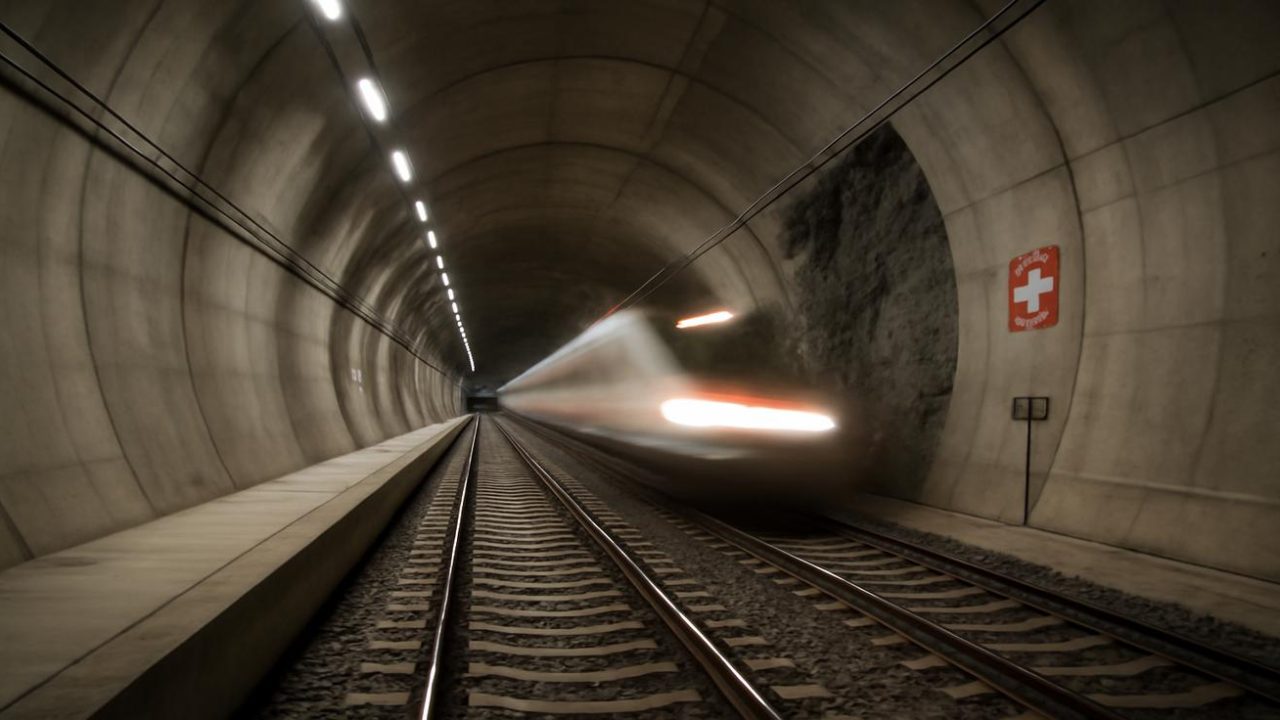
While most of the world focuses on Switzerland’s picture-perfect mountain villages and pristine lakes, the country has quietly spent three decades carving out an underground infrastructure larger and more complex than many cities that exist above ground.
Beneath the Swiss Alps lies a vast network of tunnels, caverns, service tubes, emergency routes, utility ducts, military bunkers, data centers, reservoirs, laboratories, and fallout shelters. This invisible lattice threads through granite and gneiss, creating what amounts to an entire underground nation-within-a-nation.
The scale of this subterranean achievement becomes clear when you consider that for every main railway tube travelers experience, there exists a three-dimensional spiderweb of supporting infrastructure that never sees sunlight.

How Switzerland Built an Underground City Network
The transformation began in earnest during the early 1990s, when Alpine passes were choking with truck traffic and diesel fumes were filling narrow valleys. Traffic forecasts painted an increasingly grim picture of noise, pollution, and accident risks threatening Switzerland’s mountain environment.
Rather than building more roads, Swiss citizens voted to move freight from road to rail and invest in what became the New Rail Link through the Alps. This decision launched a network of base tunnels and connecting infrastructure that would reshape the country from the inside out.
The construction process required choreography so complex it bordered on the surreal. Tunnel boring machines the size of cathedrals chewed through tough rock around the clock, while at other locations, traditional explosives shattered stone in thunderous pulses that released bursts of dust and heat.

Deep inside the mountains, workers created an environment that felt both ancient and manufactured. The air became cool and mineral-rich, scrubbed by industrial filters, while caverns opened like underground plazas filled with transformers and technical equipment.
The Scale of Switzerland’s Underground Infrastructure
To understand the true scope of this achievement, you have to stop thinking in traditional maps and start thinking in layers. While Switzerland’s surface remains postcard-perfect with glass-smooth lakes and snow-dusted peaks, the cross-section view reveals the real story.
Under every slope and mountain shoulder lies a second landscape drawn not in trees and rivers, but in concrete, steel, and artificial light. The Gotthard Base Tunnel alone stretches 57 kilometers in unwavering straightness, but that represents just the visible portion of a much larger system.

| Infrastructure Component | Function | Scale |
|---|---|---|
| Main railway tubes | Primary passenger and freight transport | Hundreds of kilometers |
| Service galleries | Maintenance access and equipment housing | Parallel to all main tubes |
| Cross-passages | Emergency evacuation routes | Every few hundred meters |
| Technical caverns | Equipment and transformer housing | Underground plaza-sized spaces |
| Ventilation systems | Air circulation and climate control | Extensive shaft networks |
The network includes major base tunnels like Lötschberg, Gotthard, and Ceneri, each supported by comprehensive auxiliary infrastructure. Geologists examined rock cores like fortune-tellers, while hydrologists tracked underground rivers that had to be rerouted around fresh wounds in the mountain massifs.
Why This Underground Revolution Matters
This subterranean transformation represents more than impressive engineering. It demonstrates how a country can fundamentally reimagine its relationship with geography and environmental protection.
Trains now slip into mountains with barely a whisper, transitioning from landscapes of snow-fed rivers, slate roofs, and grazing cows to dark rock whispering past at 200 kilometers per hour. Passengers experience impossibly smooth rides through what amounts to a continent of stone that has been patiently hollowed out meter by meter.

The system moves far beyond simple transportation. Switzerland has created a comprehensive underground ecosystem that includes:
- Military bunkers and fallout shelters for national security
- Data centers taking advantage of natural cooling and security
- Reservoirs and water management systems
- Research laboratories protected from surface interference
- Extensive utility networks serving both underground and surface infrastructure
This approach allowed Switzerland to preserve its surface environment while dramatically expanding its functional infrastructure capacity.
The Engineering Behind the Underground Network
Creating this underground infrastructure required solving challenges that pushed engineering to its limits. Workers had to contend with varying rock types, underground water systems, extreme pressures, and the need to maintain precise alignments over vast distances.

The construction timeline spanning nearly 30 years allowed for continuous refinement of techniques and technologies. Each new section benefited from lessons learned in previous excavations, creating an evolving expertise in underground construction that few countries can match.
Temperature control, air quality management, emergency systems, and structural integrity all had to be maintained across hundreds of kilometers of underground space. The result is infrastructure that operates as reliably as surface facilities while offering protection from weather, natural disasters, and other external threats.
What This Means for the Future
Switzerland’s underground infrastructure represents a new model for how countries might address space constraints, environmental protection, and infrastructure needs simultaneously. By thinking in cross-sections rather than surface maps, the Swiss have effectively doubled their usable national territory.

The system continues to evolve, with ongoing maintenance, upgrades, and potential expansions building on the foundation created over the past three decades. This underground network now forms an integral part of Switzerland’s national identity and strategic capabilities.
Other mountainous regions facing similar challenges of limited surface space and environmental sensitivity are studying Switzerland’s approach as a potential model for their own development needs.
Frequently Asked Questions
How long did it take Switzerland to build this underground infrastructure?
The major construction effort has been ongoing for nearly 30 years, beginning in earnest in the early 1990s.

What prompted Switzerland to invest in such extensive underground construction?
Alpine passes were becoming choked with truck traffic, creating pollution and noise problems that threatened Switzerland’s mountain environment.
How large is the underground network compared to surface cities?
The underground infrastructure is larger in sheer volume and complexity than many cities that exist above ground, though specific comparative measurements are not detailed in available information.
What types of facilities exist in Switzerland’s underground network?
The network includes railway tunnels, service galleries, emergency routes, military bunkers, data centers, reservoirs, laboratories, fallout shelters, and utility systems.

How fast do trains travel through these underground tunnels?
Trains travel at speeds of 200 kilometers per hour through the main tunnel systems.
Are there emergency systems in place throughout the underground network?
Yes, the system includes cross-passages every few hundred meters for emergency evacuation, along with comprehensive ventilation and safety systems.











Leave a Comment