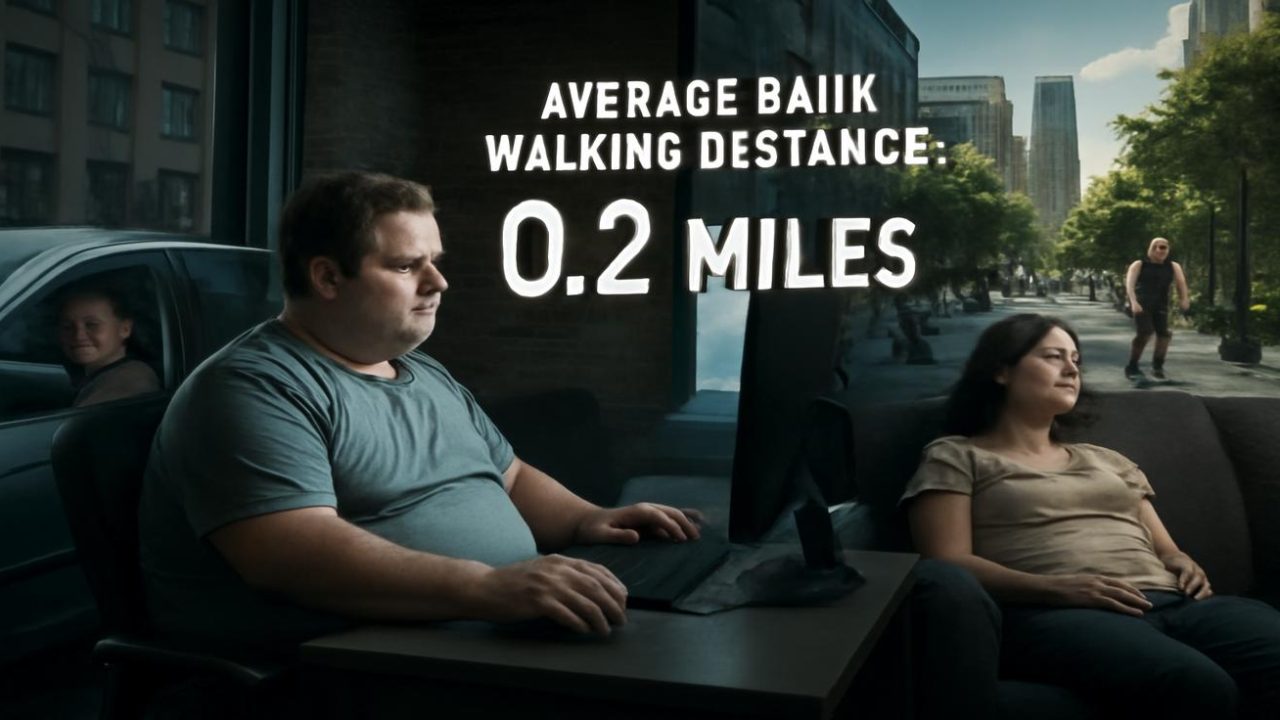
The average city dweller now walks less than 3,000 steps a day — and some surveys show numbers dipping closer to 2,000 steps. That’s roughly the distance you’d cover shuffling from a small apartment to an elevator, into a car or subway, up another elevator, then back again.
For a species that evolved to roam savannas and migrate with the seasons, we’ve somehow engineered urban life where our legs have become almost optional. The implications of this dramatic shift in daily movement are reshaping our bodies, brains, and the very fabric of city living in ways most people don’t realize.
This isn’t just about fitness — it’s about a fundamental rewiring of human existence that’s happening block by block, commute by commute, in cities around the world.

How Modern Cities Engineered Walking Out of Daily Life
Understanding this transformation requires examining what a typical weekday actually looks like for millions of urban residents. The alarm buzzes, you pad a few steps to the bathroom, then to the kitchen. Coffee in hand, you drop into a chair to scroll through emails.
The commute unfolds as a seated affair: ride-share, car, train, or bus. You might stand for a few minutes on a platform, swaying but barely moving. At the office, a conveyor belt of chairs awaits — desk chair, meeting chair, lunch chair, another meeting chair, couch in the break room.
This isn’t laziness — it’s architecture and design. We’ve quietly reprogrammed daily life around not walking through food delivery, groceries arriving via anonymous vans, meetings on screens instead of across town, and friendships maintained in group chats. Every few years, cities add another layer of frictionless convenience, and every layer steals hundreds of steps from our day.

The historical contrast is striking. Humans once walked 10 to 15 kilometers daily as hunter-gatherers. Even mid-20th century urbanites regularly clocked 8,000 to 10,000 steps just getting through routine tasks. Now, in many dense cities, large numbers of people barely scrape a third of that amount.
Public health researchers note that we’ve essentially created a world that treats walking as an inefficiency — removing it from our schedules the way we’d cut unnecessary emails. In productivity terms, this might sound smart, but our bodies aren’t software that updates to match the city’s logic.
The Physical Toll of a Walking-Free Lifestyle
Observing how city bodies move reveals small but telling betrayals: someone struggling to rise from a low bench, a person in their thirties massaging their knee by the bus stop, shallow breathing during a short climb up subway stairs. Our bodies are adapting, just not in beneficial ways.

Walking isn’t merely exercise in the gym sense — it’s a constant background signal to practically every system in the body. When we strip that signal away, concerning changes occur across multiple health dimensions.
| Body System | What Regular Walking Does | What Chronic Low Walking Can Do |
|---|---|---|
| Muscles & Joints | Maintains leg strength, joint lubrication, posture, balance | Weakness, stiffness, back and knee pain, higher fall risk |
| Heart & Metabolism | Supports healthy blood pressure, blood sugar, cholesterol, weight | Higher risk of heart disease, diabetes, weight gain, fatigue |
| Brain & Mood | Boosts blood flow to the brain, improves mood and focus | Foggy thinking, anxiety, low mood, poorer stress resilience |
| Long-Term Health | Linked to longer life and better aging | Higher risks of multiple chronic diseases and earlier mortality |
Our leg muscles function like a second heart, helping pump blood back up from the extremities. When we sit for hours, this pumping mechanism largely shuts down, affecting circulation throughout the body. The cascade of effects touches everything from cognitive function to immune system performance.
Why This Matters Beyond Individual Health
The walking crisis extends far beyond personal wellness concerns. In office-heavy neighborhoods, sub-3,000-step days are becoming the norm rather than an outlier, fundamentally altering the social and economic fabric of urban areas.

Cities designed around minimal walking create different kinds of communities. When residents rarely traverse their neighborhoods on foot, they miss the casual interactions that build social cohesion. Local businesses suffer when foot traffic disappears, replaced by delivery apps and car-dependent shopping patterns.
The economic implications ripple outward as healthcare costs rise from sedentary-related illnesses. Productivity suffers when workers experience the brain fog and fatigue associated with minimal daily movement. Urban planning decisions made for convenience today are creating public health challenges that cities will grapple with for decades.
The psychological effects compound the physical ones. People report feeling disconnected from their neighborhoods, experiencing higher anxiety levels, and struggling with focus and mood regulation. The simple act of walking — once woven seamlessly into daily life — has become something that requires deliberate scheduling and effort.

The Architecture of Immobility
Modern urban design has systematically removed reasons to walk. Parking structures connect directly to office buildings. Subway systems minimize surface-level navigation. Residential buildings integrate package delivery systems that eliminate trips to stores.
Food delivery apps have created a parallel economy where meals, groceries, and household items arrive without requiring any physical movement beyond answering the door. Digital meeting platforms mean professional interactions happen through screens rather than face-to-face encounters across the city.
Each innovation, viewed individually, represents progress and convenience. Collectively, they’ve created an environment where human movement has been engineered out of daily existence. The unintended consequence is a population whose bodies are rebelling against this radical departure from millions of years of evolutionary programming.

What Happens When Walking Disappears
The trajectory points toward increasingly sedentary urban populations unless deliberate interventions occur. Cities are beginning to recognize that walkability isn’t just an amenity — it’s a public health necessity.
Some urban planners are experimenting with designs that reintroduce walking into daily routines: mixed-use developments that require short walks between services, car-free zones that prioritize pedestrian movement, and public spaces designed to encourage lingering and strolling rather than efficient transit.
The challenge lies in reversing decades of infrastructure choices while accommodating populations that have grown accustomed to minimal walking. The solution likely requires both individual behavior changes and systemic urban redesign — recognizing that our current path is creating cities full of bodies that have forgotten how to move.

Frequently Asked Questions
How many steps should city dwellers actually walk per day?
Humans evolved walking 10-15 kilometers daily, and even mid-20th century urbanites regularly achieved 8,000-10,000 steps through routine tasks.
Is the 3,000 steps statistic really accurate for most cities?
Yes, and some surveys show numbers dipping closer to 2,000 steps per day in office-heavy urban neighborhoods.
What’s causing this dramatic reduction in daily walking?
Modern urban design has systematically removed walking through food delivery, ride-sharing, direct building connections, and digital meeting platforms.

Are there specific health risks from walking so little?
Yes, including weakness, joint stiffness, higher risks of heart disease and diabetes, brain fog, anxiety, and increased fall risk.
Can this trend be reversed in existing cities?
Some cities are experimenting with mixed-use developments, car-free zones, and public spaces designed to reintroduce walking into daily routines.
Why does walking matter more than other forms of exercise?
Walking provides a constant background signal to every body system and was integrated into human daily life for millions of years of evolution.











Leave a Comment