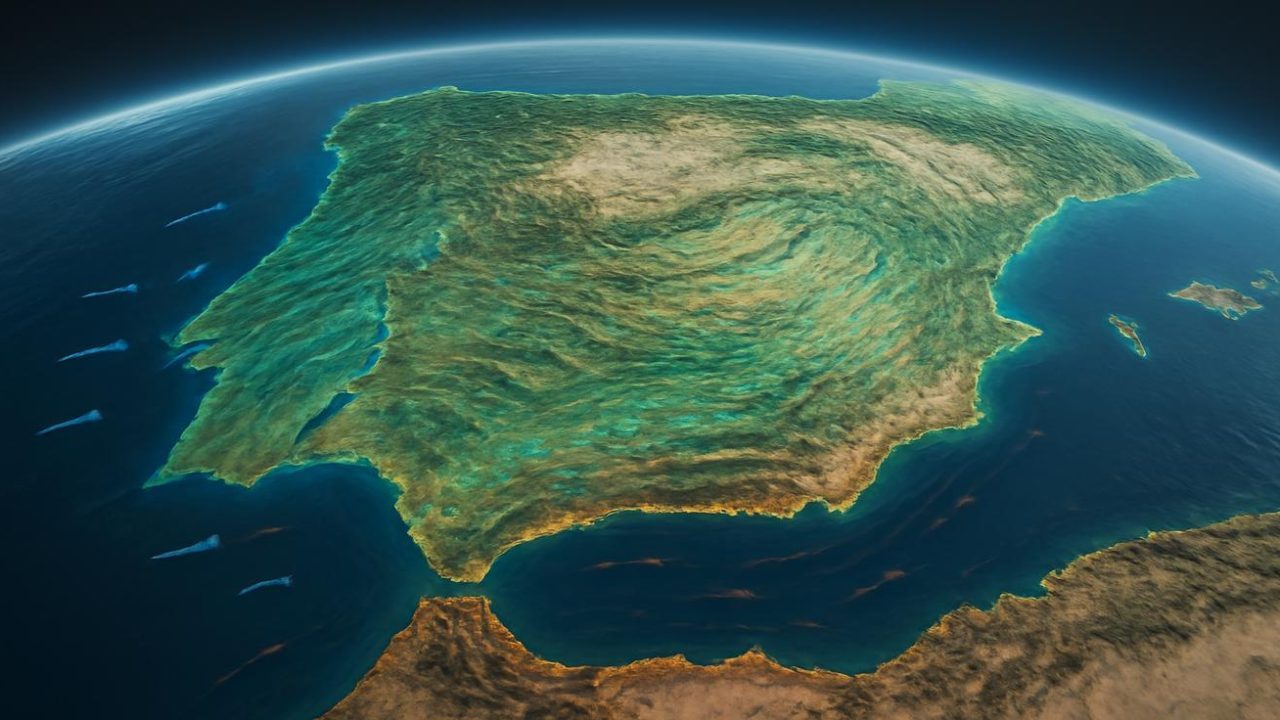
Spain and Portugal are slowly rotating in place like a massive geological pirouette, moving millimeters per year in a motion so subtle that coffee cups don’t rattle and ferry captains never need to adjust course. Yet high-precision GPS receivers scattered across the Iberian Peninsula have detected this continental dance, revealing that the entire landmass is performing what one researcher described as “a very slow pirouette.”
The discovery didn’t come from earthquakes or dramatic fault lines splitting the peninsula in two. Instead, it emerged from years of patient data collection by GPS receivers fixed to granite outcrops and concrete pillars from Galicia to the Algarve, tracking movements so small you’d need a microscope to see their human-scale equivalent.
This geological revelation has split scientific and public opinion between those raising alarm about potential consequences and others viewing it as merely another fascinating but harmless aspect of our dynamic planet.

How Scientists Discovered the Iberian Peninsula’s Slow Rotation
The evidence came from cold, relentlessly patient data. High-precision GPS receivers had been quietly listening to satellite signals for years, measuring the dance between earth and space with extraordinary accuracy. When researchers finally compiled the numbers, an unexpected pattern emerged.
Some monitoring points in Spain and Portugal were nudging northward, others slightly south, some fractionally west. But the surprise lay in how these tiny vectors aligned—not like passengers walking straight down a corridor, but like dancers rotating around a single floor tile.
The scale of movement operates on geological time. We’re talking about rotation rates of perhaps 0.1 to 0.3 degrees per million years, with lateral motions of just a few millimeters per year. That’s slower than fingernail growth, slower than a continent-wide traffic jam.

Yet on laboratory computers, the motion appears very real. A Portuguese monitoring station might show a tiny westward nudge each year, while a Spanish station 400 kilometers away creeps slightly east. Plot enough of these measurement arrows and they begin to curve around an invisible center point.
The Geological Forces Behind Iberia’s Continental Pirouette
Understanding why Spain and Portugal might be rotating requires zooming out to view Earth not as a smooth sphere, but as a jigsaw puzzle of giant, fractured plates. The Iberian Peninsula sits on the Iberian microplate, squeezed between two geological heavyweights: the African Plate to the south and the Eurasian Plate to the north.
For tens of millions of years, Africa has been pushing into Europe. This collision raised the Alps and Pyrenees, folded and crumpled seafloor sediments, and transformed quiet ocean deposits into mountain stone. The boundaries between these plates focus tension in a rough band running west of Iberia, under the Atlantic, and curving toward the Strait of Gibraltar and Mediterranean.
Along this zone, plates don’t simply collide—they grind, slide, and sometimes lock. In some places, oceanic crust dives under another plate through subduction; elsewhere, crustal blocks jam and rotate. Iberia, caught between pressures from multiple directions, responds as objects from pebbles to tectonic plates often do when squeezed unevenly: it turns ever so slightly.
| Geological Process | Rate of Movement | Time Scale |
|---|---|---|
| Iberian Peninsula Rotation | 0.1-0.3 degrees per million years | Geological |
| Lateral Plate Motion | Few millimeters per year | Slower than fingernail growth |
| Africa-Europe Collision | Ongoing for tens of millions of years | Mountain-building scale |
The Debate: Alarm Versus Scientific Curiosity
The discovery of Iberia’s rotation has created a fascinating split in both scientific circles and public perception. The divide centers on whether this geological phenomenon represents a cause for concern or simply another remarkable example of our planet’s dynamic nature.
Those expressing alarm point to the potential implications of any large-scale crustal movement, even one occurring over millions of years. They argue that understanding these processes is crucial for long-term geological hazard assessment and earthquake prediction in the region.

The indifferent camp counters that the movement is so incredibly slow—occurring on timescales that dwarf human civilization—that it poses no immediate or even long-term threat to current populations. They view it as a fascinating geological curiosity rather than a practical concern.
This split reflects broader tensions in earth sciences between those who emphasize potential risks from geological processes and others who focus on the pure scientific interest of understanding how our planet works.
What This Means for Life on the Iberian Peninsula
For the millions of people living in Spain and Portugal, this continental dance remains completely imperceptible in daily life. Ferry passengers crossing Lisbon’s harbor experience no rattling coffee cups. Drivers on motorways notice no course corrections. The movement operates entirely below the threshold of human sensation.

The rotation affects the very stage on which daily dramas of commutes, commerce, and community unfold—yet it does so millimeter by millimeter, like a giant key turning in an invisible lock. Vineyards, medieval town squares, and modern highways all participate in this slow geological waltz without anyone aboard feeling the motion.
Even the most sensitive human activities remain unaffected. Construction projects, surveying work, and navigation systems all function normally because the movement occurs at rates far below the precision required for these activities.
The Future of Iberian Geological Monitoring
Scientists continue tracking this continental rotation through their network of GPS receivers and other monitoring equipment. The data provides valuable insights into how tectonic plates behave when caught between competing geological forces.

This research contributes to broader understanding of plate tectonics and could help scientists better comprehend similar processes occurring elsewhere on Earth. The Iberian Peninsula serves as a natural laboratory for studying how continental fragments respond to multi-directional tectonic stress.
The monitoring also helps scientists refine their understanding of earthquake risks in the region, though the slow rotation itself poses no seismic threat. Instead, it represents one component of the complex tectonic environment surrounding the Mediterranean and Atlantic margins of Europe.
Frequently Asked Questions
How fast is the Iberian Peninsula actually rotating?
The peninsula rotates at rates of 0.1 to 0.3 degrees per million years, with lateral movements of just a few millimeters per year—slower than fingernail growth.

Can people living in Spain and Portugal feel this movement?
No, the movement is completely imperceptible to human senses and doesn’t cause coffee cups to rattle or require any course corrections for transportation.
What’s causing this rotation?
The Iberian Peninsula is squeezed between the African Plate pushing from the south and the Eurasian Plate to the north, causing it to rotate slightly under this multi-directional pressure.
Should people be concerned about this geological movement?
Opinion is split between those who see it as worth monitoring for long-term hazard assessment and others who view it as harmless due to its extremely slow pace.

How do scientists detect such tiny movements?
High-precision GPS receivers fixed to granite outcrops and concrete pillars across the peninsula track satellite signals to measure movements so small they require microscopic-scale precision.
Will this rotation affect earthquake risks in the region?
While the rotation itself poses no seismic threat, scientists use this data to better understand the complex tectonic environment that does influence regional earthquake patterns.









Leave a Comment