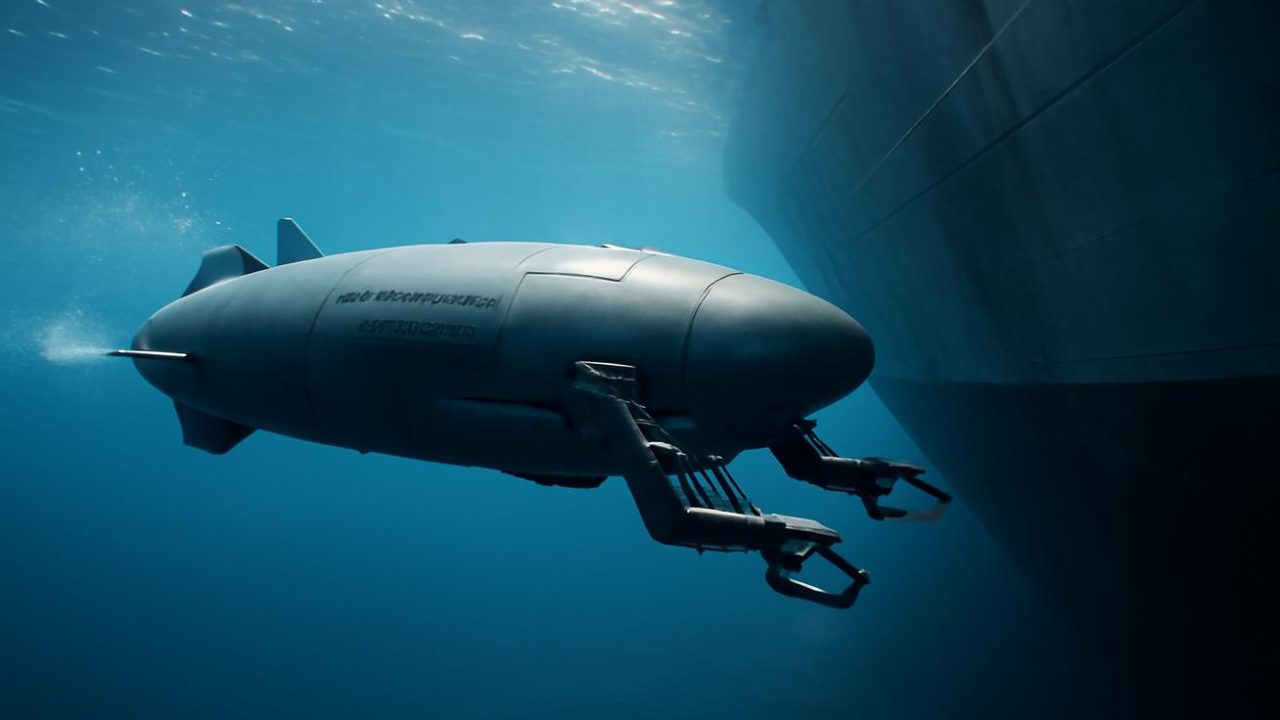
Lockheed Martin has unveiled an underwater drone that mimics one of nature’s most persistent parasites — the lamprey eel that latches onto larger fish to hitchhike through the ocean. The defense contractor’s new “Lamprey” drone is designed to attach itself to the hulls of ships, both military and civilian, creating an entirely new category of undersea warfare technology.
The torpedo-sized drone represents a fundamental shift in naval strategy. Instead of operating independently with limited battery life and range, the Lamprey can clamp onto a vessel’s hull and ride along for extended periods, essentially turning any ship into an unwitting carrier for surveillance, reconnaissance, or other military operations.
This concept challenges more than a century of naval defense thinking, where threats typically approached from a distance. The Lamprey doesn’t just get close to enemy vessels — it becomes part of their silhouette, hiding in plain sight beneath the waterline.

How the Lamprey Drone Mimics Its Animal Namesake
The lamprey eel is nature’s ultimate hitchhiker. This eel-like creature uses its circular, tooth-lined mouth to latch onto larger fish, boring in to feed while letting its host do all the navigational work. Lockheed Martin’s engineers borrowed this exact strategy for their underwater drone.
Instead of the lamprey’s nightmarish circular mouth, the mechanical version uses docking claws and magnetic pads to secure itself to ship hulls. The drone glides silently through dark water, approaching vessels from below where detection is most difficult.
Once attached, the Lamprey drone can remain dormant for extended periods, waiting for activation commands from operators who might be thousands of miles away. This patient approach solves one of the biggest limitations facing underwater drones: power consumption and operational endurance.

Key Technical Capabilities and Design Features
The Lamprey’s modular design allows it to carry different mission packages depending on operational requirements. Its metal casing houses payload bays that can accommodate various types of equipment:
- Advanced sonar systems for underwater mapping and detection
- High-resolution cameras for visual surveillance
- Signal intelligence gathering equipment
- Electronic warfare packages
- Small delivery payloads for covert operations
The drone’s smooth, pale exterior helps it blend with ship hulls, while its torpedo-like shape minimizes drag and detection signatures. By attaching to larger vessels, the Lamprey gains access to essentially unlimited power, communications capabilities, and global mobility without expending its own energy reserves.
The attachment system represents a significant engineering achievement. The drone must secure itself firmly enough to withstand ocean currents and the ship’s movement, yet be able to detach silently when needed for independent operations.

Strategic Impact on Naval Warfare
Traditional naval defense systems focus on detecting and neutralizing threats that maintain safe distances — submarines firing torpedoes from miles away, aircraft launching missiles from over the horizon, or mines planted on the seafloor. The space directly beneath a ship’s hull has historically been considered relatively secure.
The Lamprey drone exploits this blind spot in naval thinking. Surface ships have sophisticated radar systems scanning the skies and sonar arrays monitoring the waters around them, but the area immediately under their own hulls receives less attention.
This capability transforms any vessel into a potential intelligence gathering platform or delivery system. A Lamprey could attach to a civilian cargo ship in one port, ride undetected across an ocean, then detach near a target area to begin its actual mission.

| Traditional Underwater Drones | Lamprey Attachment System |
|---|---|
| Limited by battery life | Uses host vessel’s power and endurance |
| Must navigate independently | Carried to target areas by ships |
| Detectable during transit | Hidden beneath host vessel |
| Restricted operational range | Global reach via commercial shipping |
The Changing Landscape of Undersea Operations
Naval forces have relied on uncrewed underwater vehicles for decades, primarily for mine detection, reconnaissance, and research missions. These traditional drones operate independently but face significant constraints in terms of range, endurance, and stealth.
The Lamprey concept represents an evolution in thinking about how autonomous systems can leverage existing infrastructure. Rather than building larger, more powerful drones to overcome range and endurance limitations, Lockheed Martin chose to create a system that borrows these capabilities from its targets.
This approach reflects broader trends in military technology, where smaller, distributed systems often prove more effective than large, centralized platforms. A single Lamprey drone costs significantly less than a traditional submarine but can potentially gather intelligence or conduct operations in areas where larger vessels cannot safely operate.

The psychological impact may be equally important. Naval commanders must now consider that any ship in their area of operations could potentially be carrying uninvited passengers — mechanical lampreys that could detach at any moment to begin surveillance or offensive operations.
Implications for Maritime Security
The Lamprey drone raises complex questions about maritime law and international waters. If such a device attaches to a civilian vessel in international waters, determining responsibility and jurisdiction becomes challenging.
Commercial shipping companies may need to invest in new detection systems specifically designed to identify attached drones. Hull inspections, already routine for maintenance purposes, might require additional security protocols to check for unwanted mechanical passengers.

Port security operations face new complications as well. A drone that attaches to a ship in one country could potentially be carried into another nation’s territorial waters without the vessel’s knowledge, creating diplomatic incidents or security breaches.
The technology also highlights the dual-use nature of many underwater systems. While Lockheed Martin likely developed the Lamprey for military applications, similar attachment mechanisms could be adapted for legitimate purposes such as marine research, environmental monitoring, or ship maintenance.
What Happens Next in Underwater Drone Development
The unveiling of the Lamprey drone signals a new phase in underwater warfare technology. Other defense contractors and military organizations will likely develop their own attachment-capable systems, potentially leading to an arms race in hitchhiking drones.

Detection and countermeasure systems will need to evolve rapidly. Ships may require new types of sonar specifically designed to scan their own hulls, or physical inspection protocols using underwater robots or divers.
International maritime organizations may need to develop new regulations governing attachment-capable drones, similar to existing treaties covering naval mines or submarine operations. The challenge lies in creating enforceable rules for devices that operate in the legal gray areas between military and civilian domains.
Frequently Asked Questions
How does the Lamprey drone attach to ships without being detected?
The drone approaches from below using docking claws and magnetic pads, taking advantage of the limited sensor coverage directly beneath a vessel’s hull.

Can the Lamprey drone operate on both military and civilian ships?
Yes, the system is designed to attach to any vessel with a suitable hull surface, regardless of whether it’s military or civilian.
How long can a Lamprey drone remain attached to a ship?
The specific endurance capabilities have not been disclosed, but the design allows for extended operations by leveraging the host vessel’s power and mobility.
What types of missions can the Lamprey drone perform?
The modular design supports reconnaissance, surveillance, signal intelligence, electronic warfare, and payload delivery missions.
How do ships detect if a Lamprey drone has attached to their hull?
Current detection methods have not been detailed, but ships may need new sonar systems or inspection protocols specifically designed to identify attached drones.
Is the Lamprey drone currently in active military service?
Lockheed Martin has unveiled the concept, but specific deployment details and operational status have not been confirmed.










Leave a Comment