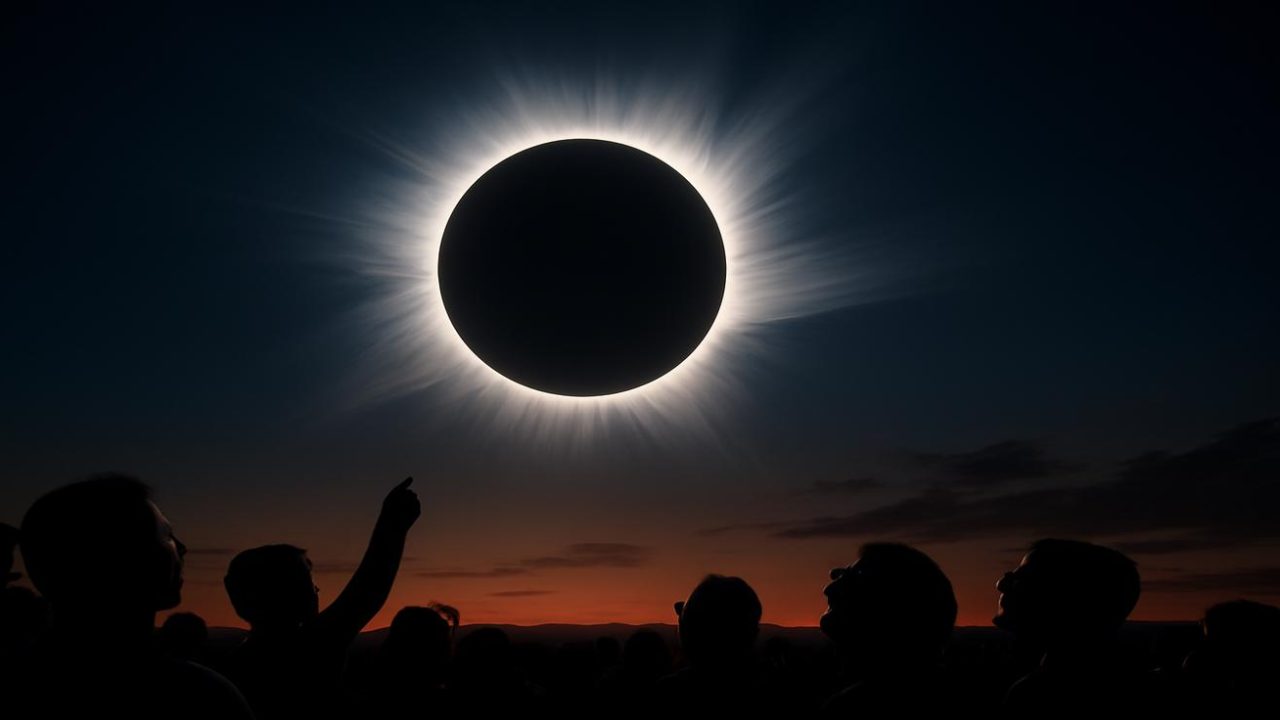
The longest total solar eclipse of the century has already been identified by astronomers, promising an extraordinary duration that will transform day into night for several precious minutes. Unlike typical solar eclipses that flash by in moments, this upcoming celestial event will offer observers a rare, extended experience of totality that won’t be matched again for decades.
Most solar eclipses leave viewers feeling like they blinked and missed the show. The familiar sequence—dimming light, dropping temperature, brief darkness, then sudden return of daylight—usually unfolds in under three minutes. This time will be different.
The extended duration comes from a perfect alignment of astronomical conditions that rarely coincide with such precision.

Why This Solar Eclipse Will Break Duration Records
The secret to this eclipse’s remarkable length lies in the intricate dance between three celestial bodies: the Sun, Moon, and Earth. A total solar eclipse occurs only when these objects align in a precise straight line, with the Moon positioned perfectly to cover the Sun’s bright disc.
The Moon’s orbit around Earth follows an elliptical path, not a perfect circle. This means our natural satellite sometimes appears closer to us (at perigee) and sometimes farther away (at apogee). When the Moon is near its closest approach to Earth, it appears slightly larger in our sky.
This upcoming eclipse represents a cosmic jackpot of favorable conditions. The Moon will be positioned close to Earth while our planet sits near its farthest point from the Sun. This geometric arrangement creates the ideal scenario for maximum eclipse duration.

The Moon’s apparent size becomes large enough to cover the Sun for an extended period, creating what astronomers describe as a “luxurious darkness” that stretches well beyond typical eclipse timeframes.
The Science Behind Extended Totality
Another factor contributing to the eclipse’s exceptional length involves the speed of the Moon’s shadow as it races across Earth’s surface. This shadow speed depends on the complex interplay between the Moon’s orbital motion, Earth’s rotation, and the eclipse path’s location on our planet.
Earth spins from west to east while the Moon’s shadow streaks across the surface in roughly the same direction. Near the equator, Earth’s rotational speed is fastest. Under optimal conditions, our planet’s surface effectively “chases” the shadow, causing it to appear slower from an observer’s perspective on the ground.

When timing, angle, and distances align perfectly, certain locations along the eclipse path experience what astronomers call a “sweet spot”—areas where the Moon’s dark umbral shadow seems to hover, granting observers an unusually long immersion in totality.
| Eclipse Factor | Typical Eclipse | This Century’s Longest Eclipse |
|---|---|---|
| Moon Distance | Variable | Near Perigee (Closest) |
| Earth-Sun Distance | Variable | Near Aphelion (Farthest) |
| Shadow Speed | Fast | Optimally Slowed |
| Totality Duration | Under 3 minutes | Several minutes |
What Extended Darkness Will Feel Like
Describing a total solar eclipse to someone who hasn’t witnessed one resembles trying to explain music to someone who’s never heard sound. The mechanics and measurements can be detailed, but the actual experience lives in physical sensations—hair standing on arms, the lump in the throat when the last sunlight bead vanishes.
This eclipse will stretch those intense moments into an almost meditative experience. Instead of the usual rushed sequence where observers barely have time to process what they’re seeing, this event will allow for a deeper appreciation of the phenomenon.

The extended totality means observers will have time to notice details often missed in shorter eclipses: the corona’s delicate structure, the 360-degree sunset effect on the horizon, the dramatic temperature drop, and the eerie quality of light during the approach and departure of totality.
Astronomers have calculated forward and backward through this entire century, confirming that no other total solar eclipse will match this event’s duration. The mathematical certainty of this record adds weight to the eclipse’s significance.
Global Impact and Viewing Opportunities
The eclipse’s exceptional nature will likely trigger unprecedented global interest. Observers are expected to travel thousands of kilometers, cross international borders, and crowd remote locations along the path of totality to witness this once-in-a-century event.

The narrow shadow path—where totality will be visible—represents just a small fraction of Earth’s surface. Only those positioned directly under the Moon’s shadow will experience the full duration of darkness. Areas outside this path will see varying degrees of partial eclipse.
The extended duration makes this eclipse particularly valuable for scientific research. Astronomers will have more time to study the Sun’s corona, conduct experiments that require the specific conditions of totality, and gather data that shorter eclipses don’t allow.
Tourism industries along the eclipse path are already preparing for massive influxes of visitors. Hotels, transportation systems, and local infrastructure in prime viewing locations face the challenge of accommodating potentially millions of eclipse chasers.

Preparing for a Historic Astronomical Event
The advance notice of this record-breaking eclipse allows for unprecedented preparation. Scientists can plan complex experiments, photographers can scout optimal locations, and the general public can make travel arrangements well in advance.
Safety remains paramount for eclipse viewing. Direct observation of the Sun without proper eclipse glasses can cause permanent eye damage. Only during the brief moments of totality—when the Moon completely covers the Sun’s bright surface—is it safe to look directly at the eclipse without protection.
The eclipse’s extended duration actually increases safety risks in some ways, as observers might be tempted to look too early or too late in the sequence when the Sun’s surface is still partially visible.

Weather considerations will play a crucial role in viewing success. Cloud cover can completely obscure an eclipse, making location selection and backup plans essential for serious observers.
Frequently Asked Questions
When will this record-breaking solar eclipse occur?
The source material indicates astronomers have identified the date, but specific timing details are not provided in the available information.
How long will the totality last?
The eclipse will last several minutes, significantly longer than typical eclipses that usually last under three minutes, though exact duration has not been specified.

Where will the eclipse be visible?
The eclipse will follow a specific path across Earth’s surface, but the exact geographic locations have not been detailed in the source material.
Why is this eclipse longer than others?
The extended duration results from optimal alignment of the Moon being near its closest approach to Earth while Earth is near its farthest point from the Sun.
Will there be longer eclipses after this one?
Astronomers have confirmed that no other total solar eclipse in this century will match this event’s duration, making it truly the longest of the 21st century.
Is it safe to look at the eclipse directly?
Direct viewing requires proper eclipse safety glasses except during the brief moments of totality when the Moon completely covers the Sun’s bright surface.










Leave a Comment