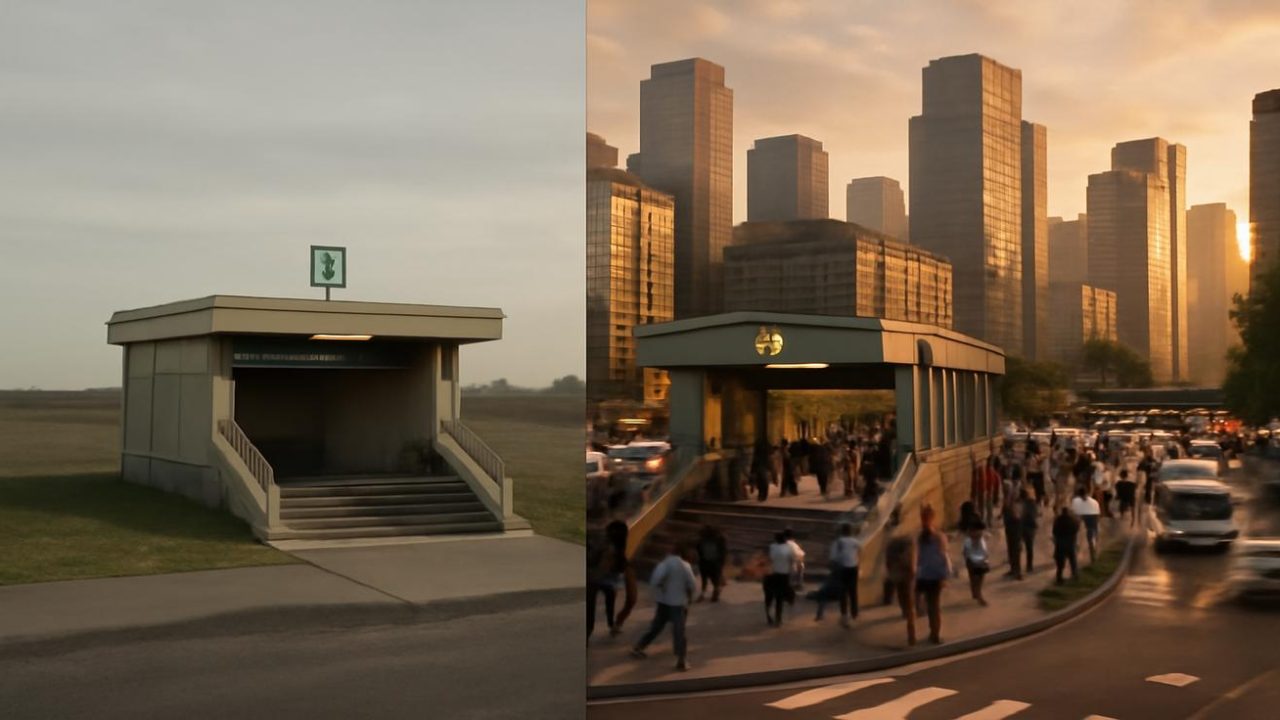
In 2008, subway stations were rising from empty fields across China while skeptics dismissed them as monuments to miscalculation. By 2025, those “ghost stations” had become the backbone of thriving urban districts that house millions of people.
The transformation represents one of the most dramatic examples of infrastructure-led development in modern history. What looked like overreach to Western observers turned out to be a calculated bet on China’s unprecedented urbanization wave.
Standing at an unfinished subway station outside Beijing in 2008, the landscape was more silence than city. Rebar sprouted from dusty ground, construction fences enclosed empty lots, and beyond them stretched scrubby fields with only scattered brick houses breaking the horizon.

When Infrastructure Preceded Population
The year 2008 marked a turning point in China’s urban development strategy. While the world focused on Beijing’s Olympic spectacle, a quieter revolution was unfolding in the suburbs and satellite cities.
Massive concrete shells were being carved into what looked like farmland, often an hour’s drive from existing city centers. Temporary billboards showed renderings of glass towers and leafy avenues for “future international districts” that seemed to exist only in planners’ imaginations.
The approach defied conventional wisdom about urban development. Traditional planning built transportation to serve existing populations. China was doing the reverse: building subway systems for people who hadn’t arrived yet.

Urban planners carried maps that resembled science fiction. Rings of rail lines radiated outward like ripples in a pond, with proposed stations marked as dots in neighborhoods that existed only on computer screens.
The Scale Nobody Believed Was Possible
The statistics bordered on unbelievable even then. Officials spoke of hundreds of kilometers of new metro lines spanning not just major cities, but second-, third-, and fourth-tier cities that in other countries would still be tangled in planning inquiries and budget fights.
This represented a fundamental shift in how infrastructure development worked. Rather than responding to congestion and overcrowding, the subway systems were designed to create the conditions for future growth.

The strategy relied on understanding China’s massive internal migration patterns. Millions of rural residents were moving toward cities each year, drawn by factory jobs and opportunities for their children. The subways weren’t built for the present population—they were built for people who hadn’t yet packed their suitcases.
| Development Phase | Characteristics | Timeline |
|---|---|---|
| 2008: Infrastructure First | Subway stations in empty fields, minimal ridership | Olympic year construction boom |
| 2010s: Gradual Fill-in | Residential and commercial development around stations | Decade of steady growth |
| 2025: Mature Networks | Fully integrated urban districts with high ridership | 17 years after initial construction |
Why Western Observers Got It Wrong
Foreign critics focused on what they could see: empty escalators, gleaming platforms with handful of commuters, and ticket machines waiting for fingers that never came. Photos of brand-new stations with almost no passengers circulated as proof of wasteful spending.
The criticism reflected a fundamental misunderstanding of China’s development timeline and scale. Western infrastructure projects typically serve existing demand. China was creating infrastructure to generate future demand.

Skeptics measured reality by immediate visibility—rice paddies, scattered villages, lone dogs trotting along roads. It seemed easier to imagine these landscapes remaining empty than sprouting skyscrapers within a decade.
The disconnect came from different approaches to risk and planning horizons. While other countries built cautiously in response to proven need, China was betting on demographic trends and economic momentum that wouldn’t fully materialize for years.
The Transformation That Proved the Strategy
By 2025, many of those “ghost stations” had become central nodes in thriving urban districts. The empty fields had filled with apartment complexes, office towers, shopping centers, and schools.

The subway lines that once seemed to serve no one were now carrying millions of daily passengers. What looked like overreach had become the foundation for some of China’s most successful new urban areas.
The strategy worked because it understood something invisible: the gravitational pull of opportunity. Build the infrastructure, and development follows. Provide transportation, and people will find reasons to live and work at the destinations.
This approach required enormous upfront investment and tolerance for short-term inefficiency. But it avoided the gridlock and retrofitting costs that plague cities where infrastructure struggles to catch up with growth.

Lessons for Urban Development Worldwide
China’s subway-first development model offers insights for rapidly growing cities worldwide. The approach demonstrates how infrastructure can shape growth patterns rather than simply respond to them.
The strategy requires coordination between transportation planning and land use policies that many democratic systems struggle to achieve. It also demands the financial capacity to invest heavily before seeing returns.
However, the long-term benefits include more sustainable urban growth patterns, reduced traffic congestion, and the ability to plan comprehensive neighborhoods rather than piecemeal development.

The transformation from empty subway stations to thriving urban districts represents more than successful infrastructure planning. It shows how patient capital and long-term thinking can create entirely new patterns of urban life.
Frequently Asked Questions
Why did China build subway stations in empty areas?
China was betting on future population growth and internal migration patterns, building infrastructure before demand materialized to guide development.
How long did it take for the “ghost stations” to become busy?
The transformation occurred over approximately 17 years, from initial construction around 2008 to mature urban districts by 2025.

What made Western observers skeptical of this approach?
Critics focused on immediate ridership numbers and visible emptiness, rather than understanding the long-term development strategy.
Did this strategy work in all Chinese cities?
The source material focuses on successful examples but doesn’t provide comprehensive data on all projects across different cities.
Could this approach work in other countries?
The strategy requires significant upfront investment, coordinated planning, and tolerance for short-term inefficiency that may be challenging in different political and economic systems.
What types of development followed the subway construction?
The areas filled with apartment complexes, office towers, shopping centers, and schools, creating comprehensive new urban districts.











Leave a Comment