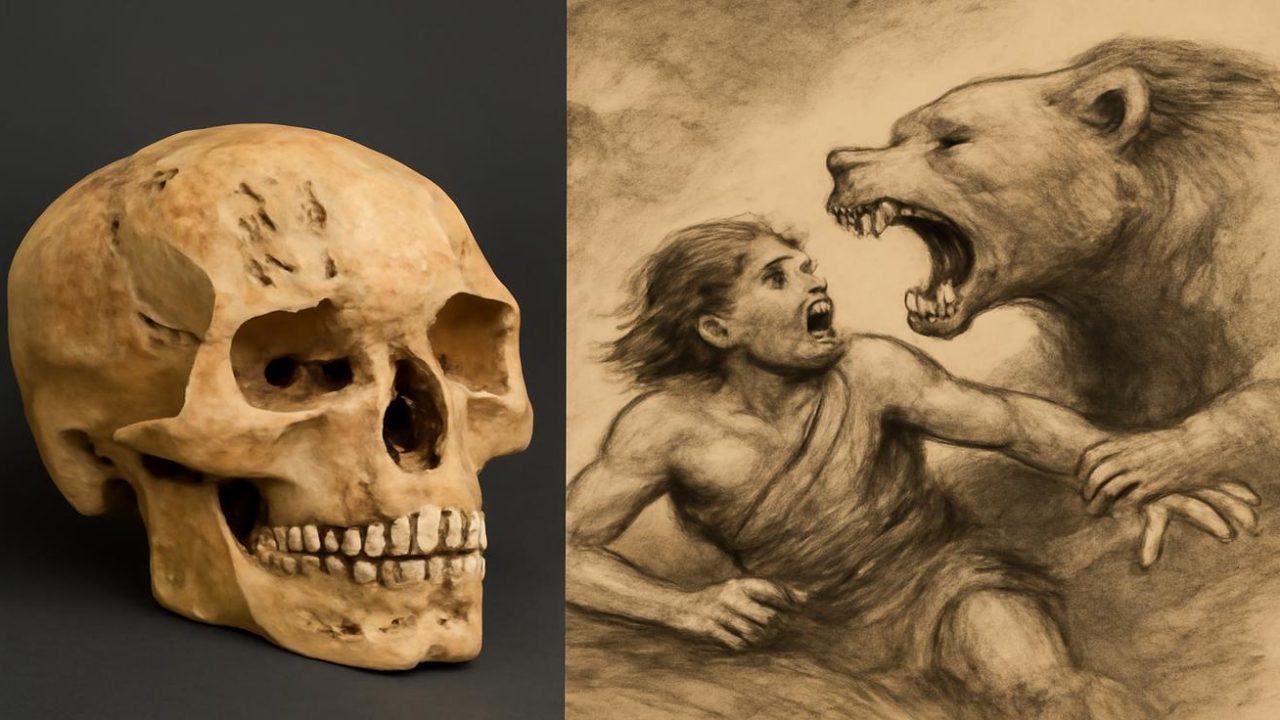
A teenage hunter who lived 28,000 years ago died in one of the most violent encounters imaginable: a brutal mauling by a massive Ice Age bear. New skeletal analysis has confirmed what researchers long suspected after discovering the scattered remains in a limestone cave—this Stone Age teenager met his end at the claws and teeth of one of prehistory’s most formidable predators.
The discovery offers an unprecedented window into the deadly realities of life during the last Ice Age, when humans shared the landscape with cave bears that could weigh twice as much as modern brown bears. For the first time, scientists have forensic evidence of exactly how dangerous these encounters could become.
The teenager’s bones tell a story of violence that unfolded across the frozen steppes of Eurasia, where small hunting groups moved carefully through territory dominated by mammoths, wolves, and massive bears that ruled their domain without question.

The Cave That Preserved a Violent Death
Archaeologists working in a limestone cavern found the partial skeleton among layers of sediment rich with Ice Age remains. At first glance, the scattered bones appeared unremarkable—just another incomplete burial from humanity’s harsh prehistoric past.
But as researchers carefully examined the fragments, a disturbing pattern emerged. The ribs showed unusual splintering and inward bending. The shoulder blade bore distinctive oval punctures. Vertebrae carried fine marks that didn’t match stone tools.
Most telling was the pelvis, warped and compressed like clay crushed in a giant fist. This wasn’t the quiet decay of time—it was evidence of devastating violence preserved in bone.

Modern forensic techniques brought the full horror into focus. Under magnification, the damage pattern became unmistakable: massive blunt force trauma consistent with the sweep of something heavy and muscular, combined with the telltale signature of large predator teeth.
Forensic Evidence Points to Massive Ice Age Bear
Researchers methodically compared the bite marks to a comprehensive database of predator jaws from the Ice Age. The oval, conical punctures in the shoulder blade and pelvis matched the dental signature of a large bear—most likely a cave bear or close relative.
These weren’t the relatively modest bears of today’s forests. Ice Age cave bears were apex predators that sometimes reached twice the weight of modern brown bears, making them among the most dangerous animals early humans encountered.

| Evidence Type | What It Reveals |
|---|---|
| Inward-bent, crushed ribs | Powerful impact compressing the chest |
| Oval punctures in shoulder and pelvis | Large predator bite marks |
| Compressed, warped pelvis | Massive crushing force |
| Vertebrae striations | Clawing or dragging trauma |
The critical question was timing: did the bear attack a living person or scavenge an already-dead body? The answer lay in the bone fractures themselves.
Some fractures showed clear signs of peri-mortem trauma—damage that occurs when bone is still fresh and threaded with blood. This indicated the teenager was alive or dying when the bear inflicted at least some of the devastating injuries.
Life and Death on the Ice Age Frontier
The teenager’s death illuminates the extraordinary dangers faced by Stone Age hunting groups. These small bands of perhaps a dozen people moved across landscapes where humans were far from the dominant species.

Cave bears weren’t just large—they were territorial sovereigns of their domain. Unlike modern bears that typically avoid human contact, these Ice Age giants had no evolutionary reason to fear the small groups of early hunters.
For a teenager old enough to hunt but young enough to lack full experience, encounters with such predators represented constant mortal danger. The steppes that provided hunting grounds for reindeer and other prey also served as highways for some of the most dangerous predators in Earth’s history.
The attack likely happened quickly and overwhelmingly. The bone damage suggests the bear’s initial assault—probably a powerful swipe or charge—was devastating enough to crush ribs and cause internal trauma that would have been rapidly fatal.

What This Discovery Reveals About Prehistoric Violence
This skeletal evidence represents something rare in archaeology: direct forensic proof of specific prehistoric violence. While researchers often find damaged bones from the Stone Age, determining exact causes of death across tens of thousands of years is extraordinarily difficult.
The preservation conditions in the limestone cave, combined with the severity of the bear attack, created an unusual situation where modern forensic techniques could definitively identify what killed this teenager.
The discovery also highlights how precarious life was for early human populations. Every hunting expedition, every movement across unfamiliar territory, every decision about where to make camp carried potentially lethal consequences.

For modern humans accustomed to being the undisputed apex predator, the teenager’s death serves as a stark reminder of our species’ more vulnerable past. These weren’t abstract dangers—they were daily realities that shaped every aspect of Stone Age life.
The Broader Context of Human-Bear Conflicts
The mauling represents just one documented case of what must have been countless dangerous encounters between early humans and Ice Age megafauna. Most such conflicts left no trace in the archaeological record, making this discovery particularly valuable.
The teenager’s death occurred during a period when human populations in Eurasia were small and scattered. Every loss of a hunting-age individual represented a significant blow to group survival, especially during the harsh conditions of the last Ice Age.

Yet humans ultimately prevailed in this ancient competition. Within a few thousand years of this teenager’s death, cave bears and most other Ice Age megafauna had vanished, while human populations continued expanding across the globe.
The bones from that limestone cave now rest in a museum, silent witnesses to a violent encounter that ended one young life 28,000 years ago. But they also testify to the remarkable resilience of our species in the face of dangers modern humans can barely imagine.
Frequently Asked Questions
How can scientists tell the teenager was attacked by a bear specifically?
The bite marks’ oval, conical shape and spacing match the dental signature of large Ice Age bears, distinct from other predators like wolves or cave lions.

Was the teenager definitely alive when the bear attacked?
Some bone fractures show peri-mortem trauma patterns that occur only when bone is fresh and blood-filled, indicating the person was alive or dying during at least part of the attack.
How common were bear attacks on Stone Age humans?
While this type of forensic evidence is extremely rare, bear attacks were likely a significant danger for Ice Age hunting groups sharing territory with massive cave bears.
What happened to the Ice Age cave bears?
Cave bears and most other Ice Age megafauna went extinct within a few thousand years of this teenager’s death, likely due to climate change and human hunting pressure.
Where exactly was this skeleton found?
The source material describes a limestone cavern but does not specify the exact geographic location of the discovery.
How do we know the teenager’s approximate age?
The source indicates the person was old enough to hunt but young enough to lack full experience, suggesting mid-teens, though specific age determination methods are not detailed in the available material.










Leave a Comment