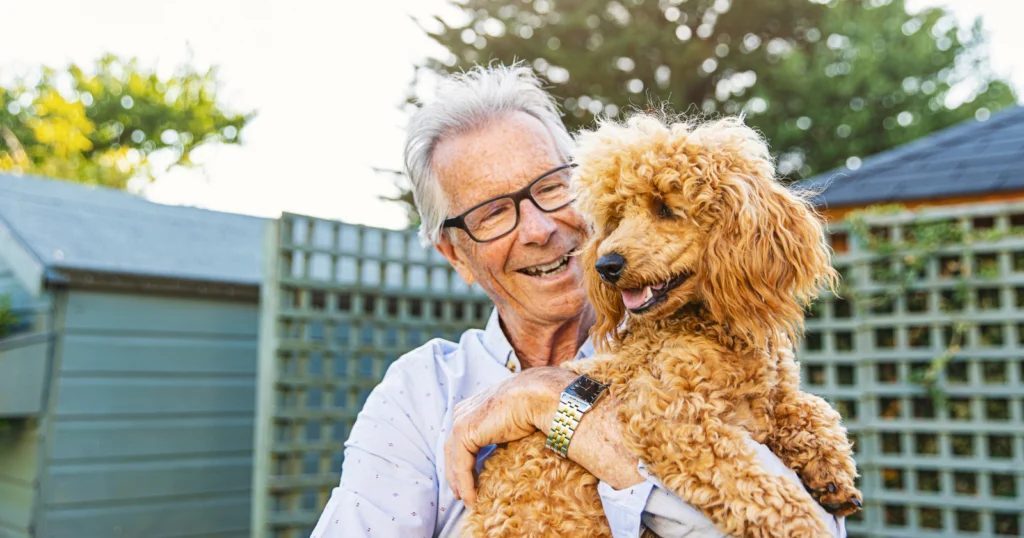
The man who never shed a tear through decades of life’s hardest moments suddenly breaks down completely when the family dog dies. It’s a scene playing out in homes across America, leaving families puzzled and uncomfortable. But the grief isn’t really about the pet.
It’s about losing the only relationship where emotional vulnerability was safe.
For men raised under rigid codes of masculinity, a dog often becomes something no human relationship can provide: a judgment-free zone where softness is allowed to exist without question or consequence.

The Unwritten Rules That Shaped a Generation
Men of certain generations grew up with emotional survival instructions disguised as character building. Boys don’t cry. Suck it up. Be strong for the family. These weren’t suggestions—they were requirements passed down through generations of fathers who learned the same harsh lessons.
Research confirms what many families have witnessed firsthand. A systematic review on masculinity norms and men’s mental health found that boys receive messages like “boys don’t cry” from early childhood, creating significant barriers to emotional expression that persist throughout their lives.
Even when men experience severe psychological distress, they’re far less likely to show it or seek help. The conditioning runs that deep.

The result isn’t men without feelings. It’s men with feelings they were never taught how to express safely.
When Emotions Get Locked Away
Psychologist Dr. Ronald Levant identified a specific condition affecting many men: normative male alexithymia. This describes men who learned to suppress their emotions so thoroughly that they struggle to identify, understand, or express what they’re feeling.
The condition doesn’t mean these men feel nothing. They feel deeply, but lack both the vocabulary and the permission to express those emotions. They recognize that something hurts, but decades of conditioning make finding words for that pain nearly impossible.

Finnish researchers discovered something telling about this emotional suppression. Men scored just as high as women on the ability to identify their feelings internally, but significantly lower on describing or expressing them to others. The older the man, the more pronounced this gap became.
| Emotional Ability | Men’s Scores | Women’s Scores |
|---|---|---|
| Identifying feelings internally | Equal to women | Baseline |
| Describing feelings to others | Significantly lower | Baseline |
| Expressing emotions openly | Much lower | Baseline |
Your father isn’t emotionally empty. He’s emotionally locked.
What Dogs Offer That Humans Can’t
A dog provides something almost no human relationship does for men conditioned to hide their feelings: complete emotional safety.

Dogs don’t judge tears. They don’t question vulnerability. They don’t require explanations, justifications, or maintenance of a certain image. When a man sits quietly with his dog, there’s no performance required. He can simply exist as he is.
Research published in Anthrozoös revealed that men who strongly endorse traditional masculine ideals often underreport the affection they feel toward their dogs. They downplay the bond when talking to others and struggle to articulate how much the relationship means to them.
But the bond itself remains enormous, even when hidden.

This creates a unique dynamic: the dog becomes a secret emotional outlet, the one relationship where authentic feelings can flow freely without social consequences or personal shame.
Why the Grief Runs So Deep
When that dog dies, the loss extends far beyond the animal itself. It represents the closing of the only emotional door that was ever fully open.
For men who spent decades suppressing feelings in every human relationship—marriages, friendships, even relationships with their own children—the dog represented emotional freedom. The grief that pours out isn’t just about missing a pet.

It’s about losing the only safe space for feelings that were never allowed anywhere else.
The breakdown often shocks families because they’re witnessing decades of accumulated emotion finally finding an acceptable outlet. Society considers grief over a beloved pet normal, even expected. For the first time, the man has permission to feel openly.
But the tears aren’t just for the dog. They’re for every emotion that was locked away, every moment of tenderness that was suppressed, every feeling that was deemed inappropriate for a man to express.

Understanding the Real Loss
Families often struggle with these intense displays of grief, especially when the same man showed little visible emotion during seemingly more significant losses. Someone might even say, “It’s just a dog, Dad.”
But understanding the true nature of the loss changes everything. The dog wasn’t “just” anything. It was the key to an emotional life that existed nowhere else.
When men of certain generations break down over a pet’s death, they’re not being overly sentimental. They’re experiencing the sound of a locked door finally breaking open—and the terrifying realization that it’s about to close again.

The grief is profound because the relationship was irreplaceable. No human connection in their lives offered the same unconditional acceptance of emotional vulnerability.
Recognizing this dynamic can help families respond with compassion rather than confusion. The tears represent not weakness, but the emergence of a emotional depth that was always there, waiting for a safe place to exist.
Frequently Asked Questions
Why do some men show more emotion over pets than people?
Men raised with strict masculine codes often find relationships with pets emotionally safer than human relationships, where vulnerability might be judged or questioned.
Is this reaction normal for older men?
Yes, research shows that men who endorse traditional masculine ideals often struggle more with emotional expression as they age, making pets uniquely important emotional outlets.
What is normative male alexithymia?
It’s a condition identified by psychologist Dr. Ronald Levant describing men who learned to suppress emotions so thoroughly they struggle to identify and express feelings, even to themselves.
Do these men actually feel emotions as strongly as others?
Yes, research shows men score equally with women on identifying feelings internally, but much lower on expressing them due to social conditioning.
How should families respond to intense grief over pets?
With understanding and compassion, recognizing that the grief often represents much more than the loss of the animal itself.
Can this pattern change in older men?
While deeply ingrained patterns are difficult to change, understanding the dynamic can help families create more emotionally supportive environments going forward.











Leave a Comment