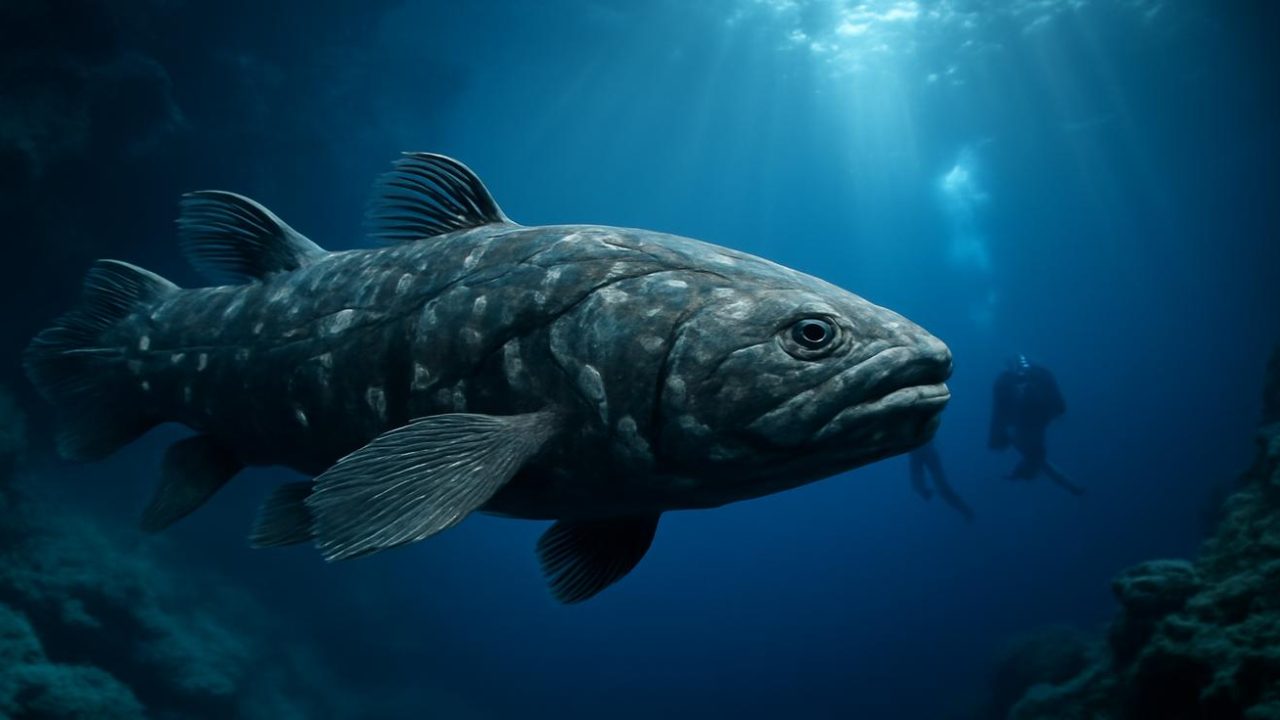
French divers have captured the first documented photographs of a coelacanth in Indonesian waters, encountering the legendary “living fossil” at depths between 100 and 150 meters. The team used specialized rebreather equipment and red lighting to photograph this ancient fish species, which was thought extinct for 66 million years before being rediscovered in 1938.
The encounter took place along a steep underwater cliff face in the mesophotic zone, where sunlight barely penetrates. The divers spotted the distinctive golden eye and lobed fins of the coelacanth resting in a cave-like recess, marking a significant moment in marine biology documentation.
This sighting adds to the limited known populations of coelacanths, previously documented only in South African waters and the Comoros Islands before recent discoveries in Indonesia.

What Makes the Coelacanth a “Living Fossil”
Coelacanths represent one of evolution’s most remarkable survivors. These fish swam alongside early dinosaurs and possess a lineage older than flowering plants. Scientists believed they had vanished completely around 66 million years ago, making their rediscovery one of the 20th century’s greatest zoological surprises.
The fish’s prehistoric appearance immediately sets it apart from modern species. Its broad, armored head and thick, rough-scaled body covered in pale spots create an unmistakable silhouette. Most distinctive are its fleshy, lobed fins that resemble primitive limbs more than typical fish fins.
The tail structure also reflects the coelacanth’s ancient origins, featuring three distinct lobes rather than the standard fish tail design. This trident-like formation represents an evolutionary blueprint that has remained virtually unchanged for hundreds of millions of years.

Beyond physical characteristics, coelacanths occupy a crucial position in understanding vertebrate evolution. Their fin structure provides insights into how early fish may have transitioned from water to land, earning them scientific importance far beyond their rarity.
The Technical Challenge of Deep-Sea Photography
Photographing coelacanths requires extreme diving expertise and specialized equipment. The French team operated well beyond recreational diving limits, using rebreather systems that recycle exhaled air and allow for extended bottom time without disturbing marine life with bubble streams.
At 120 meters depth, divers face multiple physiological challenges. Nitrogen narcosis affects mental clarity, while the increased pressure demands precise buoyancy control and deliberate movements. Every action must be calculated, as emergency ascent options become limited at such depths.

The lighting setup proved crucial for both photography and fish behavior. Red lights cause less disturbance to deep-sea creatures than standard white illumination, allowing the team to observe and document the coelacanth without causing it to flee immediately.
Water conditions at this depth create additional obstacles. The mesophotic zone exists in perpetual twilight, where colors fade to muted blues and greens. Camera settings must compensate for the filtered light while capturing the subtle details that make species identification possible.
| Diving Parameter | Specification | Challenge |
|---|---|---|
| Depth Range | 100-150 meters | Nitrogen narcosis effects |
| Equipment | Rebreather systems | Complex life support monitoring |
| Lighting | Red spectrum LEDs | Limited color photography options |
| Bottom Time | Approximately 30 minutes | Compressed decision-making window |
Where Coelacanths Live and Why They’re So Rare
The Indonesian sighting expands the known range of coelacanths beyond their previously documented habitats. Before this discovery, scientists had confirmed populations only off the South African coast and around the Comoros Islands in the Indian Ocean.

These fish prefer steep underwater cliff faces and cave systems where they can rest during daylight hours. The vertical reef walls provide the specific habitat conditions coelacanths require, including appropriate water temperatures and minimal current exposure.
Their rarity stems from extremely specific habitat requirements and reproductive patterns. Coelacanths are slow-growing, late-maturing fish that produce relatively few offspring. This conservative life strategy, while successful over geological time scales, makes populations vulnerable to environmental changes.
The depth preference also contributes to their elusiveness. Living primarily between 100 and 400 meters, coelacanths inhabit a zone that’s too deep for most recreational divers but too shallow to attract significant deep-sea research attention.

The Scientific Impact of Visual Documentation
Photographic evidence provides researchers with behavioral insights impossible to obtain from preserved specimens. The French team’s images show the coelacanth in its natural resting position, demonstrating how it uses cave structures for shelter.
The positioning of the fins and body orientation offer clues about the fish’s daily activity patterns. Unlike museum specimens, living coelacanths display natural coloration and posture that help scientists understand their ecological role.
Visual documentation also enables population studies and individual identification. The unique spot patterns on each coelacanth function like fingerprints, allowing researchers to track individual fish and estimate local population sizes.

These photographs contribute to a growing database of coelacanth sightings that helps marine biologists understand distribution patterns and habitat preferences across the Indian Ocean.
What This Discovery Means for Marine Conservation
The Indonesian coelacanth sighting highlights the importance of protecting deep-reef ecosystems that remain largely unexplored. These vertical cliff habitats support not only coelacanths but entire communities of deep-adapted species.
Documentation of new coelacanth populations provides valuable data for conservation planning. Understanding where these ancient fish live helps marine protected area designers include critical habitats in preservation efforts.

The technical diving skills required for coelacanth research demonstrate the need for specialized training programs and equipment access for marine biologists working in extreme environments.
As climate change affects ocean temperatures and chemistry, monitoring known coelacanth populations becomes increasingly important for understanding how ancient lineages respond to environmental pressures.
Frequently Asked Questions
How deep do coelacanths typically live?
Coelacanths are found between 100 and 400 meters depth, with this Indonesian sighting occurring between 100 and 150 meters.

Why are coelacanths called “living fossils”?
The term describes their unchanged appearance over hundreds of millions of years and the fact that scientists believed they were extinct for 66 million years before their rediscovery in 1938.
Where else have coelacanths been found?
Prior to this Indonesian discovery, coelacanths were documented only off the South African coast and around the Comoros Islands in the Indian Ocean.
What makes coelacanth fins special?
Their thick, lobed fins resemble primitive limbs more than typical fish fins, providing insights into early vertebrate evolution and the transition from water to land.
Why are coelacanths so rare?
They have specific habitat requirements, grow slowly, mature late, and produce few offspring, making their populations naturally small and vulnerable.
What equipment did the French divers use?
The team used rebreather systems for extended bottom time and red LED lights to minimize disturbance to the deep-sea fish during photography.










Leave a Comment