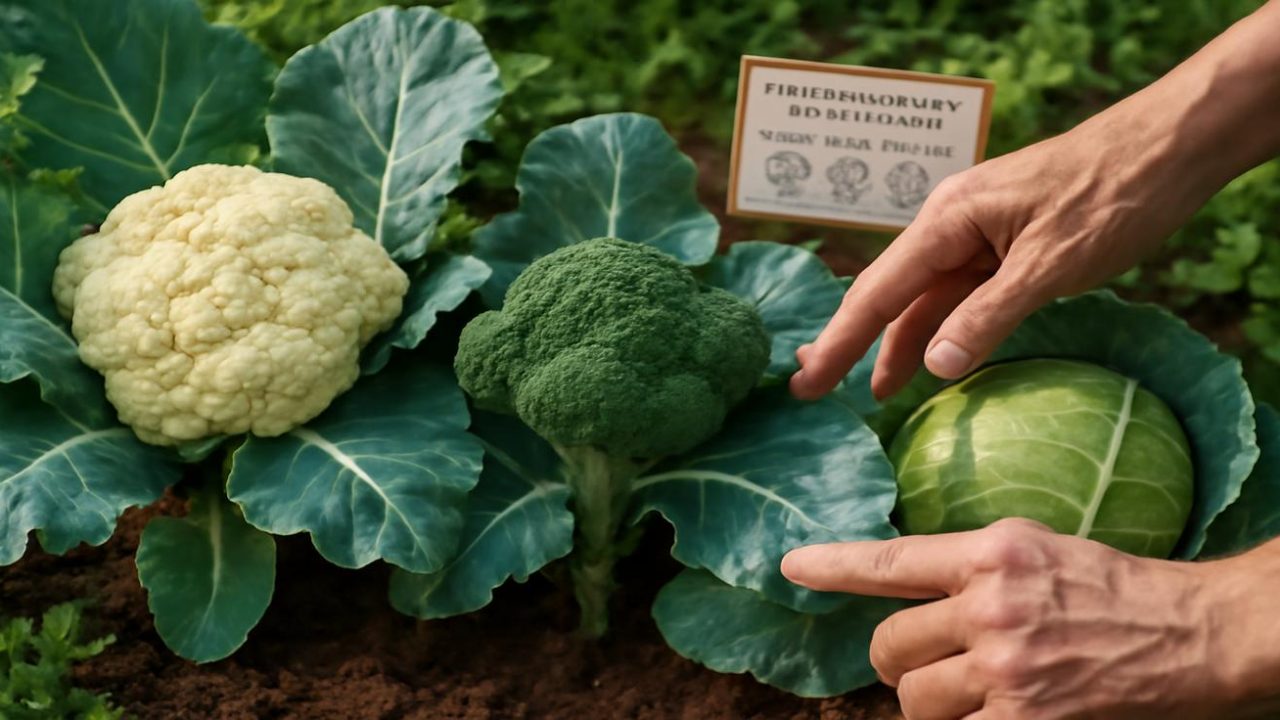
Cauliflower, broccoli, and cabbage share the same Latin name—Brassica oleracea—because they are literally the same plant species, shaped by thousands of years of selective breeding into wildly different forms.
Walk through any grocery store produce section and you’ll see what appears to be three completely unrelated vegetables. The tight white globe of cauliflower sits next to the forest-green branching clusters of broccoli, while heads of layered cabbage rest nearby. Most shoppers have no idea they’re looking at botanical siblings.
This isn’t a case of distant plant relatives or similar growing conditions. These vegetables are genetically identical variations of a single wild ancestor that once clung to European sea cliffs, transformed by human cultivation into the diverse forms we recognize today.

How One Wild Plant Became Three Kitchen Staples
The story begins with a tough, scrubby coastal plant that survived on the harsh shores of Europe. This wild ancestor bore little resemblance to today’s supermarket vegetables—it was a low-growing survivor with thick, waxy leaves the color of seafoam, built to withstand salty winds and thin soil.
Early foragers discovered something valuable in this resilient plant. Its leaves provided crucial nutrition, especially during seasons when other greens weren’t available. Over generations, these ancient cultivators began noticing subtle differences between individual plants—some had thicker leaves, others showed plumper stems, and a few displayed more compact flower clusters.
What happened next demonstrates human ingenuity at its finest. Without any understanding of genetics, these early farmers began selecting seeds only from plants with their preferred characteristics. Year after year, they planted seeds from the crunchiest stems, the most tightly packed heads, or the most abundant flower buds.

This process, repeated across different regions and cultures, slowly directed the evolution of Brassica oleracea into distinct varieties. In some areas, people favored large, sweet leaves. Elsewhere, they prized swollen flower buds or fleshy stems. Each preference gradually sculpted the plant into new forms.
Understanding the Botanical Blueprint
The key to understanding how cauliflower, broccoli, and cabbage emerged from the same source lies in thinking of Brassica oleracea as a basic template—a plant with roots, stem, leaves, buds, and flowers. Each vegetable represents an extreme development of one particular plant part.
Cabbage focuses almost entirely on leaf development. The plant folds its leaves tightly into a dense, protective ball where it stores energy and nutrients. That familiar layered structure is essentially the plant keeping its secrets wrapped up tight.

Broccoli takes a different approach, concentrating its energy on flower bud production. Those green tree-like clusters are actually thousands of flower buds packed into branching formations, harvested before they can bloom into yellow flowers.
Cauliflower pushes floral development even further. Its creamy white head consists of flower structures that have swollen and fused into a solid mass—essentially flower buds that never quite figured out how to grow up.
| Vegetable | Primary Focus | What We Eat | Plant Strategy |
|---|---|---|---|
| Cabbage | Leaf development | Tightly folded leaves | Energy storage in protective layers |
| Broccoli | Flower buds | Clustered unopened flowers | Concentrated reproductive preparation |
| Cauliflower | Modified flowers | Swollen, fused flower mass | Extreme floral structure development |
The Hidden Connections You Can See
Once you understand the shared heritage of these vegetables, their similarities become impossible to ignore. That thick broccoli stalk that many people discard? It’s essentially a reimagined cabbage stem, serving the same structural purpose.

The spiraled patterns visible in cauliflower heads mirror the branching structure of broccoli florets, just expressed in a more compact, fused form. Both represent the plant’s attempt to create the maximum number of flower sites in the smallest possible space.
Even the growing patterns reveal the connection. All three vegetables prefer similar soil conditions, growing seasons, and climate requirements because they’re working from the same genetic playbook. They face the same pests, benefit from the same nutrients, and respond to environmental stresses in remarkably similar ways.
The taste relationships become clearer too. That slightly bitter, earthy flavor that runs through all three vegetables comes from their shared chemical compounds. Cabbage’s bite, broccoli’s slight bitterness, and cauliflower’s mild earthiness all stem from the same sulfur-containing compounds inherited from their wild ancestor.

What This Means for Your Kitchen
Understanding the botanical relationship between these vegetables opens up practical possibilities in cooking and nutrition. Since they share the same basic nutritional profile, they can often substitute for each other in recipes with minor adjustments.
The cooking methods that work well for one often translate successfully to the others. Roasting brings out the natural sweetness in all three, while quick steaming preserves their distinctive textures. The sulfur compounds that give them their characteristic flavors respond similarly to heat and seasoning.
From a nutritional standpoint, all three vegetables provide similar benefits—high vitamin C content, significant fiber, and various beneficial plant compounds. They’re essentially different expressions of the same nutritional package.

This knowledge also explains why these vegetables often appear together in traditional cuisines. Cooks throughout history instinctively understood that they worked well together, not knowing they were combining different versions of the same plant.
The Broader Story of Plant Domestication
The transformation of wild Brassica oleracea into multiple distinct vegetables represents one of agriculture’s most dramatic success stories. It demonstrates how human selection pressure can reshape a species far more rapidly and dramatically than natural evolution typically allows.
This process didn’t stop with cabbage, broccoli, and cauliflower. The same wild ancestor also gave rise to kale, Brussels sprouts, and kohlrabi through similar selective breeding focused on different plant characteristics. Each represents a different answer to the question of how to optimize this particular plant for human needs.

The speed of this transformation is remarkable. While natural evolution typically requires millions of years to produce such dramatic variations, human cultivation achieved these results in mere thousands of years through consistent selection pressure.
Modern plant breeding continues this tradition, developing new varieties with improved disease resistance, better storage characteristics, or enhanced nutritional profiles. Today’s purple cauliflower, broccolini, and rainbow chard all represent ongoing chapters in this ancient story of collaboration between humans and plants.
Frequently Asked Questions
Are cauliflower, broccoli, and cabbage really the same plant?
Yes, they are all varieties of Brassica oleracea, selectively bred over thousands of years to emphasize different plant parts.

What did the original wild plant look like?
The wild ancestor was a low, scrubby coastal plant with thick, waxy leaves, growing on European sea cliffs and bearing little resemblance to modern vegetables.
How long did it take to develop these different varieties?
The transformation occurred over thousands of years through selective breeding by early farmers who saved seeds from plants with desired characteristics.
Do these vegetables have the same nutritional value?
They share similar basic nutritional profiles including high vitamin C, fiber, and beneficial plant compounds, though specific nutrient levels may vary slightly.
Can I substitute one for another in recipes?
Often yes, with minor adjustments, since they respond similarly to cooking methods and share compatible flavors due to their common genetic heritage.
What other vegetables come from the same plant?
Kale, Brussels sprouts, and kohlrabi are also varieties of Brassica oleracea, developed by selecting for different plant characteristics.











Leave a Comment