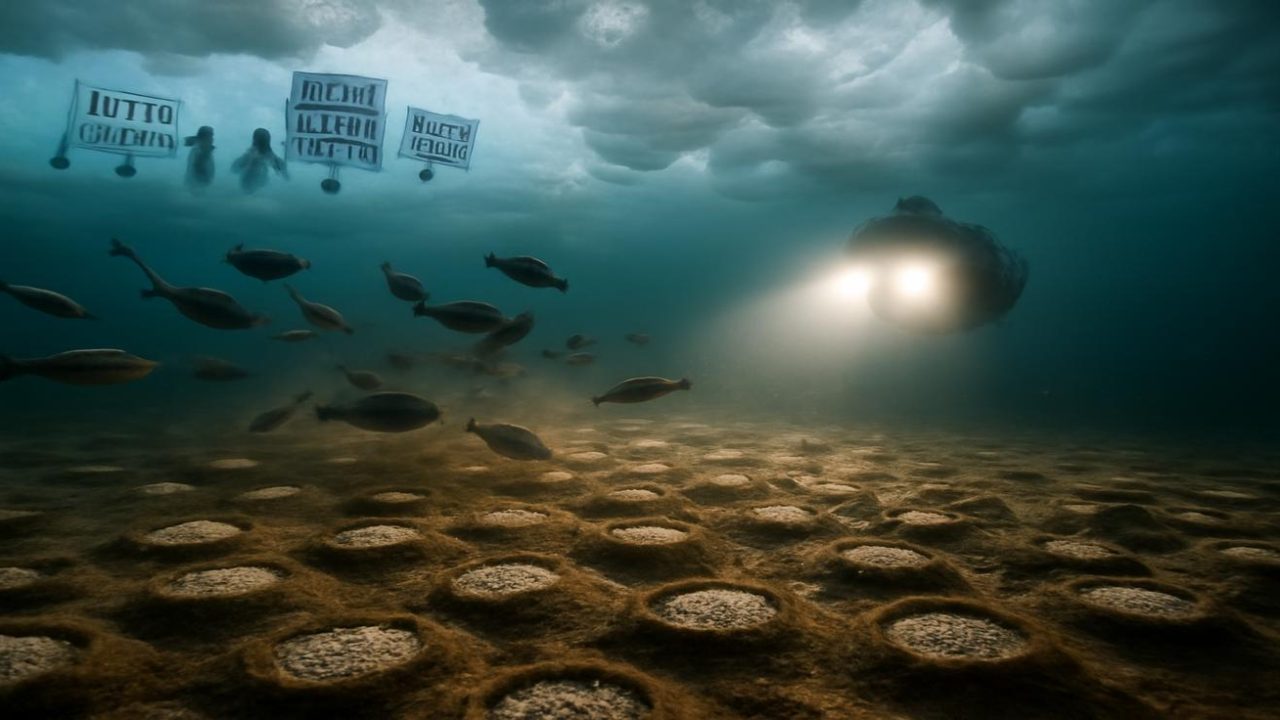
Sixty million fish nests stretching across hundreds of square kilometers beneath Antarctic ice represent what scientists believe could be the largest known fish breeding colony on Earth — and the discovery has sparked fierce debate about whether researchers should be disturbing one of the planet’s last untouched marine sanctuaries.
The extraordinary find emerged when a multinational research team aboard a German icebreaker lowered cameras through the frozen surface of the Weddell Sea, expecting to capture routine seafloor footage. Instead, their screens revealed a hidden underwater metropolis of circular nests, each carefully constructed and guarded by ghostly white icefish hovering protectively over clusters of eggs.
What started as a moment of scientific wonder has now ignited controversy over the ethics of exploring Antarctica’s most pristine ecosystems, raising uncomfortable questions about whether some discoveries come at too high a cost to the environments that harbor them.

The Accidental Discovery That Changed Everything
The research team had sailed into the Weddell Sea with standard scientific objectives: map the seafloor, sample ocean currents, and collect climate data. This remote bay, locked beneath thick sea ice and flanked by massive ice shelves, has long been considered one of Earth’s least disturbed marine ecosystems.
The towed camera sled descended through a hand-cut hole in the ice, its bright metal frame bristling with sensors and lenses. As the equipment drifted closer to the seafloor, the first nest materialized on screen — a nearly perfect circle pressed into the sediment, edged with small stones and shell fragments.
At the center lay a glistening mass of lentil-sized eggs, shimmering under artificial light. Above them hovered an icefish, milky white and almost transparent, its blood lacking red hemoglobin as an adaptation to the oxygen-rich polar waters.

Then the camera revealed another nest. And another. The seafloor appeared tiled with breeding sites packed so tightly they almost touched, continuing beyond the camera’s range like a living mosaic under an ocean previously thought to be nearly empty.
The discovery session stretched from minutes into hours as the nests kept appearing, eventually revealing what researchers estimated to be around 60 million individual breeding sites spread across the Antarctic seafloor.
Why the Weddell Sea Matters So Much
The Weddell Sea occupies a unique position in polar conservation. This is where Ernest Shackleton’s ship Endurance was crushed by ice, where early explorers and whalers were deterred by storms and shifting pack ice, and where modern research vessels visit only sporadically due to extreme weather and logistics.

Ecologists have long described the region as one of the last “pristine” marine sanctuaries on the planet. While invisible threads still connect it to distant human activity — carbon emissions changing water temperatures, plastic particles drifting under pack ice, and fishing fleets pushing closer to sea ice edges — the Weddell remains relatively free from direct human exploitation.
The newly discovered nesting grounds seemed to crystallize this pristine status. Millions of fish, synchronized by ancient biological rhythms, converge beneath the ice to dig, lay, fan, and guard their eggs in a process that has likely continued undisturbed for millennia.
Each nest represents a pair of breeding fish, creating a concentrated explosion of life in a place that rarely makes headlines unless an iceberg breaks or a remote sensor malfunctions.

The Ethics Controversy Surrounding Antarctic Fish Research
The discovery has exposed a fundamental tension in polar science: the conflict between advancing human knowledge and preserving untouched ecosystems. Critics argue that even well-intentioned research activities represent a form of disturbance that undermines the very pristine conditions scientists claim to value.
The research involved cutting holes in sea ice, lowering equipment into previously undisturbed waters, and using artificial lighting to illuminate creatures that have evolved in complete darkness. Each of these interventions, however minimal, introduces human presence into an environment that has operated independently for thousands of years.
Supporters of the research counter that understanding these ecosystems is essential for their protection, especially as climate change and human pressure increase. They argue that the knowledge gained from such discoveries far outweighs the minimal disturbance caused by careful scientific observation.

The debate reflects broader questions about scientific ethics in an era when truly untouched environments are becoming increasingly rare. As researchers gain the technological capability to explore previously inaccessible places, they face growing pressure to justify whether such exploration is necessary or simply possible.
What This Discovery Reveals About Antarctic Life
The fish nests provide unprecedented insight into how life persists in one of Earth’s most extreme environments. The icefish that guard these breeding colonies have evolved remarkable adaptations, including transparent blood that functions without red hemoglobin in the oxygen-rich polar waters.
The scale of the breeding colony suggests a level of biological organization and synchronization that scientists hadn’t previously documented in Antarctic waters. The circular nests, carefully constructed with stones and shell fragments, demonstrate sophisticated behavioral patterns in creatures living under permanent ice cover.

The discovery also raises questions about what other hidden ecosystems might exist beneath Antarctic ice. If a breeding colony of this magnitude could remain undiscovered until now, researchers wonder what other forms of life might be thriving in unexplored polar waters.
| Discovery Details | Scale |
|---|---|
| Number of nests discovered | Approximately 60 million |
| Area covered | Hundreds of square kilometers |
| Nest construction | Circular patterns with stone and shell edges |
| Egg size | Lentil-sized clusters |
| Guardian species | Transparent icefish |
The Future of Antarctic Research and Conservation
The fish nest discovery has intensified ongoing debates about how to balance scientific research with conservation in Antarctica’s most sensitive areas. The controversy highlights the need for clearer guidelines about when and how researchers should access previously undisturbed ecosystems.
Some advocates argue for establishing expanded no-research zones in critical Antarctic habitats, allowing certain ecosystems to remain completely free from human intervention. Others push for developing less invasive research technologies that could gather data without physical presence in sensitive areas.

The debate also underscores the urgency of understanding Antarctic ecosystems before climate change and increasing human pressure alter them permanently. As sea ice patterns shift and global temperatures rise, windows for studying pristine polar environments may be closing rapidly.
The Weddell Sea fish colony represents both a remarkable scientific achievement and a cautionary tale about the complex ethics of exploration in Earth’s last wild places. Whether future discoveries will be celebrated or criticized may depend on how well the scientific community addresses these growing concerns about environmental disturbance.
Frequently Asked Questions
How were the fish nests discovered beneath Antarctic ice?
Researchers aboard a German icebreaker lowered cameras through a hole cut in the Weddell Sea ice during a routine seafloor mapping expedition.

What type of fish created these massive breeding colonies?
The nests are guarded by icefish, which are transparent, white fish with blood that lacks red hemoglobin as an adaptation to polar waters.
Why is this discovery considered controversial?
Critics argue that researchers are disturbing one of Earth’s last pristine marine sanctuaries, while supporters contend the scientific knowledge gained justifies minimal research intrusion.
How large is the fish breeding colony?
Scientists estimate approximately 60 million nests spread across hundreds of square kilometers of Antarctic seafloor.
Could there be other undiscovered ecosystems in Antarctica?
The scale of this previously unknown breeding colony suggests other hidden ecosystems may exist beneath Antarctic ice, though this remains speculative.
What happens to these fish colonies as climate change affects Antarctica?
The source material does not address how climate change might impact these newly discovered breeding grounds.










Leave a Comment