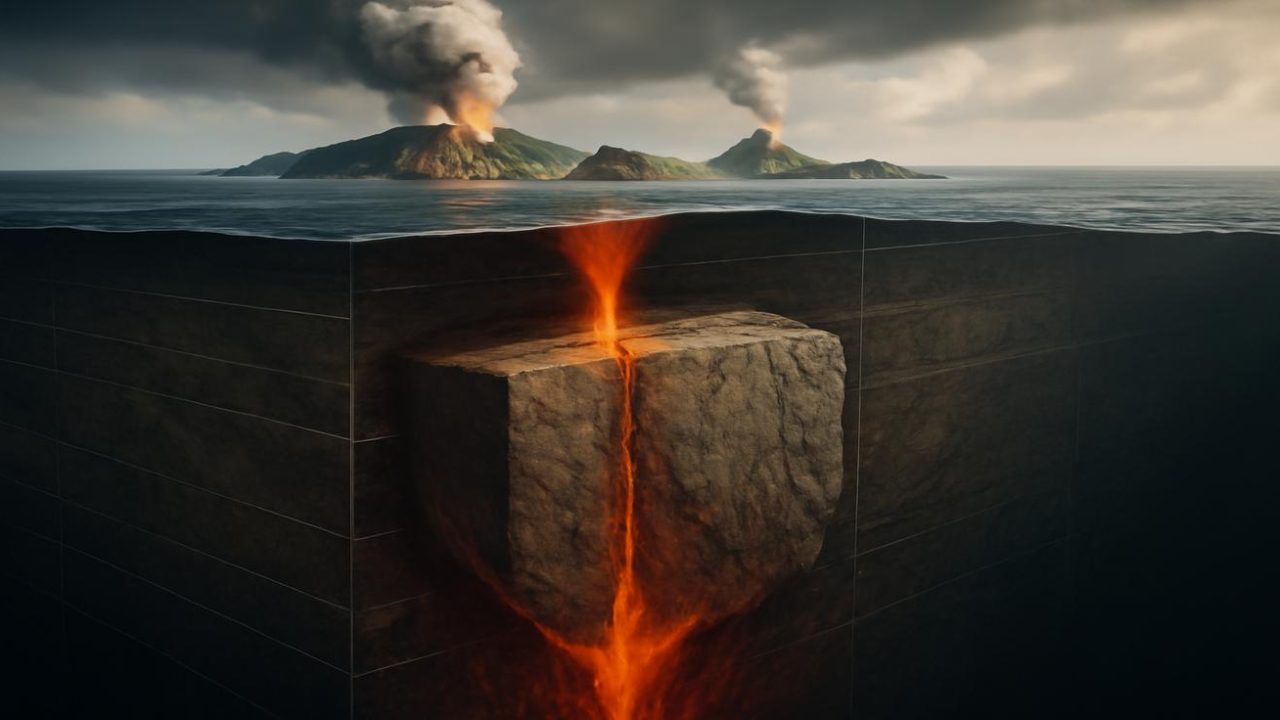
Deep beneath the Hawaiian Islands lies a massive buried block of rock that could finally explain one of Earth’s most puzzling geological mysteries: why volcanic hotspots like Hawaii remain so remarkably stable over tens of millions of years while everything else on our planet’s surface constantly drifts and changes.
This gigantic structure, revealed through advanced seismic imaging, sits hundreds of kilometers below the ocean floor and appears to act as an anchor for the Hawaiian volcanic system. The discovery challenges our understanding of how hotspots work and why some volcanic regions seem frozen in place while others wander across the globe.
Scientists have long struggled to explain Hawaii’s unusual volcanic behavior. The islands sit in the middle of the Pacific Plate, far from the chaotic boundaries where tectonic plates collide and separate, yet they’ve produced steady fountains of hot rock for millions of years in nearly the same location.

How Scientists Listen to Earth’s Hidden Structures
Understanding what lies deep beneath our feet requires a technique that resembles trying to map the inside of a cathedral using only sound echoes. Geophysicists use seismic waves from earthquakes as they travel through the planet, listening carefully to thousands of small pulses that reveal Earth’s unseen interior.
When these seismic waves encounter different types of rock, they behave predictably. Denser, colder rock speeds the waves along, while hotter, less dense material slows them down. By comparing how signals arrive at monitoring stations scattered across the world, scientists can reconstruct detailed 3D images of structures buried deep inside the planet.
This seismic imaging technique has become Earth’s equivalent of a medical CT scan, revealing features that would otherwise remain completely hidden from human observation. The method has uncovered mountain ranges beneath the ocean floor, traced the paths of ancient tectonic movements, and now revealed the massive block beneath Hawaii.

The Buried Giant That Anchors Hawaii’s Volcanoes
The structure beneath Hawaii defies easy description. It’s not a neatly shaped cube that could be sketched on paper, but rather a region of unusually dense, compositionally distinct rock that extends for hundreds of kilometers. Seismic waves that pass through this buried block slow down and bend in telltale ways, revealing material that differs significantly from the surrounding mantle.
This anomalous rock may be enriched with recycled oceanic crust that sank long ago and pooled near the base of the mantle, or it could contain iron-rich minerals that make it denser and more resistant to movement. Either way, the block appears to function like an underwater mesa in the mantle, providing stability to the volcanic system above.
The discovery helps explain why Hawaii’s hotspot has remained so remarkably steady. While the Pacific Plate drifts northwest at a rate of several centimeters per year, the volcanic plume feeding Hawaii’s volcanoes has barely wobbled over tens of millions of years, creating the distinctive chain of islands that stretches across the Pacific Ocean floor.

| Hawaiian Volcano | Current Status | Formation Method |
|---|---|---|
| Mauna Loa | Active | Built from countless lava flows over millions of years |
| Kīlauea | Active | Continuous volcanic activity from stable hotspot |
| Mauna Kea | Dormant | Formed as Pacific Plate moved over hotspot |
Why This Discovery Matters for Volcanic Science
The buried block beneath Hawaii represents a fundamental shift in how scientists understand volcanic hotspots. For decades, the prevailing theory suggested that Hawaii sits above a deep mantle plume—essentially a focused conveyor belt of hot rock rising from near Earth’s core. As the Pacific Plate moved northwest, this plume would continue feeding magma to the surface, building each island in sequence.
While this explanation accounted for the island chain’s formation, it left critical questions unanswered. Why would such a plume remain so stable over geological time scales? Why do some hotspots wander significantly while Hawaii seems locked in place?
The massive buried structure provides a missing piece of the puzzle. Rather than relying solely on rising material from the deep mantle, Hawaii’s stability may depend equally on what lies dormant below—a colossal keystone that holds the entire volcanic system in position.

This discovery could revolutionize our understanding of other volcanic hotspots around the world. Scientists are now investigating whether similar buried structures exist beneath other stable volcanic regions, and what role these hidden anchors might play in global volcanic activity.
How Seismic Imaging Reveals Earth’s Secrets
The technology behind this discovery represents decades of advancement in seismological research. Modern seismic imaging can detect variations in rock density and composition at depths that would be impossible to reach through direct drilling or sampling.
When major earthquakes occur anywhere in the world, they generate waves that travel through Earth’s entire interior. These waves carry information about every layer of rock they encounter, from the thin crust beneath our feet to the molten outer core thousands of kilometers below.

Scientists have built vast networks of sensitive instruments that can detect these waves and measure their arrival times with extraordinary precision. By analyzing thousands of earthquake signals over many years, researchers can construct detailed maps of Earth’s internal structure with resolution that improves constantly as more data becomes available.
What This Means for Understanding Earth’s Interior
The Hawaiian discovery opens new questions about how Earth’s deep interior influences surface geology. If massive buried blocks can anchor volcanic systems for millions of years, similar structures might explain other geological puzzles around the world.
Scientists are particularly interested in understanding how these deep structures formed and how long they can maintain their stability. The composition of the Hawaiian block suggests it may contain recycled oceanic crust—material that was once at Earth’s surface but sank into the deep mantle through tectonic processes.

This recycling process connects surface geology with deep Earth dynamics in ways that scientists are only beginning to understand. The buried block beneath Hawaii may represent just one example of how ancient surface materials can influence volcanic activity millions of years later.
The research also highlights how much remains unknown about our planet’s interior. Despite decades of seismological research, Earth continues to reveal unexpected structures and processes that challenge existing theories about how our planet works.
Frequently Asked Questions
How big is the buried block beneath Hawaii?
The structure extends for hundreds of kilometers and is thicker than any mountain on Earth’s surface, making it one of the largest known anomalous features in the deep mantle.
How do scientists know this block exists if they can’t see it directly?
Seismic waves from earthquakes slow down and bend when passing through the structure, creating a distinctive signature that reveals its presence and properties through advanced imaging techniques.
What is this buried block made of?
The structure appears to contain unusually dense rock that may be enriched with recycled oceanic crust or iron-rich minerals, though its exact composition remains under investigation.
Does this discovery change our understanding of other volcanic hotspots?
Scientists are now investigating whether similar buried structures exist beneath other stable volcanic regions around the world, which could revolutionize hotspot theory.

How long has this block been anchoring Hawaii’s volcanoes?
The structure appears to have provided stability for tens of millions of years, explaining why Hawaii’s volcanic activity has remained remarkably consistent over geological time scales.
Could this buried block affect future volcanic activity in Hawaii?
The block appears to provide long-term stability to the volcanic system, suggesting that Hawaii’s volcanoes will likely continue their current patterns of activity for the foreseeable future.







Leave a Comment