At 22.13 kilometers, China has just opened the world’s longest highway tunnel, carving a new record through mountains that have stood for millennia. The achievement represents more than just impressive numbers—it’s a feat of engineering that required moving massive volumes of rock and coordinating intricate systems to keep travelers safe deep underground.
The tunnel’s inauguration marks another milestone in China’s ambitious infrastructure development, joining a portfolio that already includes the world’s highest bridges and longest sea crossings. But this project feels different, disappearing into the landscape rather than dominating it.
For drivers making the journey, the experience is unlike any typical tunnel. Digital signs count down the distance to daylight in patient green numbers that seem almost surreal: 17 kilometers, 15 kilometers, 12 kilometers remaining.

Engineering Marvel Carved Through Ancient Rock
The tunnel’s construction required removing enormous quantities of mountain stone, pouring concrete, and threading cables through rock formations older than recorded history. Workers repeated the same precise gestures day after day, deep inside the mountain, until two separate construction efforts finally met in a perfect circle of light.
On inauguration day, officials in dark coats gathered outside in the crisp highland air. Banners snapped in the wind against the subdued greens and grays of surrounding peaks. Local villagers watched with quiet attention as the first convoy of vehicles approached the tunnel entrance—a dark, perfectly rounded archway framed by rock that had been forced to make room.
Television crews balanced tripods while cameras captured the moment headlights disappeared one by one into the mountain. For the engineers and workers who spent years underground, the opening represented less spectacle than relief—a chance to finally see their project in its entirety.

Many brought their families to witness the completion, pointing to the carved slopes with words only they could say with complete honesty: “We built that.”
Inside the World’s Longest Underground Highway
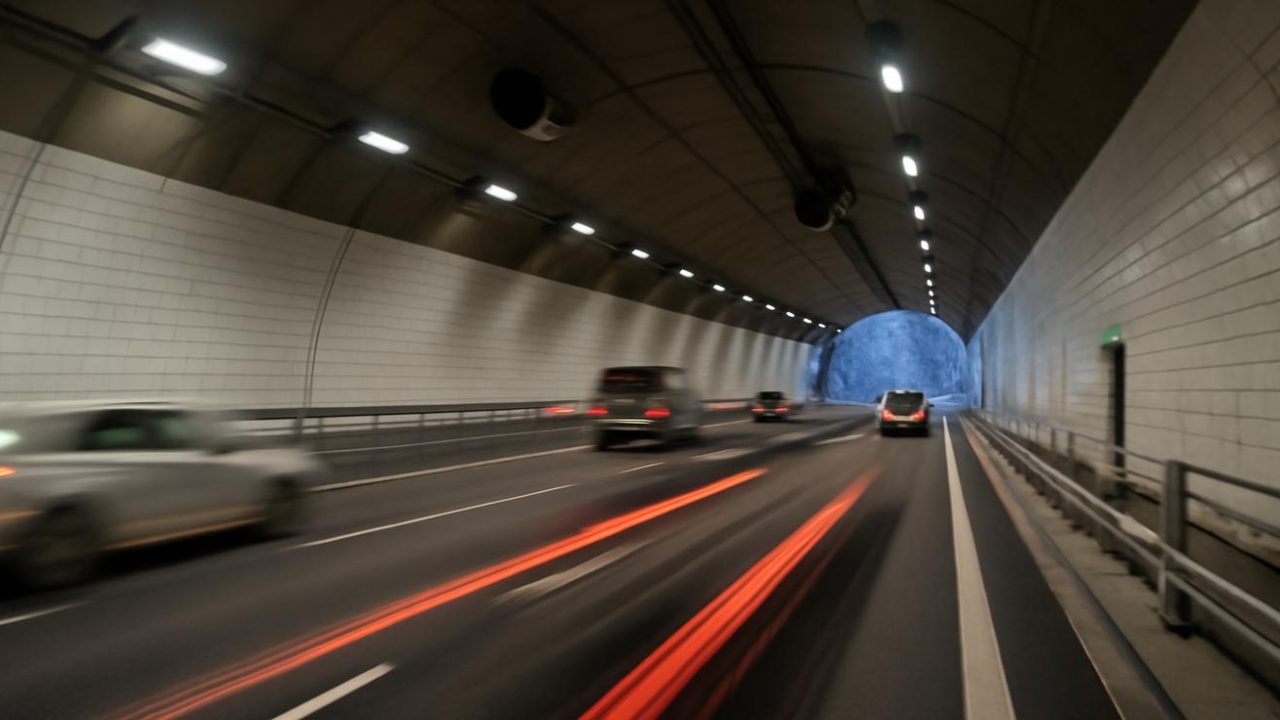
Driving through the tunnel creates an almost otherworldly experience. Daylight fades quickly at the entrance, thinning to a blue-gray wash before giving up entirely. The world outside becomes rumor as windows turn into moving mirrors, reflecting the rhythm of lights spaced at careful intervals along the ceiling.
The tunnel’s extraordinary length demanded sophisticated engineering solutions layered like geological strata. Fresh air must be continuously fed in while stale air gets pulled out. Cameras monitor constantly for smoke, stalled vehicles, or hazard lights. Emergency systems operate around the clock to ensure safety in an environment where help could be kilometers away.

Key safety features include:
- Emergency bays positioned at regular intervals
- Cross passages allowing evacuation to parallel tubes
- Communication systems with emergency phones
- Fire suppression equipment in each emergency alcove
- Advanced ventilation managing air quality throughout
The air inside stays cool, dry, and faintly metallic. Headlights slide along curved concrete walls like pale fish moving through a man-made ocean. Somewhere far overhead, the Yangtze River pushes downstream, mountains shoulder the sky, and wind combs through pine needles—but none of that penetrates the tunnel’s quiet interior.
Technical Specifications and Construction Challenges
The tunnel represents a masterpiece of underground construction, requiring solutions to problems that don’t exist in shorter passages. Ventilation systems must move massive volumes of air across unprecedented distances. Emergency response protocols needed complete reimagining for a space where the nearest exit might be over 10 kilometers away.

| Specification | Details |
|---|---|
| Total Length | 22.13 kilometers |
| Previous Record | Broken by this tunnel |
| Construction Type | Highway tunnel through mountain |
| Location | China (specific region not detailed) |
| Key Features | Emergency bays, cross passages, advanced ventilation |
Construction crews worked simultaneously from multiple points, boring through rock formations with precision engineering. The project required coordination between teams who couldn’t see each other for months at a time, trusting surveying and computer modeling to ensure their separate efforts would eventually align.
The moment when construction teams from opposite ends finally broke through to meet each other represented years of calculations proving correct in a single dramatic instant.
Impact on Transportation and Regional Development
The tunnel transforms travel across a region where mountains previously created significant barriers. What once required lengthy detours around peaks now becomes a straight shot through them, potentially reducing travel times and transportation costs across the area.

For local communities, the tunnel represents more than just convenience. It connects previously isolated areas to broader economic networks, potentially bringing new opportunities while preserving the landscape above ground.
The project also showcases China’s continued investment in infrastructure development, adding to a portfolio that has already redefined what’s possible in construction and engineering. Each new project builds on lessons learned from previous record-breaking achievements.
Regional impacts include:

- Reduced travel times across mountainous terrain
- Lower transportation costs for goods and services
- Improved connectivity for isolated communities
- Economic development opportunities in previously remote areas
- Environmental benefits from preserving surface landscape
What This Achievement Means for Future Infrastructure
The successful completion of a 22.13-kilometer highway tunnel pushes the boundaries of what engineers considered possible. The project required innovations in ventilation, emergency systems, and construction techniques that will likely influence future underground projects worldwide.
Other countries studying major tunnel projects now have new benchmarks for length, safety systems, and construction methodologies. The engineering solutions developed for this tunnel could prove valuable for similar projects in mountainous regions globally.
The tunnel also demonstrates how infrastructure can work with natural landscapes rather than against them. By going through mountains instead of over or around them, the project minimizes surface disruption while maximizing transportation efficiency.

For China’s infrastructure development program, this tunnel represents another milestone in a decades-long effort to connect the country’s diverse regions through ambitious engineering projects. The expertise gained from this project will likely inform future tunneling efforts as the country continues expanding its transportation networks.
Frequently Asked Questions
How long is China’s new record-breaking highway tunnel?
The tunnel measures 22.13 kilometers, making it the longest highway tunnel in the world.
What safety features does the tunnel include?
The tunnel contains emergency bays with phones and fire extinguishers, cross passages for evacuation, and advanced ventilation systems to maintain air quality.

How long did construction take?
The source material does not specify the construction timeline, though it references years of work by engineering teams.
Where exactly is the tunnel located in China?
The specific regional location is not detailed in available information, though it passes through mountainous terrain near the Yangtze River.
What was the previous world record for longest highway tunnel?
The previous record holder is not specified, only that this 22.13-kilometer tunnel has broken the existing world record.
How does driving through the tunnel feel?
Drivers experience a unique journey with digital signs counting down kilometers to daylight, cool metallic air, and the sensation of traveling through the quiet interior of the mountain itself.











Leave a Comment