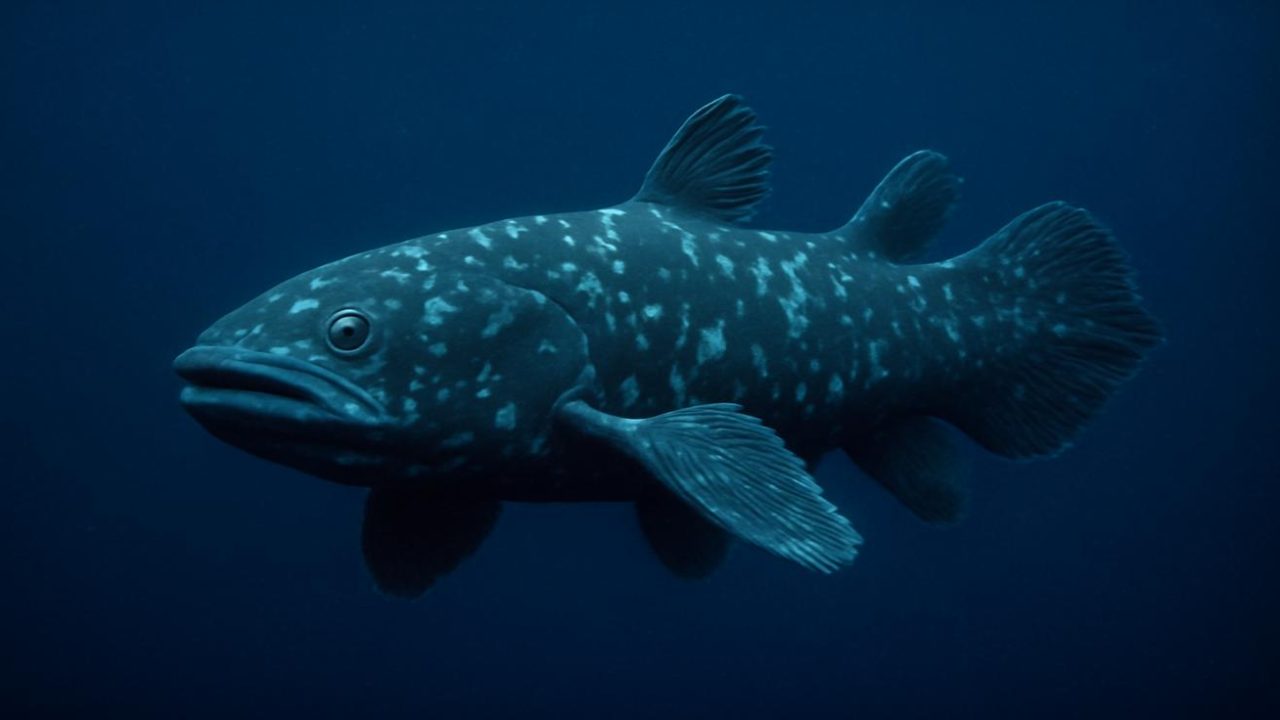
At 120 meters below the surface of Indonesian waters off Sulawesi, three French divers encountered something that shouldn’t exist—a living remnant from 400 million years ago. The coelacanth, long thought extinct, revealed itself in their camera lights with opal blue eyes and bronze-colored scales that seemed to shimmer with ancient secrets.
This rare encounter marks another extraordinary sighting of one of Earth’s most elusive “living fossils,” a fish whose lineage predates the dinosaurs and whose very existence rewrote scientific understanding when the first modern specimen was discovered in 1938.
The French diving team had descended into the deep waters following local fishing village stories of strange “king fish” that occasionally appeared in nets, their flesh quickly deteriorating in the morning heat after being brought up from the depths.

The Fish That Defied Extinction
The coelacanth’s scientific story began dramatically in 1938 when South African museum curator Marjorie Courtenay-Latimer spotted something impossible in a trawler’s catch. The five-foot-long fish, armored in thick blue scales with distinctive lobed fins, resembled creatures that science insisted had vanished with the dinosaurs 66 million years ago.
That first preserved specimen forced scientists to completely revise their understanding of evolutionary timelines. The coelacanth hadn’t gone extinct—it had simply moved deeper, surviving in the ocean’s most remote depths while the world above transformed beyond recognition.
The term “living fossil” doesn’t mean the coelacanth stopped evolving entirely, but rather that it maintained its general body plan through geological epochs that saw continents drift apart and ice ages reshape the planet. While forests were just beginning to colonize land during the Devonian period, this fish was already swimming in ancient seas.

Coelacanths belong to the lobe-finned fishes, a group that includes the ancient relatives of all terrestrial vertebrates. Their fleshy, limb-like fins contain bone structures that echo our own arms and legs, making them a crucial evolutionary link between aquatic and terrestrial life.
A Deep-Sea Encounter in Indonesian Waters
The French divers’ expedition took them through distinct layers of ocean water, each colder and darker than the last. Their dive computers tracked their descent as they left the warm surface waters and entered the deep realm where sunlight never penetrates.
At 80 meters, the reef structure changed dramatically, falling away into undercut ledges decorated with ghostly whip corals. The divers’ artificial lights revealed a hidden world of green sponges, pale shrimp, and suspicious moray eels backing into crevices.

By 100 meters depth, communication was reduced to hand signals and the steady rhythm of breathing apparatus. The team searched along vertical walls draped in black corals, exploring the fractures and shadowed caves where local knowledge suggested these legendary fish might rest during daylight hours.
The coelacanth revealed itself not with dramatic movement, but with characteristic stillness. A broad, fringed tail flicked once, and then the bronze-colored body emerged into the light beam. The creature hovered upright, its distinctive fins splayed downward as if standing on an invisible seafloor.
| Dive Details | Specifications |
|---|---|
| Maximum Depth | 120 meters |
| Location | Off Sulawesi coast, Indonesia |
| Water Conditions | Cold, deep water below thermocline |
| Habitat Type | Vertical reef walls with caves and overhangs |
Why This Sighting Matters for Marine Science
Coelacanth encounters remain extraordinarily rare, making each documented sighting valuable for scientific research. These fish inhabit some of the most challenging diving environments on Earth, where technical diving skills and specialized equipment are essential for human observation.

The Indonesian waters around Sulawesi represent part of the broader Indo-Pacific region where coelacanths have been occasionally documented. The area’s deep, collapsed reef systems and dramatic underwater topography create the specific conditions these ancient fish require.
Unlike the more famous South African population discovered in 1938, the Indonesian coelacanth represents a distinct species adapted to Indo-Pacific waters. Each encounter provides researchers with crucial behavioral and habitat data about these secretive deep-water residents.
The fishing village reports that led to this encounter highlight the important role local knowledge plays in marine discovery. Stories of unusual catches often provide the first clues that guide scientific expeditions to significant findings.

The Challenges of Studying Living Fossils
Documenting coelacanths requires extreme technical diving capabilities. At 120 meters depth, divers face significant physiological challenges, limited bottom time, and the need for extensive decompression stops during ascent.
The fish themselves are notoriously sensitive to depth changes. When brought to shallower waters, their flesh quickly deteriorates, which explains the fishing village descriptions of catches that turned to “jelly” in the morning heat.
Coelacanths prefer the twilight zone of the ocean, where they can move slowly between caves and overhangs during daylight hours. Their metabolism is extremely slow, and they can remain motionless for extended periods, making them difficult to locate even when divers reach the correct depths.

The creatures’ prehistoric appearance—with their distinctive lobed fins, armored scales, and unblinking eyes—creates an almost surreal encounter for the few humans who witness them alive in their natural habitat.
What These Discoveries Reveal About Ocean Mysteries
Each coelacanth sighting reinforces how much remains unknown about deep ocean ecosystems. The fact that a fish this large and distinctive avoided scientific detection until 1938 suggests countless other species may inhabit the deep waters beyond current human observation.
The Indonesian encounter demonstrates that coelacanths have a broader geographic distribution than initially understood. As diving technology advances and more technical divers explore extreme depths, additional populations may be discovered in other suitable habitats.

These living fossils serve as indicators of healthy deep-water ecosystems. Their presence suggests intact food webs and stable environmental conditions in areas that remain largely unexplored by marine science.
The connection between ancient evolutionary history and modern conservation becomes particularly relevant as deep-sea environments face increasing pressure from fishing, mining, and climate change.
Frequently Asked Questions
How deep do coelacanths typically live?
Based on this encounter and previous sightings, coelacanths are typically found between 100-200 meters depth in caves and overhangs along steep reef walls.

Why are coelacanth sightings so rare?
They inhabit extreme depths that require technical diving skills to reach, prefer caves and shadowed areas, and have very slow metabolisms that keep them nearly motionless for long periods.
Are Indonesian coelacanths the same species found in South Africa?
No, the Indonesian coelacanth represents a distinct species adapted to Indo-Pacific waters, separate from the South African population discovered in 1938.
What makes coelacanths “living fossils”?
They’ve maintained the same basic body plan for approximately 400 million years, with lobed fins and bone structures that represent the evolutionary transition from fish to terrestrial vertebrates.
How did local fishing villages help locate this coelacanth?
Village stories about strange “king fish” that occasionally appeared in nets and quickly deteriorated provided crucial clues about where to search in the deep waters off Sulawesi.
What equipment do divers need to reach coelacanth depths?
Technical diving equipment including mixed gases, dive computers for decompression calculations, and powerful lights are essential for safely reaching 120-meter depths where these encounters occur.










Leave a Comment