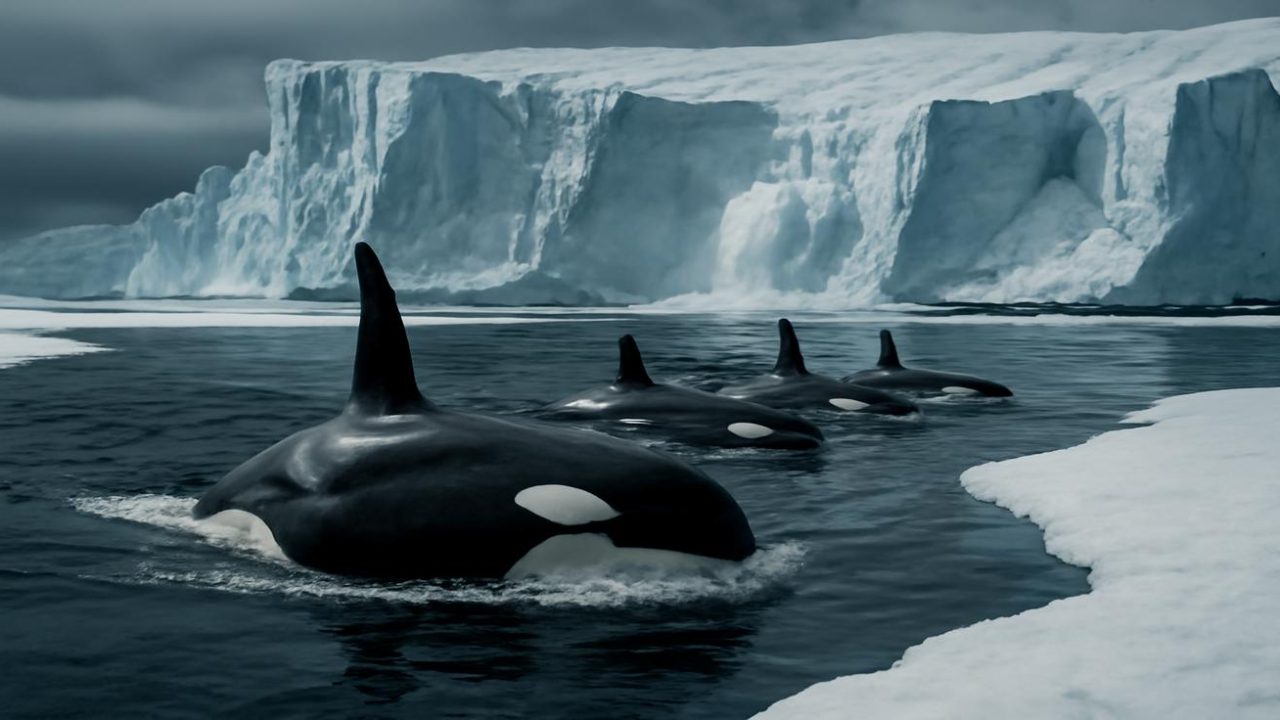
The sound comes first—a wet, hollow exhale cutting through Arctic stillness. Then the unmistakable black dorsal fin slices through waters that should still be locked in ice. This summer in Greenland, orcas arrived earlier and in greater numbers than many coastal residents can remember, following retreating sea ice into waters once too frozen for their presence.
The timing isn’t coincidental. As climate change accelerates ice melt along Greenland’s western coast, it’s reshaping one of the Arctic’s most delicate marine ecosystems—and creating a crisis that has prompted authorities to declare a state of emergency over melting ice and marine disruption.
What’s unfolding in Greenlandic waters reveals how quickly warming temperatures can cascade through an entire food web, turning apex predators into unwitting symbols of environmental upheaval.

When Natural Borders Disappear
For centuries, sea ice along Greenland’s coast functioned as an invisible boundary. It kept open-water predators at bay while protecting the marine life sheltered beneath—seals resting on ice floes, narwhals navigating under white ceilings, and the hunting routes that coastal communities have depended on for generations.
This year, that boundary dissolved with unprecedented speed. In fishing villages like Qeqertarsuaq, residents watched ice that appeared solid begin rotting from below. Fishermen testing the surface with poles felt it sag and shiver beneath their weight.
Cracks spread across bays that typically remained frozen until late summer. By June, broad stretches of open water appeared where thick ice should have supported sled runners and traditional hunting routes.

The early melt created a highway for orcas to access waters usually blocked by ice barriers. What began as a spectacle—children running along rocky shorelines to track tall dorsal fins cutting through swells—gradually shifted into something more ominous as the ice retreat continued.
Predators Without Traditional Boundaries
Orcas, sometimes called “wolves of the sea,” are highly intelligent pack hunters that typically make brief summertime visits to Arctic waters. This year’s extended ice-free season has allowed them to establish a more persistent presence in areas where their primary prey had little evolutionary experience avoiding them.
Narwhals, the tusked whales often called “unicorns of the sea,” evolved to navigate ice-choked fjords where thick cover helps them evade predators. Their sensitive skin requires protection from open-water waves, and ice floes provide crucial camouflage from aerial detection.

Without that cover, narwhals become starkly visible dark shadows in clear water. Hunters and fishers have reported coordinated orca attacks that feel like systematic culling—killer whale pods cutting off escape routes, herding narwhals into coves, and using their powerful heads as battering rams.
The shift represents more than isolated predation events. It’s a fundamental disruption of hunting patterns, migration routes, and survival strategies that Arctic marine life developed over millennia.
A State of Emergency Rooted in Daily Reality
Greenland’s declaration of a state of emergency over melting ice impacts wasn’t issued in abstract policy language. Instead, it was anchored in tangible changes reshaping daily life across coastal communities.

The emergency status allows the government to mobilize resources more quickly, adjust hunting quotas, support struggling fishers, and coordinate scientific monitoring of rapidly changing conditions. But beyond bureaucratic mechanisms, the declaration signals recognition that climate change has moved from future projection to present crisis.
The changes extend far beyond orca invasions. Sled dogs sit idle for much of the year as traditional ice routes become impassable. Fish populations are shifting northward, following cooler waters. Whale and seal migrations have become unpredictable, disrupting hunting seasons that communities have relied on for subsistence and cultural continuity.
| Traditional Ice Season | Current Conditions | Impact on Marine Life |
|---|---|---|
| Ice barriers protect Arctic species | Early melt creates open-water access | Orcas reach previously protected areas |
| Narwhals use ice cover for protection | Reduced ice leaves them exposed | Increased vulnerability to predation |
| Stable hunting and migration routes | Unpredictable seasonal patterns | Disrupted food webs and community subsistence |
Beyond Villains and Heroes
In media coverage, orcas often become convenient symbols—either villains destroying Arctic ecosystems or innocent victims of human-caused climate change. The reality in Greenlandic communities is more nuanced.

Local hunters understand that orcas aren’t invaders in any meaningful sense. They’re responding to available habitat and prey opportunities created by changing environmental conditions. The whales are following their instincts in a world where traditional boundaries no longer apply.
One hunter in Ilulissat captured this perspective: “We are afraid for the narwhals, for the seals, for our hunting traditions. But the orcas are not our enemy. The ice is…” The incomplete sentence speaks to a complex relationship with environmental change that defies simple narratives.
This complexity extends to potential solutions. Protecting narwhal populations might require managing orca access to certain areas, but such interventions raise questions about interfering with natural predator-prey relationships in an already disrupted ecosystem.

What Comes Next for Arctic Waters
The situation in Greenland represents a preview of changes likely to accelerate across the Arctic as warming continues. Ice-dependent species face increasing pressure as their habitat shrinks, while temperate species expand their ranges northward.
Scientific monitoring will be crucial for understanding how these ecosystem shifts unfold and whether marine life can adapt to rapidly changing conditions. The emergency declaration provides framework for enhanced research and potential intervention strategies.
For coastal communities, adaptation means developing new approaches to subsistence hunting, fishing practices, and cultural traditions built around predictable ice seasons. Some changes may be reversible if global warming slows, but others—like altered migration patterns and predator-prey relationships—could persist for generations.

The orcas now present in Greenlandic waters may establish permanent residence if ice-free seasons continue expanding. Their presence will likely reshape marine ecosystems in ways scientists are only beginning to understand, making ongoing research and monitoring essential for both wildlife conservation and community adaptation.
Frequently Asked Questions
Why are orcas appearing in Greenlandic waters earlier than usual?
Accelerated ice melt has removed traditional barriers that kept orcas out of coastal Arctic waters, allowing them earlier and more extensive access to areas usually protected by sea ice.
Are the orcas harming narwhal populations?
Hunters and fishers report increased predation on narwhals, which have lost their traditional ice cover protection and become more vulnerable to coordinated orca attacks.

What does Greenland’s state of emergency actually do?
The declaration allows faster resource mobilization, hunting quota adjustments, fisher support, and enhanced scientific monitoring of changing marine conditions.
Could this situation reverse if ice conditions improve?
Some changes might be reversible with restored ice barriers, but altered migration patterns and predator-prey relationships could persist even if ice seasons recover.
Are similar changes happening in other Arctic regions?
The source material focuses specifically on Greenland, but similar ice loss and ecosystem disruption patterns are occurring across Arctic waters as global temperatures rise.
How are local communities adapting to these changes?
Communities are dealing with disrupted hunting seasons, altered fish populations, and reduced use of traditional ice routes, requiring new approaches to subsistence and cultural practices.









Leave a Comment