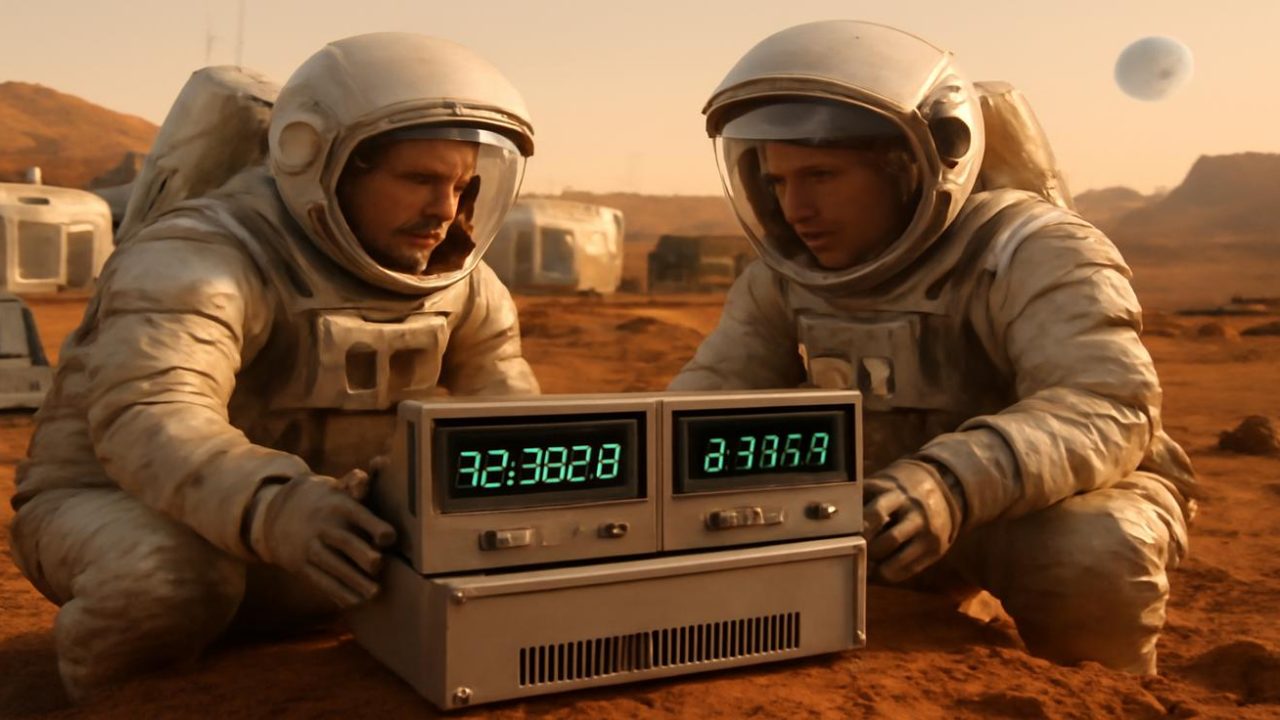
Einstein’s theory of relativity predicted it over a century ago, and now Mars missions are confirming what physicists have long known: time flows differently on the red planet. The difference isn’t dramatic—we’re talking milliseconds drifting into seconds over long mission periods—but it’s enough to create serious operational challenges for spacecraft navigation and mission planning.
When rover clocks started showing persistent drift compared to Earth time, engineers initially suspected technical glitches. But the pattern was too consistent, too predictable. Mars was demonstrating Einstein’s fundamental insight that time itself is not universal—it bends and flexes around gravity and motion.
For future Mars missions, this isn’t just a fascinating physics lesson. It’s a practical problem that could mean the difference between successful landings and multibillion-dollar crashes in the Martian dust.

How Einstein’s Relativity Plays Out on Mars
Einstein’s theories of special and general relativity fundamentally changed how we understand time. Rather than being a universal constant, time is elastic—affected by gravity and relative motion. On Earth, we rarely notice these effects because they’re incredibly small, though GPS satellites must account for them to maintain accuracy.
Mars presents a perfect laboratory for observing these relativistic effects on a planetary scale. The red planet has about 38% of Earth’s gravity, meaning spacetime is less “curved” there. In Einstein’s framework, this causes clocks on Mars to tick slightly faster than identical clocks on Earth.
But gravity is only part of the equation. Mars orbits farther from the Sun, where solar gravity is weaker—another factor that nudges Martian clocks to run faster relative to Earth’s. Add in the relative motion of both planets hurtling through space in different orbits at different speeds, and special relativity joins the mix, further shifting the apparent time flow depending on the observer’s perspective.

The cumulative effect isn’t cinematic—astronauts won’t age differently in any noticeable way. But precision instruments and mission-critical software now have the resolution to detect and measure these tiny temporal differences across millions of kilometers of space.
The Practical Challenge for Space Missions
Modern spacecraft operations demand ruthless precision. Navigation systems, landing sequences, and communication protocols all depend on split-second timing. Even tiny temporal discrepancies can cascade into major problems.
Consider what happens when mission clocks drift out of sync with Earth-based control systems:

- Engine burns triggered fractions of a second off-schedule can result in thousands of kilometers of navigational error
- Landing sequences mistimed by milliseconds can scatter expensive equipment across the wrong patch of Martian terrain
- Communication windows become increasingly difficult to coordinate as time drift accumulates
- Automated systems may execute commands based on outdated temporal references
The challenge isn’t theoretical anymore. Rover missions have already documented persistent clock drift that can’t be explained by equipment malfunction or software lag. The red planet is methodically confirming what Einstein’s equations predicted: time really does behave differently there.
| Factor | Effect on Mars Time | Relative to Earth |
|---|---|---|
| Lower gravity (38% of Earth) | Clocks run faster | Less spacetime curvature |
| Greater distance from Sun | Clocks run faster | Weaker solar gravity |
| Different orbital velocity | Variable effect | Depends on relative motion |
What This Means for Future Mars Exploration
As Mars missions become more ambitious—with plans for human settlements, sample return missions, and complex multi-vehicle operations—temporal synchronization becomes increasingly critical. Mission planners can no longer treat time as a simple, universal backdrop for operations.
Future Mars missions will need to account for relativistic time effects in several key areas. Navigation systems must incorporate time dilation calculations into their core algorithms. Communication protocols require built-in corrections for temporal drift. Landing sequences need buffer zones to account for timing uncertainties.

The implications extend beyond individual missions. A permanent Mars colony would need its own temporal reference system, synchronized with but distinct from Earth time. Supply missions, communication schedules, and emergency protocols would all need to account for the fundamental difference in how time flows on each planet.
This isn’t just about adjusting clocks—it’s about recognizing that Mars operates in its own temporal reality, one that Einstein predicted but that we’re only now beginning to experience operationally.
The Technology Adaptation Challenge
Current spacecraft systems weren’t designed with relativistic time effects as a primary consideration. Most mission software treats time drift as an error to be corrected rather than a fundamental property of interplanetary travel.

Engineers are now working to develop new approaches that embrace rather than fight these temporal differences. This includes creating dual-time systems that maintain both Earth and Mars temporal references, developing algorithms that can predict and compensate for relativistic drift, and designing communication protocols that remain robust even as time synchronization gradually degrades.
The precision required is extraordinary. Mission-critical operations often depend on timing accurate to fractions of seconds. When those fractions accumulate over months or years of mission duration, the cumulative effect can overwhelm safety margins and operational tolerances.
What Happens Next for Mars Missions
The confirmation of Einstein’s predictions on Mars forces a fundamental shift in how space agencies approach mission planning. Rather than treating relativistic effects as exotic physics relevant only to extreme conditions, they’re becoming standard operational considerations.

Future missions will likely incorporate relativistic timing corrections from the design phase. Software systems will need dual temporal references. Communication protocols will build in assumptions about gradual time drift. Navigation systems will treat Einstein’s equations as essential operational tools rather than theoretical curiosities.
This represents a milestone in human space exploration—the point where Einstein’s century-old insights transition from theoretical physics to practical engineering requirements. Mars isn’t just confirming relativity; it’s forcing us to live with its consequences.
The red planet continues to whisper back confirmation of what Einstein predicted decades ago: time itself is not the universal constant we once believed. For future Mars explorers, that whisper is becoming an operational reality that can’t be ignored.

Frequently Asked Questions
How much faster do clocks run on Mars compared to Earth?
The difference is extremely small—milliseconds accumulating into seconds over long mission periods, not dramatic enough for humans to notice but significant enough to affect precision spacecraft operations.
Why didn’t we know about this time difference before?
Einstein’s equations predicted it, but only recently have our instruments and clocks achieved the precision necessary to detect and measure these tiny differences across interplanetary distances.
Will astronauts age differently on Mars?
The time difference is far too small to have any noticeable effect on human aging or biological processes.

How are current Mars missions dealing with this timing issue?
Engineers initially thought persistent clock drift was equipment malfunction, but are now recognizing it as confirmation of relativistic effects that require operational adaptation.
Will this affect plans for human Mars missions?
Yes, future missions will need to incorporate relativistic timing corrections into navigation, communication, and operational planning from the design phase.
Does this time difference affect other planets too?
Yes, every celestial body with different gravity and orbital characteristics will have its own relativistic time effects, though Mars is where we’re first experiencing this operationally.









Leave a Comment