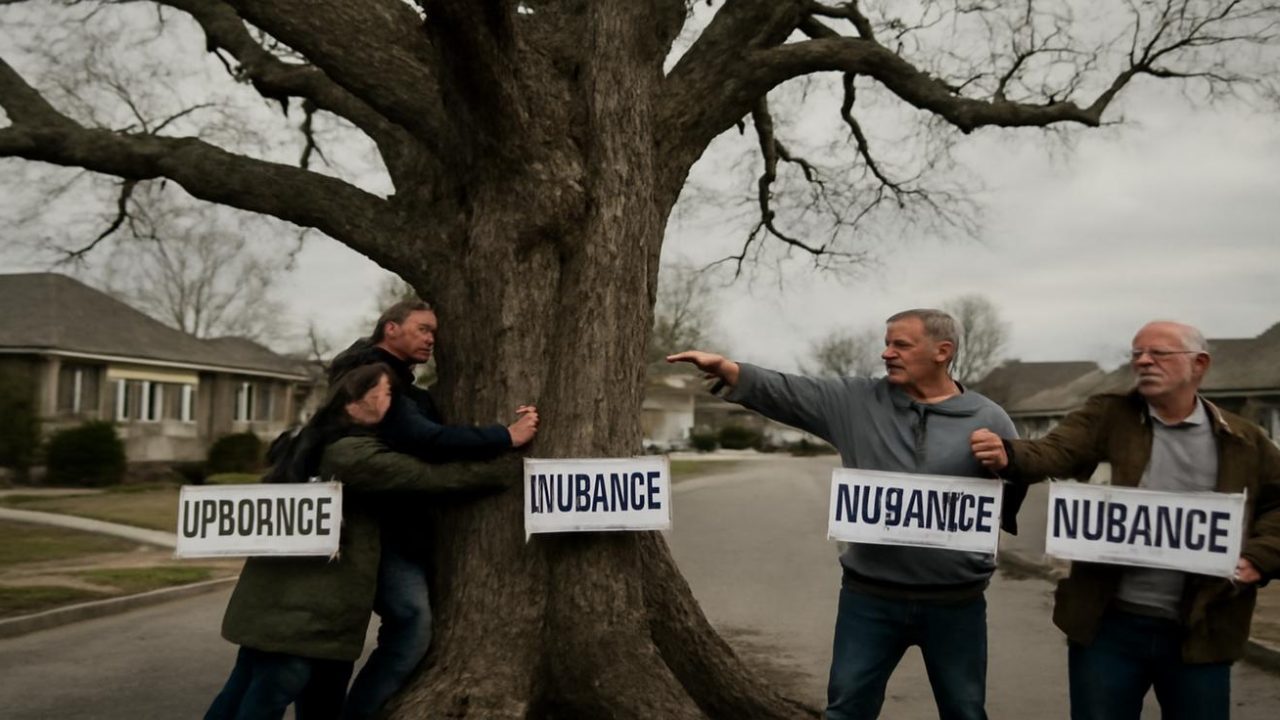
A 140-year-old oak tree stands at the center of a neighborhood dispute that reveals how communities grapple with competing values of heritage preservation, safety concerns, and property rights. The ancient tree, estimated by the town’s arborist to be around 140 years old, has become a flashpoint for residents who must decide between preserving a living piece of history and addressing legitimate safety risks.
The conflict began when residents noticed significant changes in the oak’s health. Dead and dying branches, missing leaves in large sections of the crown, and a long crack appearing in a major limb that leans toward the street have transformed what was once a beloved landmark into a source of anxiety and division.
When a chunk of dead wood crashed onto the asphalt during a storm, leaving a crater of splintered bark, the informal conversations became formal neighborhood meetings. The incident forced residents to confront a question that many tree-lined communities face: at what point does heritage become hazard?

The Tree That Shaped a Community
Wrenfield Lane represents the kind of established neighborhood that developers try to recreate with marketing terms like “heritage” and “charm.” The sidewalks show their age, cracked by roots that predate the houses themselves. Small front lawns blur together across invisible property lines, creating the sense of shared space that makes neighborhood trees feel communal rather than private.
The oak has served as more than landscaping for generations of residents. Old-timers describe it as a remnant of the original oak savanna that existed before the subdivision was carved from fields and woods. Its broad, muscular trunk and thick, sheltering limbs have created a canopy that throws gentle green light over everything beneath it during summer months.
The tree carries the neighborhood’s collective memory. Lightning once struck the tallest branch, sending a jagged wound down one side and leaving a black streak that children whispered about on Halloween. Summer block parties regularly featured bunting or lights tied to its lower branches. Decades of children have climbed into its crook to read, to experience first kisses, or to watch storm clouds roll in over roofs and satellite dishes.

But the oak’s role as neighborhood landmark has become complicated by its declining health. Larger limbs have been dropping over recent years, initially dismissed as normal aging. The real alarm came when bare twigs appeared where there should have been soft clouds of unfolding green leaves, signaling serious distress in the upper third of the crown.
When Heritage Meets Safety Concerns
The emergency neighborhood meeting that followed the falling branch incident revealed three distinct camps among residents. The “Tree People” – neighbors who wear hiking sandals, know bird names, and share articles about forest bathing benefits – advocate for preservation efforts and professional tree care rather than removal.
The “Safety Crowd” takes a more pragmatic approach, focusing on roof repairs, liability issues, and the unpredictable trajectory of falling branches. Their concerns center on property damage, insurance claims, and the potential for injury from a tree that has already demonstrated its capacity to drop substantial debris.

Between these positions sits the “Quiet Majority” – residents who aren’t sure how they feel but find themselves suddenly very interested in tree law, property rights, and municipal liability. This group often holds the deciding vote in neighborhood disputes, making their eventual position crucial to the outcome.
The debate reflects broader tensions in established communities between preserving character-defining features and managing practical risks. Trees that have outlived several generations of neighbors carry emotional and historical weight that purely safety-based calculations cannot easily quantify.
The Complex Reality of Tree Ownership
One of the most challenging aspects of the dispute involves determining actual ownership and responsibility for the oak. While everyone refers to it as “their oak,” no one can quite agree on whose it really is. This ambiguity is common in older neighborhoods where trees predate current property lines and have grown to serve multiple adjacent properties.

The ownership question becomes critical when considering the costs and liability associated with either professional tree care or removal. A 140-year-old oak of this size would require significant investment for proper maintenance, including regular professional assessment, selective pruning, and potentially expensive measures like cable bracing for compromised limbs.
Removal costs for a tree of this magnitude can reach thousands of dollars, especially when working around power lines, houses, and streets. The expense often falls to whoever is determined to be the legal owner, creating financial pressure that can influence decision-making beyond purely emotional or environmental considerations.
| Tree Management Option | Typical Cost Range | Timeline | Outcome |
|---|---|---|---|
| Professional Assessment | $200-500 | 1-2 weeks | Detailed health report and recommendations |
| Selective Pruning | $800-2,500 | 1-3 days | Removal of dead/dangerous branches |
| Cable Bracing | $300-800 per cable | 1 day | Support for compromised limbs |
| Complete Removal | $2,000-8,000+ | 2-5 days | Elimination of tree and stump |
What Science Says About Aging Trees
Tree health professionals recognize that oaks can live for centuries with proper care, but they also acknowledge that very old trees require more intensive management as they age. The symptoms observed on Wrenfield Lane – crown dieback, limb cracking, and increased branch drop – are common indicators of stress in aging trees.

However, these symptoms don’t automatically mean a tree is doomed. Professional arborists can often extend the life of heritage trees through targeted interventions. Dead and dying branches can be removed to reduce weight and eliminate immediate hazards. Cable systems can provide support for compromised limbs. Root zone management can improve soil conditions and reduce stress.
The challenge lies in balancing the costs and ongoing maintenance requirements against the realistic lifespan extension such interventions can provide. A tree showing significant crown dieback may benefit from professional care for another decade or two, but it’s unlikely to return to its former vigor.
Beyond One Tree: A Pattern Across America
The Wrenfield Lane dispute reflects a broader pattern occurring in established neighborhoods across the country. As suburbs built in the mid-20th century mature, their original trees are reaching ages that require difficult decisions about preservation versus removal.

Climate change adds another layer of complexity, as extreme weather events become more frequent and intense. Trees that might have lasted another decade under historical weather patterns face increased stress from severe storms, drought, and temperature extremes.
Many communities are developing formal policies for managing heritage trees, including criteria for protection, funding mechanisms for maintenance, and clear procedures for removal decisions. These frameworks can help neighborhoods avoid the kind of divisive disputes that emerge when decisions are made on an ad hoc basis.
The emotional attachment residents develop to neighborhood trees often exceeds their attachment to other community features. Trees provide daily interaction through seasonal changes, wildlife habitat, and microclimate effects that make them feel like living neighbors rather than mere landscape elements.

Frequently Asked Questions
How old is the oak tree at the center of this dispute?
The town’s arborist estimated the tree at around 140 years old, possibly more, making it a remnant of the original oak savanna that existed before the subdivision was built.
What specific signs of decline has the tree shown?
The tree has exhibited crown dieback with bare twigs where leaves should be, a long crack in a major limb leaning toward the street, increased dropping of large branches, and dead wood that fell during a storm and created a crater in the asphalt.
Who owns the tree legally?
The source material indicates that while everyone refers to it as “their oak,” no one can quite agree on whose it really is, which is common in older neighborhoods where trees predate current property lines.

What are the main positions in the neighborhood dispute?
Three groups have emerged: “Tree People” who advocate for preservation and professional care, the “Safety Crowd” focused on liability and property damage risks, and the “Quiet Majority” who are undecided but interested in the legal and practical aspects.
What happened during the storm that escalated the situation?
A chunk of dead wood fell from the tree during a storm, hitting the asphalt and leaving a crater of splintered bark, which prompted residents to hold emergency neighborhood meetings about the tree’s future.
How long has this tree been part of the neighborhood’s history?
The tree has outlived several generations of neighbors and carries decades of community memories, from lightning strikes that left visible scars to children climbing in its branches and summer block parties held beneath its canopy.










Leave a Comment