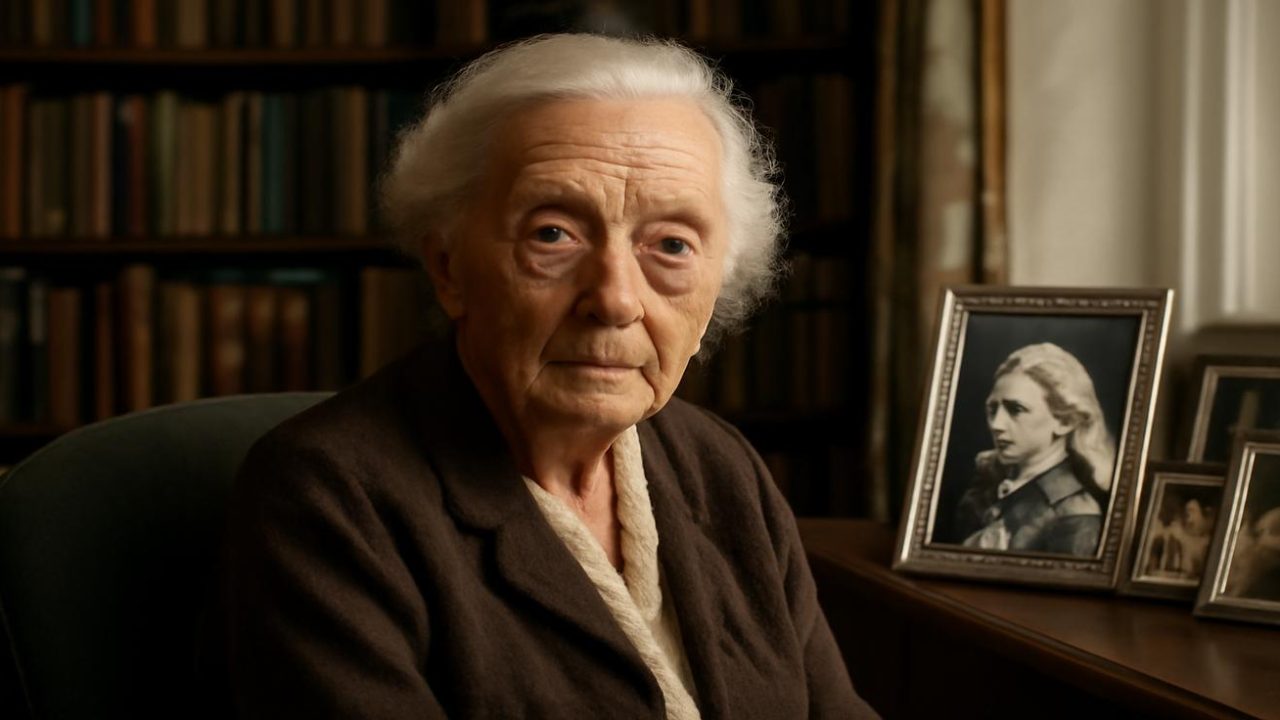
Queen Victoria’s granddaughter Princess Alice, Countess of Athlone, lived an extraordinary 98 years—born in 1883 when carriages ruled London streets and dying in 1981 when color television, jumbo jets, and space shuttles were ordinary news. She walked calmly from the gas-lit 19th century straight into the humming electronics of the late 20th century.
This remarkable span makes Princess Alice one of the most fascinating bridges between the Victorian era and the modern world. Her life story reads like a time-travel novel, connecting the height of the British Empire to the space age.
Born on February 25, 1883, at Kensington Palace, Princess Alice entered a world vastly different from the one she would leave behind nearly a century later.

A Royal Birth in Victoria’s England
Princess Alice was born into the very heart of royal power. Her father was Prince Leopold, Duke of Albany—Queen Victoria’s youngest son—and her mother was Princess Helena of Waldeck and Pyrmont. The corridors of Kensington Palace in winter 1883 were cool and echoing, scented with beeswax and coal smoke.
Outside the palace walls, London was a city of clattering hooves and fog-damp wool coats. The British Empire was still expanding toward its peak, and Alice represented another living thread in the web of dynasties that connected London, Berlin, Vienna, and beyond.
Her grandmother, Queen Victoria, was already becoming legendary even as she lived—a stern figure in black who wielded power over continents. Baby Alice, with her soft curls and solemn gaze, was one of many royal grandchildren serving as living proof that European thrones were stitched together by bloodlines as much as treaties.

Tragedy struck early in Alice’s life. Her father, Prince Leopold, suffered from hemophilia—the blood disorder that haunted many of Victoria’s descendants. When Alice was just one year old, he died after a fall, leaving behind a posthumous son and a little girl who would grow up largely under her formidable grandmother’s expectations.
Growing Up as Europe Changed
As Princess Alice grew, Europe remained a chessboard of royal cousins, but the world was beginning to tilt toward modernity. Trains thundered across countries that once took weeks to cross, telegrams carried news with lightning speed, and electric light nibbled away at the edges of perpetual night.
Alice’s education followed the typical pattern for royal girls of her era: languages, music, history, religion, and the elaborate etiquette of a life lived perpetually in public. She wasn’t meant for a profession—her role was to serve as a living link between dynasties.

In 1904, she married her cousin Prince Alexander of Teck, a member of the sprawling German-descended branch of the royal family. The ceremony featured the usual royal trappings—uniforms and jewels, church organs shaking stone vaults with sound—but the world outside was beginning to hum with unease.
The Russo-Japanese War was underway, and the old order could sense tremors beneath its feet, even if it couldn’t predict the earthquake coming within a decade.
From Teck to Athlone: Navigating a Changing World
The transformation from Princess Alice of Teck to Princess Alice, Countess of Athlone, reflects the seismic shifts of the early 20th century. German-sounding titles became not just inconvenient but dangerous as royal cousins went to war with one another.

The couple’s journey took them far from the familiar corridors of British palaces. They witnessed the collapse of old certainties and the birth of new realities that would have been unimaginable in Alice’s Victorian childhood.
| Era | Technology | Alice’s Age |
|---|---|---|
| Birth (1883) | Horse-drawn carriages, gas lighting | 0 |
| Marriage (1904) | Early automobiles, electric lighting spreading | 21 |
| World War I (1914-1918) | Aircraft, radio communication | 31-35 |
| World War II (1939-1945) | Television, radar, early computers | 56-62 |
| Death (1981) | Color TV, jumbo jets, space shuttles | 98 |
Witnessing Nearly a Century of Change
Princess Alice’s longevity allowed her to witness transformations that would have seemed like magic to her Victorian childhood companions. She was born when the fastest way to cross the Atlantic was by steamship, and she died in an era when space shuttles regularly orbited Earth.
Her early life unfolded in drawing rooms lit by gas flames and warmed by coal fires. Servants carried messages by hand, and the height of technology might have been a telephone in the grandest houses. By the time of her death, color television brought images from around the world instantly into ordinary homes.

The social changes were equally dramatic. Alice was raised in a world where royal bloodlines determined the fate of nations and empires seemed permanent fixtures. She lived to see the British Empire dissolve, monarchies topple, and new forms of government emerge across the globe.
A Living Bridge Between Centuries
What makes Princess Alice’s story particularly fascinating is how she represents continuity amid radical change. Born into the rigid hierarchies of Victorian society, she adapted to each new era while maintaining her royal identity.
Her photographs capture this remarkable journey. Early images show her in the elaborate dress and formal poses typical of Victorian royalty. Later pictures reveal someone who had learned to navigate a world that would have been utterly foreign to her grandmother, Queen Victoria.

The span of her life encompasses the entire transition from the 19th to the 20th century and beyond. She personally experienced the shift from an age of empires to an age of nations, from horse-drawn transport to space exploration, from candlelit evenings to electric cities that never sleep.
Frequently Asked Questions
How was Princess Alice related to Queen Victoria?
Princess Alice was Queen Victoria’s granddaughter, born to Prince Leopold, Duke of Albany, who was Victoria’s youngest son.
When did Princess Alice live?
She was born on February 25, 1883, and died in 1981, living for 98 years.

Who did Princess Alice marry?
She married her cousin Prince Alexander of Teck in 1904.
What major historical changes did she witness?
She lived through the transition from horse-drawn carriages to space shuttles, from gas lighting to color television, and from the height of the British Empire to the modern era.
Why is her lifespan historically significant?
Her nearly century-long life bridged the gap between the Victorian era and the modern world, making her a living witness to unprecedented technological and social transformation.
What happened to her father?
Prince Leopold died when Alice was just one year old, after suffering a fall. He had hemophilia, a blood disorder that affected many of Queen Victoria’s descendants.











Leave a Comment