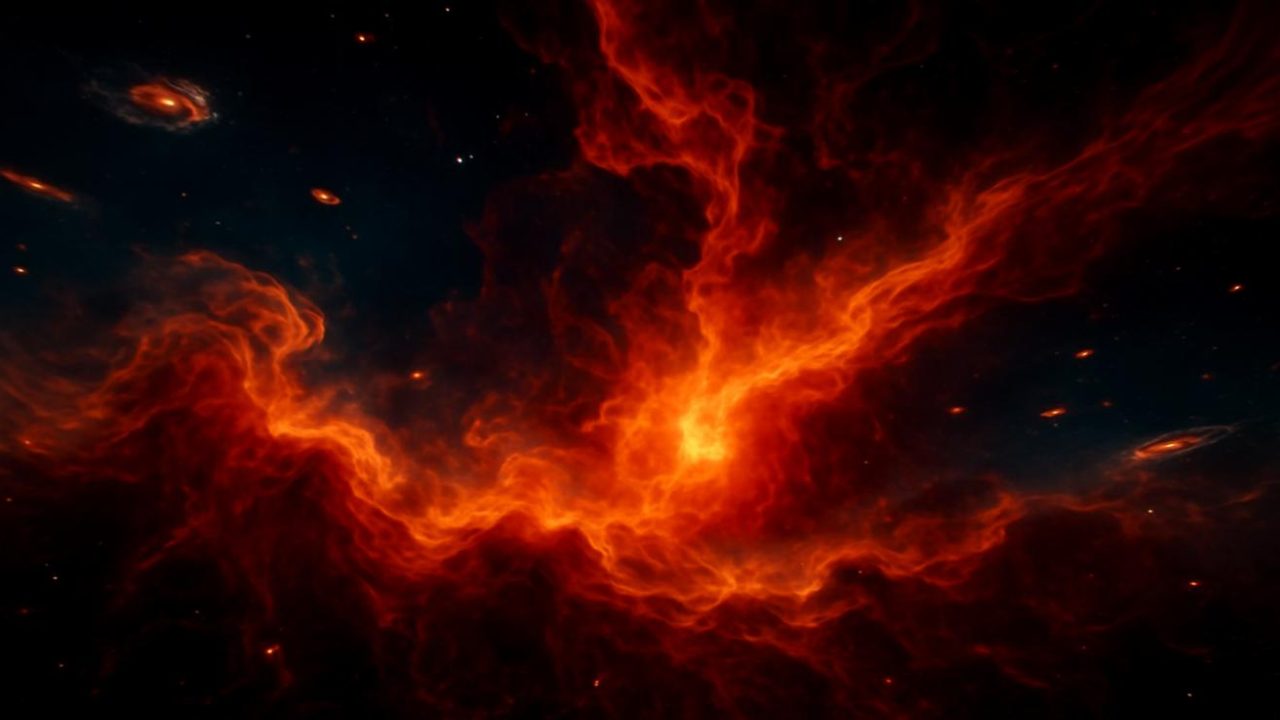
Light that traveled for more than 12 billion years recently delivered a shocking message to astronomers: the early universe was far more violent than anyone expected. When researchers analyzed data from powerful telescopes pointed at distant regions of space, they discovered gas clouds heated to temperatures so extreme that one scientist described them as “too strong to be real.”
These aren’t the gentle, fragile structures that models predicted for the cosmic dawn. Instead, astronomers found massive clouds of gas—stretched across hundreds of thousands of light-years—boiling at temperatures reaching a million degrees or more.
The discovery challenges fundamental assumptions about how the universe behaved when it was only a tenth of its current age, during an era when the first generations of stars were exploding and black holes were feeding voraciously.

When the Universe Was a Cosmic Furnace
To understand what astronomers discovered, imagine looking back through time to when galaxies were still learning how to assemble themselves. The universe was crowded with hydrogen and helium—the lightest elements—floating in great filaments like invisible rivers between emerging cosmic structures.
Scientists call this distant epoch the “cosmic dawn,” a time when light was carving out safe havens in a universe soaked in darkness. The farther astronomers look into space, the younger the universe they’re observing, thanks to the finite speed of light.
Researchers expected to find something fragile when they pointed their instruments at these far-flung regions. Early galaxies are typically messy and small, with tenuous gas that’s easily pushed around. The prevailing models painted a picture of a cosmos still learning subtlety.

Instead, what they found looked less like a gentle dawn and more like a furnace door cracked open.
Gas Clouds Boiling at Impossible Temperatures
The word “boiling” hardly captures what astronomers observed. On Earth, boiling water reaches 100°C (212°F). In these early-universe structures, the gas wasn’t at hundreds of degrees—it was at millions of degrees. In some regions, even hotter.
At such extreme temperatures, atoms are literally torn apart. Electrons escape the pull of their nuclei, transforming gas into plasma—a sizzling soup of charged particles. This level of heat doesn’t come from a quiet, sleepy universe. It comes from violence.

As telescope data accumulated, scientists realized they were observing entire clouds of gas cooking in this invisible fire. This wasn’t just a few angry pockets around newborn stars—it was colossal, extended, and disproportionately intense.
The temperatures and turbulence levels were so extreme that researchers initially suspected their instruments had malfunctioned. Cosmic gas is expected to be hot near certain galaxies and black holes, but not this hot, not this widespread, and certainly not this early in cosmic history.
The Mystery Behind the Extreme Heat
Astronomers did what they always do when confronted with impossible data: they checked and rechecked. They cleaned the data, recalibrated instruments, and cross-matched observations with other telescopes and wavelengths. The signal persisted. The gas really was boiling.

To understand how the universe could cook its own material so violently, scientists had to consider the invisible hand of dark matter. Dark matter doesn’t glow, reflect, or block light—you can’t see, touch, or bottle it. But its gravitational influence shapes everything else.
In the early universe, most matter wasn’t the ordinary kind we’re made of—it was dark matter, pooling into invisible structures that would later become the scaffolding for galaxies and galaxy clusters.
| Early Universe Conditions | Observed Reality | Previous Expectations |
|---|---|---|
| Gas Temperature | Over 1 million degrees | Moderately heated |
| Distribution | Hundreds of thousands of light-years | Localized pockets |
| Universe Age | One-tenth current age | Same timeframe |
| Gas State | Violent plasma | Tenuous, easily displaced |
Why This Discovery Changes Everything
The implications of finding such extreme conditions in the early universe extend far beyond academic curiosity. These observations suggest that the processes shaping cosmic structure were far more energetic and dramatic than previously understood.

The discovery forces astronomers to reconsider fundamental models of how galaxies formed and evolved. If gas was being heated to such extreme temperatures so early in cosmic history, it means the universe was undergoing violent processes that current theories struggle to explain.
This finding also has implications for understanding how the elements necessary for life eventually spread throughout the universe. The extreme heating observed could have dramatically affected how and where heavier elements—forged in the nuclear furnaces of early stars—were distributed across space.
The widespread nature of these hot gas clouds suggests that whatever was causing this heating wasn’t isolated to specific regions or events. Instead, it appears to have been a fundamental characteristic of how the early universe operated.

What Astronomers Are Investigating Next
The discovery raises more questions than it answers. Researchers are now working to identify the specific mechanisms that could generate such extreme heating across such vast regions of space.
Potential explanations being investigated include the influence of supermassive black holes, the explosive deaths of the first generation of stars, and the gravitational effects of dark matter structures colliding and merging.
Scientists are also examining whether this extreme heating was a brief phase in cosmic evolution or a sustained condition that persisted for significant periods. Understanding the duration and extent of these conditions will be crucial for refining models of early universe physics.

Additional observations using different wavelengths and instruments are being planned to confirm and expand upon these initial findings. The goal is to determine whether these extreme conditions were common throughout the early universe or limited to specific regions.
Frequently Asked Questions
How hot was the gas that astronomers discovered?
The gas reached temperatures of a million degrees or more, hot enough to tear atoms apart and create plasma.
How far back in time are astronomers looking?
The light they observed had been traveling for more than 12 billion years, showing the universe when it was only a tenth of its current age.

Why did scientists initially think their instruments were wrong?
The temperatures and turbulence levels were so extreme that they exceeded what models predicted was possible for that era of cosmic history.
What caused these extreme temperatures?
The exact mechanism is still being investigated, but it likely involves dark matter, early black holes, or the explosive deaths of first-generation stars.
How large were these hot gas regions?
The heated gas clouds stretched across hundreds of thousands of light-years, making them enormous cosmic structures.
What does this mean for our understanding of the early universe?
It suggests the early universe was far more violent and energetic than previously thought, requiring scientists to revise fundamental models of cosmic evolution.











Leave a Comment