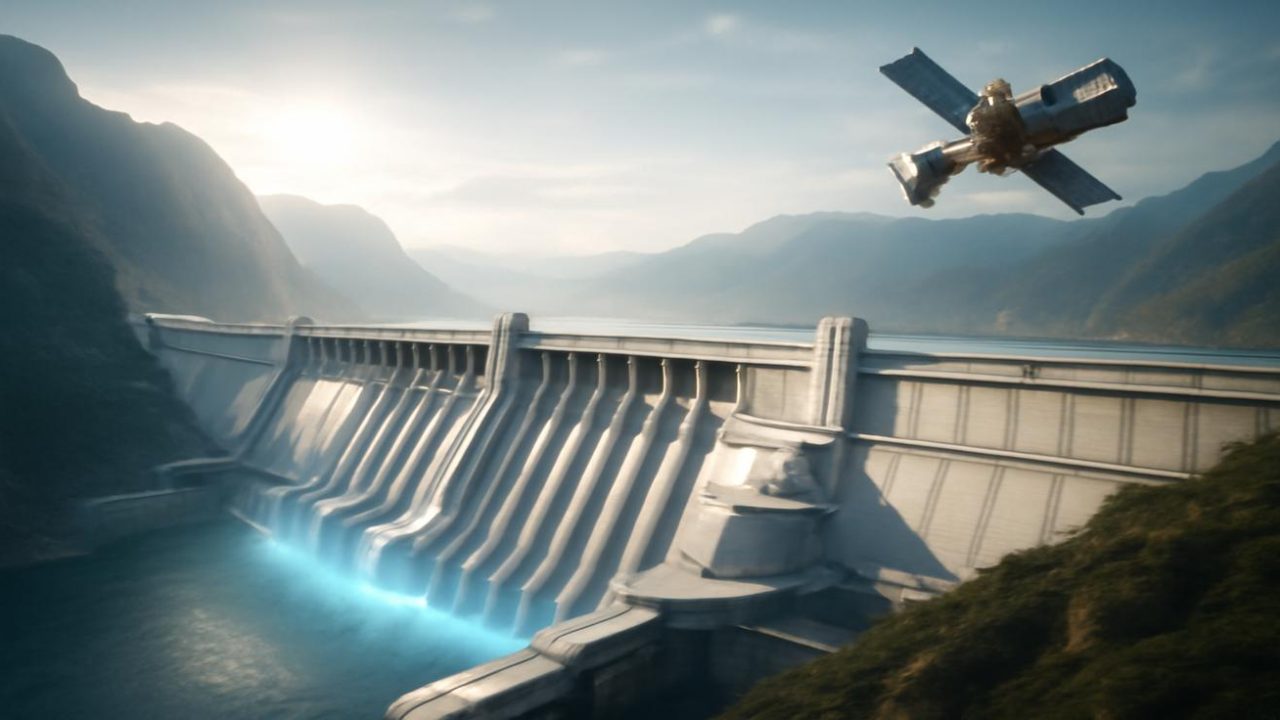
A viral claim spreading across social media suggests NASA has confirmed that China’s massive infrastructure projects will slow down Earth’s rotation. The story has captured millions of views with dramatic thumbnails showing the planet tilted and enormous structures spanning its surface.
The reality behind these sensational headlines reveals a fascinating intersection of physics, engineering, and viral misinformation that’s worth understanding.
At the heart of this story lies a basic principle of physics: when you move massive amounts of material on Earth, you can theoretically affect how fast our planet spins. But the gap between theoretical possibility and measurable impact is enormous.

The Science Behind Earth’s Rotation Changes
Earth spins at over 1,600 kilometers per hour at the equator, carrying all of us along for the ride without us feeling the motion. This rotation follows the same physics as a figure skater spinning faster by pulling their arms in, or slowing down by extending them outward.
When humans build massive structures or move enormous quantities of material, we’re essentially redistributing Earth’s mass. Moving water from oceans to inland reservoirs, constructing gigantic dams, or even major earthquakes that shift rock formations can theoretically affect our planet’s rotation.
NASA and other scientific organizations do study these effects. They’ve documented how natural phenomena like glacial melting, major earthquakes, and large-scale human projects can influence Earth’s rotation by microscopic amounts.

The key word here is microscopic. We’re talking about changes measured in microseconds—millionths of a second that no human could ever perceive.
China’s Three Gorges Dam: The Real Example
The viral stories often point to China’s Three Gorges Dam as evidence of rotation-slowing megaprojects. This massive dam did indeed have a measurable effect on Earth’s rotation when its reservoir was filled.
Scientists calculated that moving such an enormous volume of water inland and upward slightly changed Earth’s moment of inertia. The result was adding roughly 0.06 microseconds to the length of each day.

| Project Impact | Time Change | Human Perception |
|---|---|---|
| Three Gorges Dam | 0.06 microseconds longer days | Completely undetectable |
| Major earthquakes | Microsecond variations | Completely undetectable |
| Glacial melting | Microsecond variations | Completely undetectable |
To put 0.06 microseconds in perspective: it’s six hundredths of a millionth of a second. This change is real and measurable with precise scientific instruments, but it’s far smaller than the natural variations in Earth’s rotation that occur due to atmospheric conditions, ocean currents, and seasonal changes.
How Viral Misinformation Transforms Science
The viral claims about China slowing Earth’s rotation represent a perfect example of how legitimate science gets distorted into sensational misinformation. The process typically follows this pattern:
- Scientists publish research about tiny, measurable effects of human projects on Earth’s rotation
- Content creators grab these findings and amplify them with dramatic language
- The microscopic reality gets presented as something massive and concerning
- Clickbait headlines suggest immediate, noticeable impacts that don’t exist
The stories often mention mysterious “Titanic Projects” in China—sometimes described as networks of megastructures, chains of artificial islands, or even space-based solar power systems. These descriptions typically lack specific details because they’re largely fictional extrapolations from real but much smaller infrastructure projects.

NASA has never “confirmed” that China will slow Earth’s rotation in any meaningful way. What NASA has done is conduct routine scientific measurements of how various factors, including large construction projects, affect our planet’s rotation by infinitesimal amounts.
The Scale Required for Noticeable Changes
To actually slow Earth’s rotation in a way humans could perceive would require moving amounts of mass that dwarf anything humanity has ever built. We’re talking about projects that would need to be visible from space not just as points of light, but as major geographical features.
Even China’s most ambitious infrastructure projects—high-speed rail networks spanning thousands of kilometers, cities housing millions of people, and dams creating massive artificial lakes—fall far short of the scale needed to create noticeable changes in planetary rotation.

The physics demands are simply staggering. Earth’s rotational momentum is so enormous that even our most impressive engineering achievements barely register as statistical noise in the measurements.
Natural processes dwarf human impacts. Seasonal changes in atmospheric pressure, major storms redistributing water and air masses, and the gravitational effects of the moon and sun all create larger variations in Earth’s rotation than any human construction project.
What This Means for Future Megaprojects
As China and other nations continue building massive infrastructure projects, scientists will continue measuring their microscopic effects on Earth’s rotation. This research serves important purposes for understanding our planet’s systems and improving the precision of timekeeping and navigation systems.

Future projects might include even larger dams, extensive high-speed transportation networks, or massive renewable energy installations. While these could theoretically have slightly larger effects on rotation, they would still fall well within the range of natural variation.
The viral nature of these rotation stories reflects broader patterns in how scientific information spreads online. Complex research gets simplified, amplified, and sometimes distorted as it moves through social media platforms optimized for engagement rather than accuracy.
Understanding the real science helps separate legitimate engineering achievements from science fiction scenarios. China’s infrastructure projects represent remarkable human accomplishments, but they’re not going to change how fast Earth spins in any way you’d ever notice.

Frequently Asked Questions
Did NASA really confirm China will slow Earth’s rotation?
No. NASA studies how various factors affect Earth’s rotation by microscopic amounts, but has never confirmed any project will slow rotation in a noticeable way.
How much did the Three Gorges Dam actually affect Earth’s rotation?
It added approximately 0.06 microseconds to each day—a change completely imperceptible to humans but measurable with scientific instruments.
Could any human project significantly slow Earth’s rotation?
The scale required would be far beyond current human capabilities, requiring mass movements thousands of times larger than our biggest construction projects.

Why do these stories go viral if they’re not true?
They combine real science with dramatic presentation, creating content that feels both credible and sensational enough to share widely.
Are there natural processes that affect Earth’s rotation more than human projects?
Yes. Seasonal atmospheric changes, major earthquakes, glacial melting, and gravitational effects from the moon and sun all create larger variations than human construction.
What is China’s actual “Titanic Project” referenced in these stories?
The viral stories typically don’t reference any single real project, instead mixing together various infrastructure developments with fictional elements for dramatic effect.











Leave a Comment