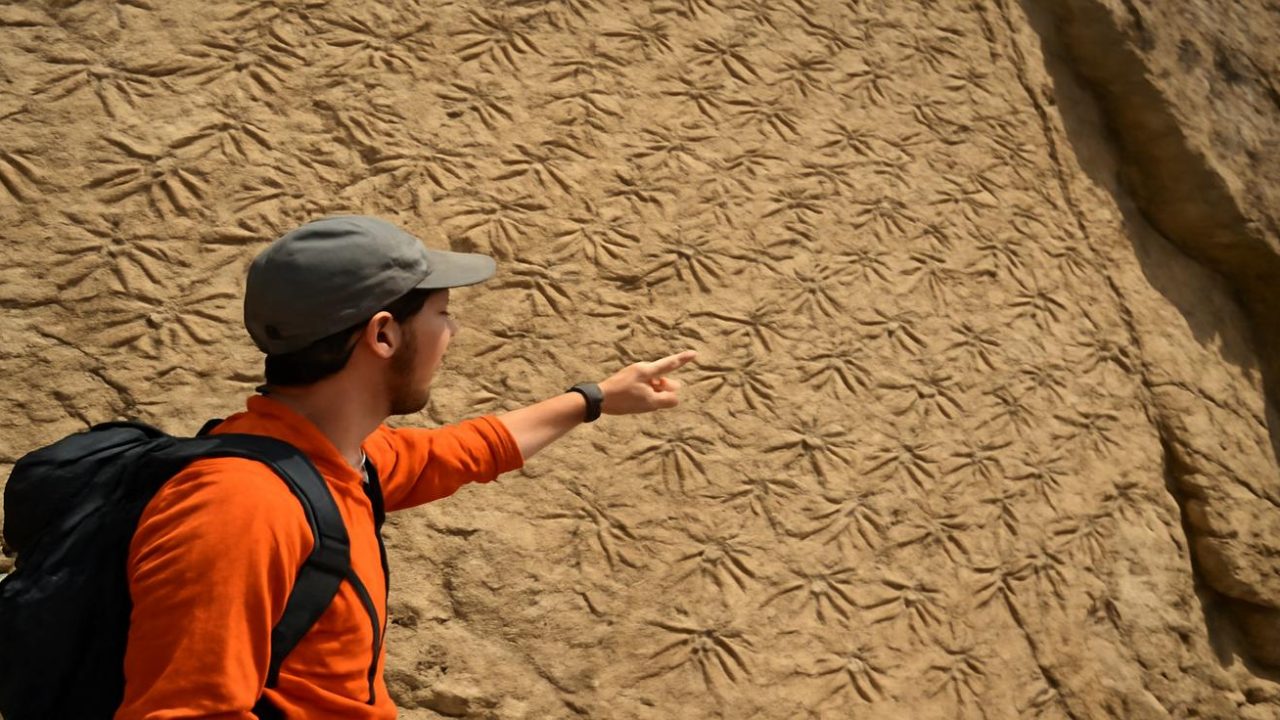
Rock climbers scaling a limestone cliff in Italy made an extraordinary discovery that has captivated paleontologists worldwide: evidence of what appears to be an 80 million-year-old sea turtle stampede preserved in stone.
The discovery happened by chance when a climber paused mid-route, noticing strange patterns beneath his fingertips. What looked like broad, shallow impressions marching diagonally across the cliff face turned out to be ancient trackways from the Late Cretaceous period.
Scientists are calling this one of the strangest fossil trackways they’ve ever encountered, offering a rare glimpse into a chaotic moment when dozens, possibly hundreds, of ancient sea turtles fled across the seafloor in apparent panic.

How Climbers Uncovered Ancient History
The limestone wall that draws modern climbers was once the bottom of a warm, shallow sea. During the Late Cretaceous period, 80 million years ago, this Italian valley lay submerged under water similar to today’s Mediterranean lagoons.
When the first climber spotted the unusual patterns, they appeared as overlapping oval and triangular impressions scattered across the rock face. Some tracks overlapped others, suggesting rapid, simultaneous movement of multiple large creatures.
Within days, word spread through the climbing community. A local geologist hiked out to examine the site, and within months, researchers were studying what would become recognized as an exceptional paleontological find.

The cliff face itself tells the story of dramatic geological change. Every layer of limestone represents sediment that once settled quietly on the ancient seafloor. The pockets and ledges that climbers now use for handholds were carved by millions of years of water dissolution and geological transformation.
What the Ancient Sea Turtle Stampede Reveals
The trackway patterns suggest a sudden, coordinated flight response among marine turtles of various sizes. Some of these ancient creatures may have been as large as dining room tables, while others were smaller and more streamlined than modern sea turtles.
The preserved tracks show the turtles’ broad, paddle-like flippers pushing through fine sediment as they moved rapidly in roughly the same direction. The overlapping nature of the impressions indicates this wasn’t leisurely movement, but rather a mass exodus triggered by some unknown threat.

Scientists can only speculate about what caused this ancient panic. Potential triggers include:
- Sudden appearance of a large predator
- Dramatic shift in ocean currents
- Underwater storm surge
- Seismic activity or underwater landslide
- Shockwaves from distant geological events
The preservation of these tracks required perfect timing. The turtles’ movement had to occur when the seafloor sediment was just the right consistency to capture detailed impressions, and burial had to happen quickly enough to prevent currents from erasing the evidence.
Why This Discovery Matters for Paleontology
Fossil trackways like this are exceptionally rare because they require very specific conditions for preservation. Unlike bones or shells, which can fossilize under various circumstances, behavioral evidence like tracks needs immediate protection from erosion and disturbance.

This site provides insights into ancient marine ecosystems that skeletal fossils alone cannot offer. The trackways reveal information about:
- Group behavior patterns in ancient sea turtles
- Population density in Cretaceous marine environments
- Predator-prey relationships 80 million years ago
- Environmental conditions on the ancient seafloor
| Aspect | Evidence from Trackways | Scientific Significance |
|---|---|---|
| Turtle sizes | Various track dimensions | Shows diverse species coexisted |
| Movement direction | Consistent orientation | Indicates coordinated response |
| Speed of movement | Deep, overlapping impressions | Suggests rapid, urgent locomotion |
| Seafloor conditions | Clear track preservation | Reveals sediment consistency and environment |
The discovery also highlights how dramatically Earth’s geography has changed. The Italian mountains where climbers now practice their sport were once covered by hundreds of feet of warm seawater, supporting complex marine ecosystems completely different from today’s terrestrial environment.
The Intersection of Recreation and Science
This discovery demonstrates how outdoor recreation can unexpectedly contribute to scientific knowledge. Rock climbers, with their intimate contact with cliff faces and keen attention to surface details, are uniquely positioned to spot geological anomalies that might otherwise go unnoticed.

The climbing community’s quick recognition of the find’s potential importance led to rapid scientific involvement. Rather than dismissing the unusual patterns, climbers documented their observations and contacted experts, ensuring the site could be properly studied.
Similar discoveries have occurred worldwide when outdoor enthusiasts encounter unexpected geological features. Hikers, climbers, and cavers often serve as informal field observers, extending the reach of scientific research into remote or specialized locations.
What Scientists Plan to Study Next
Researchers are now conducting detailed analysis of the trackway site to extract maximum information from this rare find. Future studies will likely focus on precise measurement and mapping of individual tracks to better understand the species involved and their behavior patterns.

Advanced imaging techniques may reveal additional details about the ancient environment, including sediment composition, water depth, and seasonal conditions when the tracks were made. Chemical analysis of the limestone could provide insights into ocean chemistry during the Late Cretaceous period.
The site’s accessibility to climbers also raises questions about conservation and protection. Balancing continued recreational use with preservation of this significant paleontological resource will require careful management and ongoing collaboration between the climbing community and scientists.
This discovery adds to growing evidence that the Late Cretaceous period featured rich, complex marine ecosystems with sophisticated animal behaviors. Each new find helps scientists piece together a more complete picture of life on Earth during this crucial period in evolutionary history.

Frequently Asked Questions
How did rock climbers recognize these tracks as fossils?
A climber noticed unusual patterns of broad, shallow impressions that looked like overlapping footprints marching across the cliff face, which seemed too organized to be natural rock formations.
Why are 80 million-year-old sea turtle tracks so rare?
Fossil trackways require perfect preservation conditions where sediment captures detailed impressions and gets buried quickly before currents can erase the evidence.
What size were these ancient sea turtles?
Based on the track evidence, some ancient marine turtles were as large as dining room tables, while others were smaller and more streamlined than modern species.

What might have caused the sea turtle stampede?
Scientists speculate it could have been a sudden predator, current shift, storm surge, underwater landslide, or seismic activity, but the exact trigger remains unknown.
How did a cliff in Italy used to be underwater?
During the Late Cretaceous period 80 million years ago, this area was covered by warm, shallow seas before geological processes lifted it to form the current mountain landscape.
Will this discovery change how we understand ancient marine life?
The trackways provide rare behavioral evidence showing coordinated group responses in ancient sea turtles, offering insights that skeletal fossils alone cannot provide.











Leave a Comment