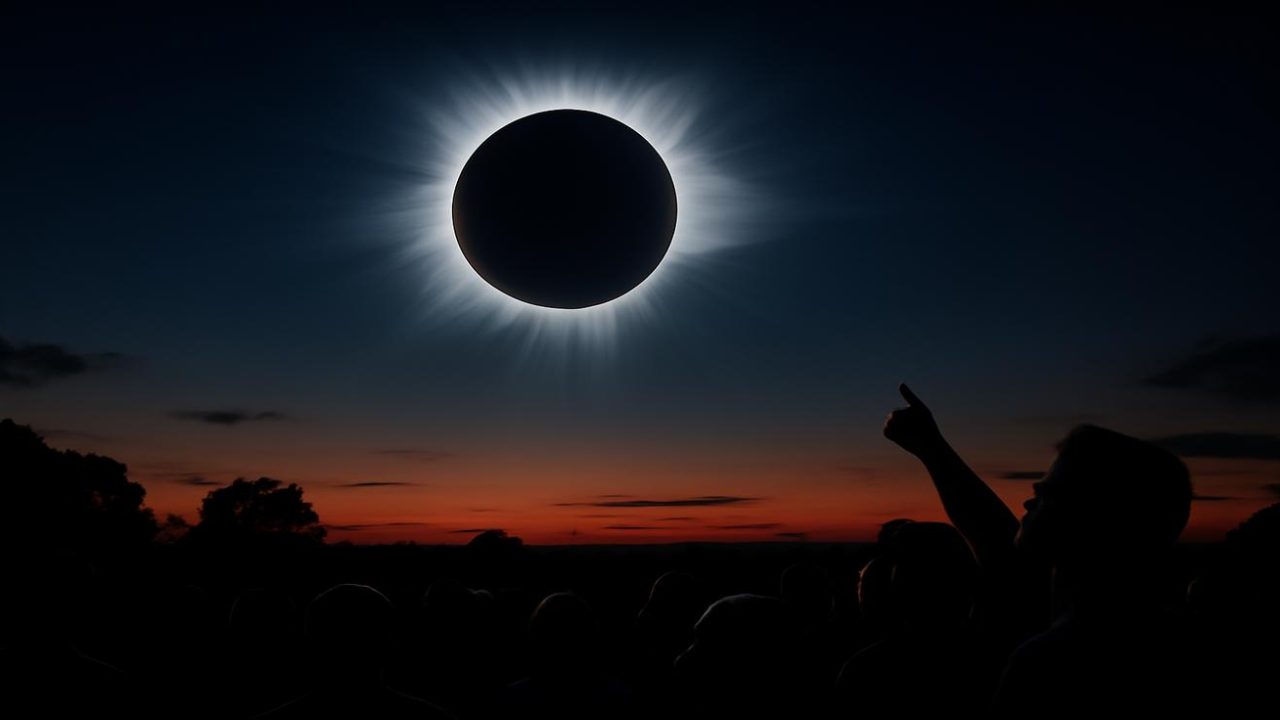
The longest total solar eclipse of the century will sweep across large parts of the globe, transforming day into night as the Moon’s shadow races across Earth’s surface faster than a jetliner. This rare celestial event will create a narrow corridor of totality where the Sun will be completely obscured, while millions outside that path will witness a partial eclipse.
The experience begins subtly—a small bite appears on the Sun’s edge, like a smudge on a bright coin. But within minutes, this astronomical alignment will trigger profound changes that affect not just what we see, but what our bodies feel and how animals behave around us.
From deserts to dense cities, from remote tundras to tourist-packed beachfronts, communities along the path of totality will pause their daily routines to witness this cosmic ballet that reminds us we live on a small, moving rock in space.

How the Moon’s Shadow Creates an Artificial Night
The eclipse’s path will carve a dark river of totality across the Earth’s surface—a narrow corridor where the Moon will completely cover the Sun. Outside this track, millions will still observe a partial eclipse, with the Sun appearing as a crescent shape.
Astronomers can chart the shadow’s route down to the kilometer and predict the exact minutes and seconds of totality for any given location. This precision serves an astonishing fact: despite their vastly different sizes and distances, the Sun and Moon align almost perfectly from our vantage point on Earth.
The eclipse begins as orbital mechanics play out in real time. People will step out of offices, leave café tables, and pause at farm fields and fishing docks, holding eclipse glasses to witness the first tangible sign that something enormous and ancient is unfolding.

Schools will schedule special viewing times, observatories will open their doors wide, and small clusters of people will gather on balconies, in parking lots, on riverbanks, and hilltops with cardboard glasses, pinhole projectors, and filtered telescopes.
The Physical Sensations of Totality
Long before totality arrives, human bodies will sense something is fundamentally wrong with the day. Even without looking up, skin, eyes, and ears will send subtle alerts that the normal patterns of daylight have been disrupted.
The light changes first—not disappearing, but becoming oddly incorrect, as if someone has dialed down the saturation on the world. Colors flatten and lose their warm edges. Tree greens and lawn grass turn metallic, while faces take on a faint, theater-like pallor.

Temperature will begin dropping in a quiet, steady cooling similar to what occurs before thunderstorms, even though the sky remains clear and deeply blue. A soft breeze might rise where minutes before the air was still and heavy, causing leaves to flutter with slight unease.
| Physical Changes During Eclipse | When They Occur | What You’ll Notice |
|---|---|---|
| Light quality shifts | First contact | Colors become flat and metallic |
| Temperature drops | Partial phase deepens | Quiet, steady cooling begins |
| Shadows sharpen | Approaching totality | Crescent-shaped shadows appear |
| Wind patterns change | Near totality | Soft breezes arise unexpectedly |
How Animals Respond to the Eclipse
Animals will be among the first to behave strangely as the eclipse progresses. Birds that were actively chattering will fall silent, then burst into confused, half-hearted evening calls typically reserved for dusk.
Some birds will fly toward their roosting sites as if the day has been cut short without explanation. Bees may hurry back to their hives in apparent confusion about the time of day.

Livestock might shift restlessly in fields, sensing the disruption to normal daily rhythms. Near bodies of water, nighttime insects could begin their chittering songs over a sunlit landscape that’s slipping into broad daylight dusk.
These animal behaviors serve as natural indicators of the eclipse’s progression, often alerting humans to changes before they consciously notice them themselves.
The Global Scale of This Solar Eclipse Event
This total solar eclipse represents the longest such event of the century, making it particularly significant for both scientific observation and public experience. The path of totality will cross multiple continents, allowing billions of people to look up together and witness the same cosmic phenomenon.

The eclipse’s duration and geographic scope create unprecedented opportunities for coordinated scientific research. Multiple research teams will position themselves along the path to study the Sun’s corona, atmospheric changes, and animal behavior during totality.
For many observers, this will be a once-in-a-lifetime opportunity to experience totality. The next eclipse of comparable length won’t occur for several decades, making this event particularly precious for both amateur astronomers and casual observers.
The global nature of this eclipse also means that social media and communication networks will be flooded with real-time observations, creating a shared human experience that spans continents and time zones.

What to Expect During the Peak Moments
As totality approaches, shadows will become increasingly sharp and defined. Looking at the ground beneath leafy trees or between fingers will reveal crescent-shaped shadows—projections of the partially eclipsed Sun.
The final moments before totality bring the most dramatic changes. The temperature drop becomes more pronounced, and an eerie twilight spreads across the landscape despite the clear sky overhead.
During the brief minutes of totality, the Sun’s corona becomes visible as a shimmering halo around the Moon’s silhouette. Stars may appear in the darkened sky, and the horizon glows with colors similar to sunset in all directions.
The return of sunlight happens suddenly and dramatically. A brilliant flash marks the end of totality as the Sun’s edge emerges from behind the Moon, instantly restoring normal daylight and ending the celestial spectacle.
Frequently Asked Questions
How long will the total solar eclipse last?
The duration of totality varies by location along the path, but this eclipse is notable for being the longest of the century, with some areas experiencing several minutes of total darkness.
Is it safe to look directly at the eclipse?
Special eclipse glasses or proper solar filters are required to safely view the eclipse. Only during the brief moments of totality is it safe to look directly at the corona without protection.

Will the temperature really drop noticeably during the eclipse?
Yes, the source material confirms that temperatures will drop in a quiet, steady cooling similar to what occurs before thunderstorms, even with clear skies.
Why do animals behave strangely during eclipses?
Animals rely on natural light patterns to regulate their behavior. The gradual dimming and return of light confuses their internal clocks, causing them to exhibit evening behaviors during daytime.
How fast does the Moon’s shadow move across Earth?
The shadow races across Earth’s surface faster than a jetliner, allowing astronomers to predict its exact path and timing for any location.
Will this eclipse be visible as a partial eclipse outside the path of totality?
Yes, millions of people outside the narrow path of totality will still see a partial eclipse, where the Sun appears as a crescent shape rather than being completely obscured.









Leave a Comment