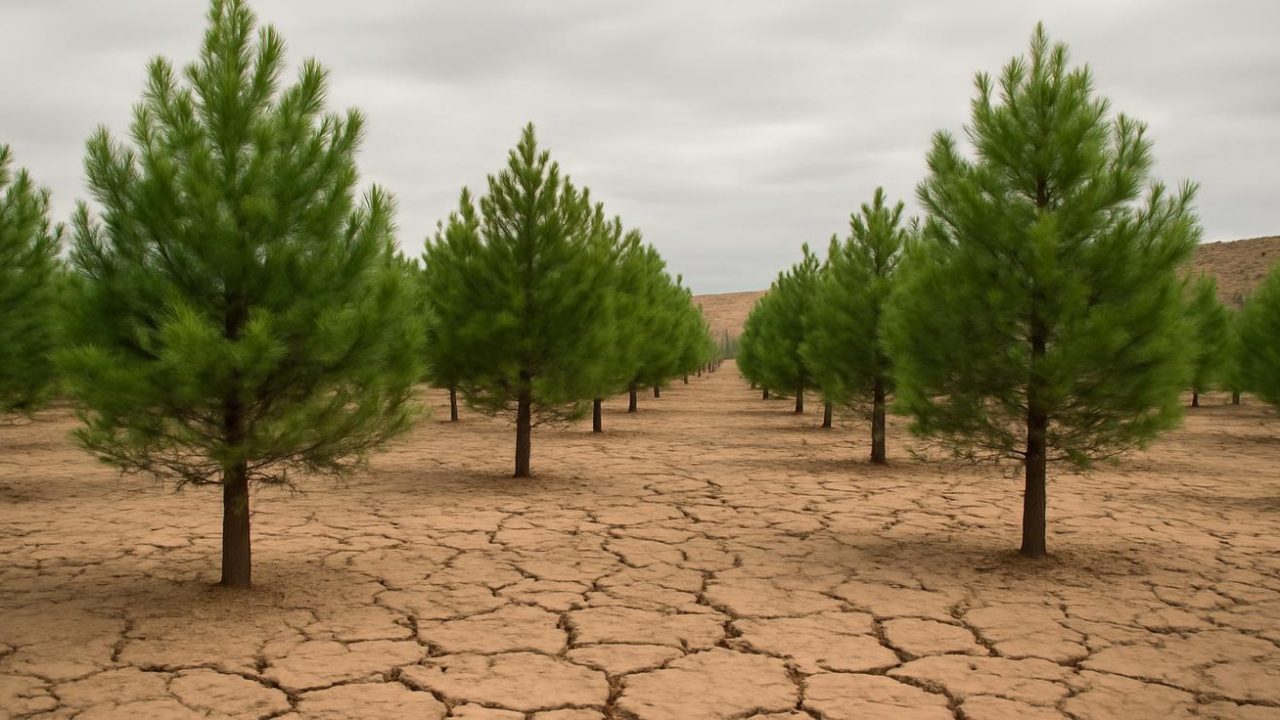
China has planted more than a billion trees across its northern deserts over four decades in one of the world’s most ambitious environmental campaigns. The massive reforestation effort, known as the Three-North Shelterbelt Program, has successfully reduced sandstorms reaching Beijing and slowed desert expansion in many areas.
But scientists studying the project’s long-term effects are discovering an uncomfortable truth: the cure for desertification may be quietly damaging the very ecosystems it was designed to protect.
The warning signs are appearing beneath the surface, where thirsty tree roots are draining groundwater and disrupting delicate dryland ecosystems that have evolved over thousands of years to survive on minimal water.

The Great Green Wall: China’s Desert Battle Plan
Since the late 1970s, China has been attempting to redraw its environmental map with what officials call a “Great Green Wall” of trees. The goal sounds almost mythic: create a massive forest barrier across the country’s arid north to stop the Gobi Desert from creeping into farmland, cities, and urban air.
From satellite images, the progress looks impressive. Swirls of yellow and tan desert are slowly bordered by new patches of green. Sandstorms that once swept dust all the way to Beijing have become less violent and less frequent by most measurements.
On the ground, the landscape tells a more complex story. Regimented armies of poplars, willows, and pines stand in ruler-straight lines, their trunks wrapped in sun-faded plastic guards, with irrigation tubes snaking between them like black veins.

The scale of the undertaking is staggering. Billions of trees have been planted or sown across vast stretches of Inner Mongolia and northern China’s other arid regions. Some desert edges are holding steady or even retreating, creating what appears to be an environmental success story.
Hidden Life in the “Empty” Desert
The problem with viewing deserts as empty wastelands ready for planting is that they’re not empty at all. What looks like barren sand to passing drivers is actually a functioning dryland ecosystem evolved over millennia.
Desert surfaces are bound together by biological soil crusts made of lichens, mosses, and microscopic algae. These living crusts hold the sand against wind erosion while supporting networks of hardy grasses, shrubs, and flowers that send roots deep into scarce water pockets.

This subtle tapestry feeds beetles, ants, birds, and mammals that move mostly at night, leaving only scattered tracks for morning sun to reveal. When such systems are disturbed through aggressive planting or water diversion, the ecological damage can ripple outward in unexpected ways.
Researchers hiking into older plantation areas have begun finding unsettling evidence: thirsty forests standing over exhausted soil, native shrubs withering in artificial shade, and riverbeds running thinner than historical records show.
The Water Crisis Beneath the Trees
Many of the tree species chosen for the reforestation campaign, especially fast-growing varieties like poplars, function like biological sponges. They pull water from deep underground aquifers and absorb precious rainfall that once seeped slowly through soil to recharge water tables and feed native plants.

The water consumption has measurable consequences. In some areas, scientists have recorded groundwater levels dropping several meters after large-scale tree planting operations. Springs that historically flowed year-round have begun drying up during certain seasons.
| Environmental Impact | Observed Changes |
|---|---|
| Groundwater levels | Dropped several meters in planted areas |
| Sandstorm frequency | Reduced in many regions |
| Desert expansion | Slowed or stopped at some edges |
| Native plant survival | Declining in shade of new forests |
| Seasonal water flow | Previously permanent springs now intermittent |
This water competition creates a cascade of unintended consequences. Native desert plants that have adapted to extract moisture from minimal sources find themselves unable to compete with the aggressive root systems of introduced tree species.
The Ecological Trade-offs Scientists Are Tracking
The tension between stopping desertification and preserving existing ecosystems represents a fundamental challenge in large-scale environmental engineering. While the tree-planting campaign has demonstrably reduced blowing sand and stabilized some desert margins, it has also altered the delicate water balance that desert life depends on.

Biological soil crusts, which take decades to fully develop, can be destroyed during planting operations and may not recover under the changed conditions created by tree cover. The loss of these living surfaces reduces the land’s natural ability to resist wind erosion without human intervention.
The regimented plantation forests also create different habitat conditions than the native ecosystem they replace. While some species may benefit from increased shade and modified microclimates, others that evolved for open desert conditions struggle to adapt.
Desert animals that rely on specific native plants for food and shelter face disrupted migration patterns and breeding cycles when their habitat is converted to tree plantations, even if the overall environmental health of the region appears improved by conventional measures.

Balancing Desert Control with Ecosystem Protection
The discoveries about ecological side effects don’t negate the program’s achievements in reducing sandstorms and slowing desert expansion. Instead, they highlight the complexity of managing landscapes where human needs intersect with natural systems.
The challenge moving forward involves finding approaches that can control desertification without completely transforming existing dryland ecosystems. This might involve more selective planting strategies, greater use of native species, or hybrid approaches that combine reforestation with ecosystem preservation.
Some scientists suggest focusing tree-planting efforts on areas where human activity has already disrupted natural desert systems, while leaving intact dryland ecosystems undisturbed even if they appear “empty” to casual observation.

The water consumption issue may require rethinking which tree species are planted and where irrigation resources are allocated. Native desert shrubs and grasses typically require less water than fast-growing introduced trees, though they may provide less dramatic visual evidence of environmental intervention.
Frequently Asked Questions
How many trees has China planted in its desert reforestation program?
China has planted or sown more than a billion trees since the Three-North Shelterbelt Program began in the late 1970s.
Has the tree-planting program successfully reduced sandstorms?
Yes, sandstorms reaching Beijing have become less violent and less frequent, and some desert edges are holding steady or retreating.

What types of trees are being planted in the desert regions?
The program uses various species including poplars, willows, and pines, with many plantations featuring fast-growing varieties like poplars.
How much have groundwater levels dropped in planted areas?
Scientists have measured groundwater levels dropping several meters in some areas after large-scale tree planting operations.
Are desert ecosystems really alive if they look empty?
Yes, desert surfaces contain biological soil crusts made of lichens, mosses, and algae that support networks of plants and animals adapted to arid conditions.
What happens to native desert plants when trees are planted?
Native shrubs and other desert plants often struggle to survive in the shade of new forests and face competition from tree roots for limited water resources.











Leave a Comment