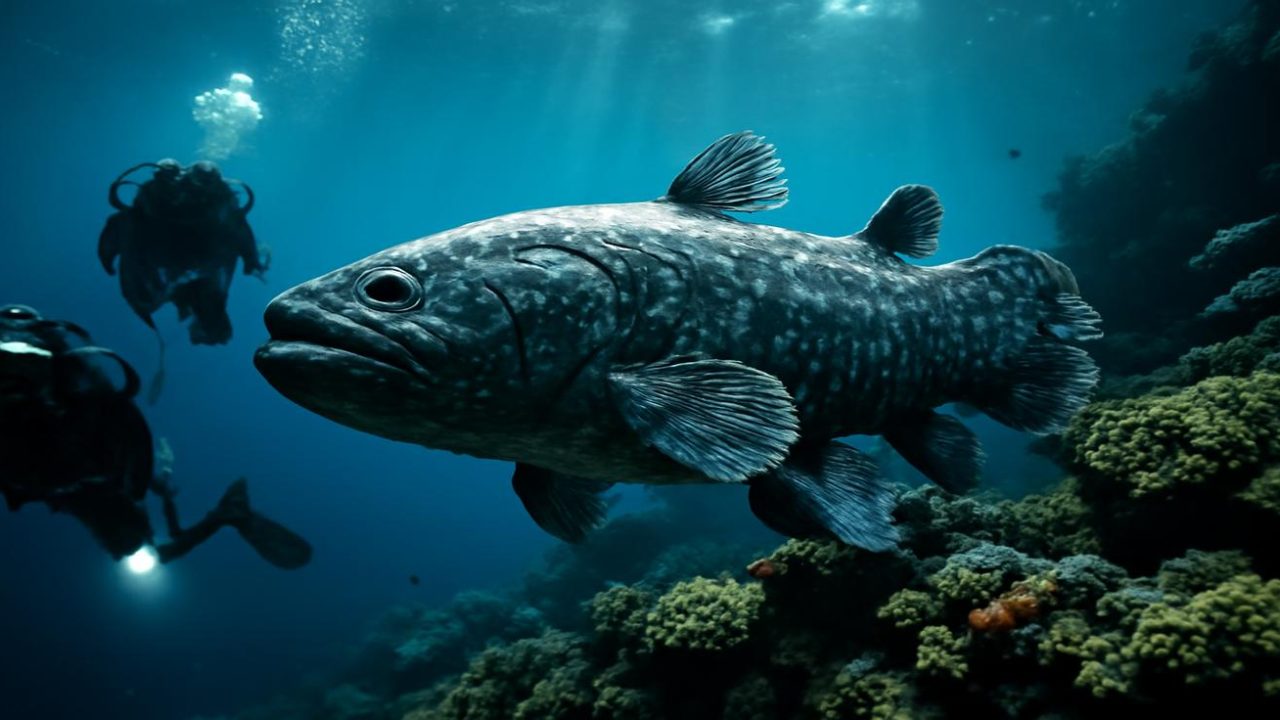
French divers have captured extraordinary footage of one of Earth’s most elusive creatures in Indonesian waters—a coelacanth, the legendary “living fossil” that predates dinosaurs by millions of years. The encounter occurred at depths of 120 meters below the surface, where these ancient fish continue their quiet existence in the ocean’s twilight zone.
The discovery represents a rare glimpse into a world most humans will never see. Coelacanths were thought extinct for 66 million years until a specimen turned up in a South African fishing net in 1938, stunning the scientific community and rewriting our understanding of evolutionary history.
The French diving team’s encounter began with a pair of pale, glassy eyes emerging from the darkness. Their dive lights revealed a fish that seemed to defy time itself—thick, lobe-like fins beneath a scaled body the color of storm clouds, dotted with white markings like constellations.

Why This Ancient Fish Matters More Than You Think
The coelacanth isn’t just another rare species—it’s a direct link to our planet’s distant past. This fish shared the oceans with giant marine reptiles, witnessed the extinction of dinosaurs, and survived every mass extinction event Earth has experienced.
What makes coelacanths truly remarkable is their unique anatomy. Their fins rotate in a walking motion similar to four-legged animals, offering scientists crucial insights into how life transitioned from water to land hundreds of millions of years ago.
Most marine biologists go entire careers without seeing a living coelacanth in its natural habitat. The fish prefers depths beyond recreational diving limits, in the mesophotic zones where sunlight never penetrates and pressure would crush unprotected humans.

The Indonesian waters where this encounter occurred are known to local fishermen but rarely explored by researchers. These remote locations, far from tourist maps, harbor some of the ocean’s most ancient secrets.
The Extreme Challenge of Deep-Sea Encounters
Finding a coelacanth requires more than luck—it demands years of technical diving training and careful preparation. The French team spent days searching along steep underwater cliffs where the seafloor drops into abyssal trenches.
At 120 meters depth, the diving conditions are unforgiving. There’s no natural light, no bright colors—everything exists in muted blues and steel greys. Divers must carry their own illumination, creating narrow cones of light that reveal only fragments of this alien world.
The physical demands are extreme. Each minute spent at such depths requires careful decompression on the way back up, as dissolved gases must slowly escape from the divers’ blood. A single dive can stretch to five hours, with most time spent suspended in the water column during mandatory safety stops.
| Depth Zone | Characteristics | Coelacanth Presence |
|---|---|---|
| 0-40 meters | Bright coral reefs, recreational diving | Absent |
| 40-100 meters | Reduced light, technical diving required | Rare |
| 100+ meters | Complete darkness, extreme pressure | Primary habitat |
What Scientists Learn From Living Fossil Encounters
Every coelacanth sighting provides valuable data about one of evolution’s most important chapters. These fish represent a crucial evolutionary stepping stone, with features that bridge the gap between aquatic and terrestrial life.
Their lobe-like fins contain bone structures similar to the limbs of land animals. Watching a coelacanth move through the water is like observing the slow, deliberate pacing of an ancient four-legged creature—because that’s essentially what it is.

The behavior captured by the French divers shows the coelacanth in its natural element. The fish hovered near rocky outcrops, tilted head-down as if listening to something deep within the earth. Its massive tail moved with thoughtful, languid sweeps—every motion deliberate and ancient.
These observations help scientists understand how these remarkable creatures have survived virtually unchanged for hundreds of millions of years. Their slow metabolism, deep-water habitat, and cautious behavior have allowed them to persist while countless other species vanished.
The Broader Impact on Marine Conservation
Coelacanth discoveries highlight the importance of protecting deep-sea environments that remain largely unexplored. These ancient fish serve as indicators of ocean health in regions where human impact is still minimal.

The Indonesian waters where this encounter occurred represent critical habitat for numerous rare species. Remote locations like these face increasing pressure from commercial fishing, deep-sea mining, and climate change.
Conservation efforts for coelacanths face unique challenges. Unlike shallow-water species that can be easily monitored, these deep-sea dwellers inhabit regions that are expensive and dangerous to access. Each documented encounter becomes crucial for understanding population dynamics and habitat requirements.
The French team’s footage provides not just scientific value but also public awareness. Visual documentation of these living fossils helps communicate the importance of marine conservation to audiences who might never otherwise encounter such creatures.

What This Discovery Means for Future Research
The successful documentation of coelacanths in Indonesian waters opens new possibilities for research in the region. The encounter confirms that viable populations exist in these remote locations, potentially leading to expanded conservation efforts.
Technical diving capabilities continue to improve, allowing researchers to spend more time in the coelacanth’s deep-water domain. Better equipment and longer bottom times mean more opportunities to observe and document these elusive creatures.
The footage captured by the French team will be analyzed frame by frame, providing insights into coelacanth behavior, habitat preferences, and interaction with their environment. Every detail matters when studying a species this rare and evolutionarily significant.

Future expeditions to Indonesian waters will likely build on this success, using the documented location as a starting point for broader surveys of deep-sea biodiversity in the region.
Frequently Asked Questions
How deep do coelacanths typically live?
Coelacanths prefer depths beyond 100 meters, in the mesophotic and deeper zones where sunlight cannot penetrate.
Why are coelacanths called living fossils?
They were thought extinct for 66 million years until rediscovered in 1938, and their anatomy has remained virtually unchanged for hundreds of millions of years.

How rare is it to see a coelacanth in the wild?
Most marine biologists go entire careers without seeing a living coelacanth in its natural habitat due to their deep-water preferences and elusive nature.
What makes coelacanth fins special?
Their lobe-like fins contain bone structures similar to land animal limbs and rotate in a walking motion, providing insights into the transition from water to land.
Where else have coelacanths been found?
The first modern specimen was discovered off South Africa in 1938, and populations have since been documented in various deep-water locations in the Indian Ocean.
How long can technical divers stay at coelacanth depths?
Dives to 120 meters require extensive decompression and can last up to five hours total, with most time spent on mandatory safety stops.









Leave a Comment