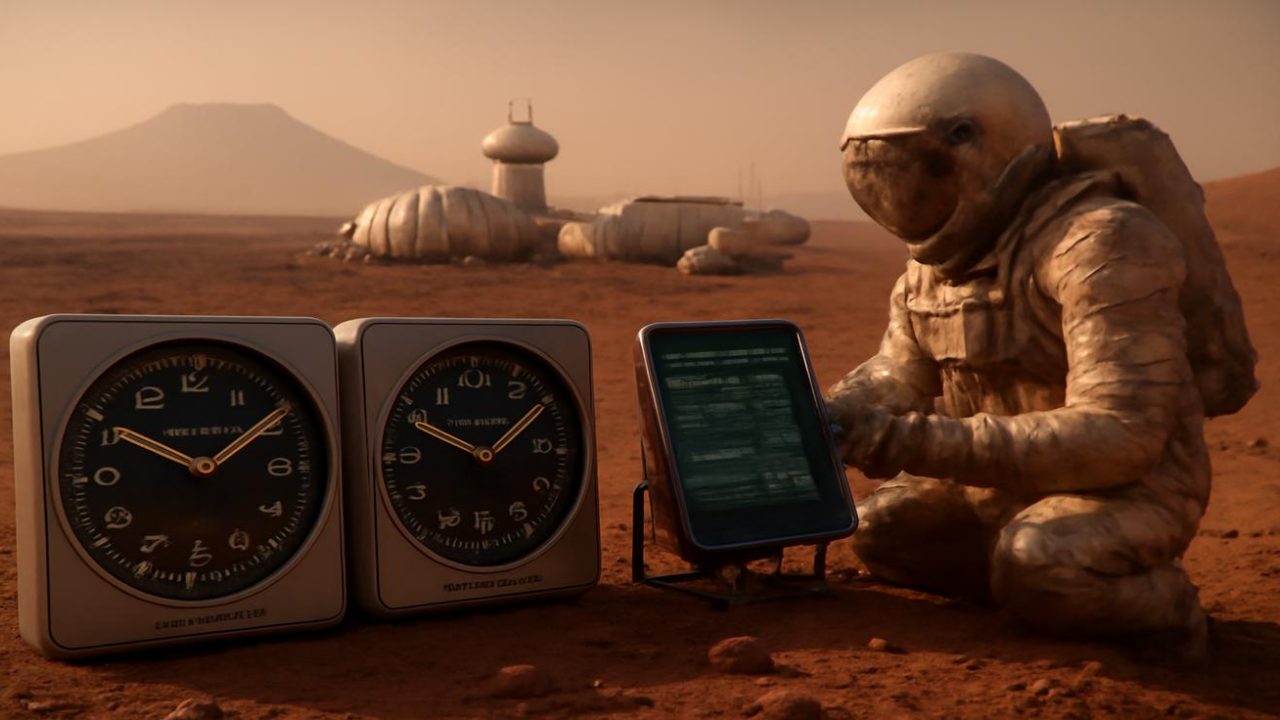
Time flows differently on Mars than it does on Earth — and Albert Einstein’s century-old theory of relativity is finally being confirmed by the Red Planet’s rovers and orbiters in ways that could reshape how we plan future space missions.
The difference is tiny — measured in nanoseconds and microseconds per day — but as Mars missions become more precise and synchronized, these subtle temporal variations are stepping out of the realm of academic curiosity and into mission-critical territory. When spacecraft are screaming into Mars’ thin atmosphere at over 20,000 kilometers per hour, the difference between a safe landing and creating a new crater can come down to fractions of a second in signal timing.
What mission engineers are discovering is that Mars doesn’t just have a different day length — its fundamental relationship with time itself differs from Earth’s.

Einstein’s Equations Are Already in Mission Control
More than a century ago, Einstein revolutionized our understanding of time by showing it isn’t the rigid, universal constant we once believed. His theory revealed that time stretches and bends based on gravity and motion — where gravity is stronger, time runs slower, and where it’s weaker, time moves faster.
Mars, roughly half the size of Earth, has significantly weaker gravity at about 38% of what you experience right now. This gravitational difference means that time on Mars flows at a slightly different rate than on Earth — your seconds would be imperceptibly longer on the Red Planet.
For decades, this remained mostly theoretical for planetary scientists. But as orbiters, landers, and rovers coordinate with unprecedented precision, a subtle but consistent pattern has emerged: Martian time doesn’t just shift due to the planet’s 24-hour-39-minute day cycle — it actually drifts relative to Earth time.

Recent missions have confirmed what Einstein’s relativity predicted all along. When spacecraft time signals, atomic clocks, and Earth-based tracking systems are synchronized within tight parameters, the temporal drift becomes measurable and consistent.
The Practical Challenge of Martian Time Drift
Mars has always presented timing challenges for mission teams. The planet’s sol — its day length of 24 hours and 39 minutes — has forced Earth-based teams to completely rewire their schedules during critical operations. Some mission teams literally live on “Mars time,” with their clocks, meals, and sleep shifting 39 minutes later each Earth day.
But the relativistic time drift adds another layer of complexity. Engineers are now noticing that even freshly synchronized clocks begin showing discrepancies that accumulate over weeks and months, like grains of red dust quietly building up on a solar panel.

The phenomenon manifests in mission control rooms where tired engineers squint at timing logs, comparing Earth-based atomic clocks with rover internal chronometers that were synchronized just weeks earlier, only to find they’ve drifted apart by measurable amounts.
| Time Factor | Earth | Mars | Difference |
|---|---|---|---|
| Day Length | 24 hours | 24 hours 39 minutes | +39 minutes |
| Gravity | 9.8 m/s² | 3.7 m/s² | 38% of Earth’s |
| Relativistic Time Flow | Standard reference | Microseconds faster per day | Accumulates over time |
Why This Matters for Future Mars Missions
The timing precision requirements for Mars missions are becoming increasingly demanding. Current rovers and orbiters must coordinate complex maneuvers, from atmospheric entry sequences to synchronized orbital communications windows. Future missions will likely require even tighter coordination.
Consider the challenge: when mission controllers on Earth send a command to a Mars rover, they’re not just accounting for the 4-to-24-minute communication delay depending on planetary positions. They must also factor in the subtle but persistent drift between Earth time and Mars time that accumulates due to relativistic effects.

For human missions to Mars — still years away but actively planned — this temporal drift could affect everything from life support system synchronization to emergency response protocols. Astronauts living on Mars for months or years would experience time flowing at a slightly different rate than their Earth-based support teams.
The implications extend beyond individual missions. As we establish permanent infrastructure on Mars — communication networks, navigation systems, and eventually human settlements — maintaining precise time synchronization with Earth becomes a fundamental engineering challenge.
The Technical Reality of Interplanetary Timekeeping
To understand the practical impact, imagine two friends starting perfectly synchronized stopwatches — one heads up a mountain while the other stays in a valley. When they reunite, their watches will have drifted slightly due to the gravitational difference. Now scale that concept to interplanetary distances with one “friend” on Earth and another on Mars, never meeting again but needing to coordinate complex operations across space.

Mission planners are developing new protocols to account for this drift. Instead of assuming universal time synchronization, future missions will likely incorporate relativistic time corrections as standard operating procedure, much like how GPS satellites already account for Einstein’s effects to maintain accuracy.
The challenge becomes more complex when considering that Mars missions don’t operate in isolation. They must coordinate with Earth-based tracking stations, orbital relay satellites, and other spacecraft — each potentially experiencing slightly different temporal flows based on their gravitational environment and motion.
What This Means for Space Exploration’s Future
The confirmation of Einstein’s predictions on Mars represents more than just scientific validation — it marks a new phase in space exploration where relativistic effects transition from theoretical considerations to practical engineering requirements.

Future Mars missions will need to build relativistic time corrections into their fundamental systems architecture. This includes everything from navigation computers that account for temporal drift to communication protocols that adjust for the accumulating time differences between planets.
As space agencies plan for eventual human settlements on Mars, they’re grappling with questions that would have seemed like science fiction just decades ago: How do you maintain synchronized systems across planets where time itself flows differently? How do you coordinate emergency responses when the very fabric of time is operating at different rates?
The solutions being developed for Mars will likely inform missions to other destinations where gravitational differences create similar temporal challenges. Each celestial body presents its own relativistic signature that future explorers will need to account for.

Frequently Asked Questions
How much faster does time flow on Mars compared to Earth?
The difference is extremely small — measured in nanoseconds and microseconds per day — but it accumulates over time due to Mars’ weaker gravity.
Do current Mars rovers experience timing problems because of this?
Engineers have noticed timing drift in synchronized systems, with clocks that were matched weeks earlier showing measurable differences that require periodic corrections.
How will this affect future human missions to Mars?
Astronauts on Mars would experience time flowing at a slightly different rate than Earth-based support teams, requiring new protocols for coordinating life support systems and emergency responses.

Is this the same effect that GPS satellites experience?
Yes, it’s the same relativistic principle — GPS satellites already incorporate Einstein’s time corrections to maintain accuracy, and Mars missions will need similar adjustments.
Will this make Mars missions more difficult?
It adds complexity but isn’t insurmountable — mission planners are developing protocols to account for relativistic time drift as standard procedure for future Mars operations.
Does this affect communication between Earth and Mars?
Beyond the existing 4-to-24-minute delay based on planetary positions, the temporal drift creates an additional layer of timing considerations that must be factored into communication protocols.









Leave a Comment