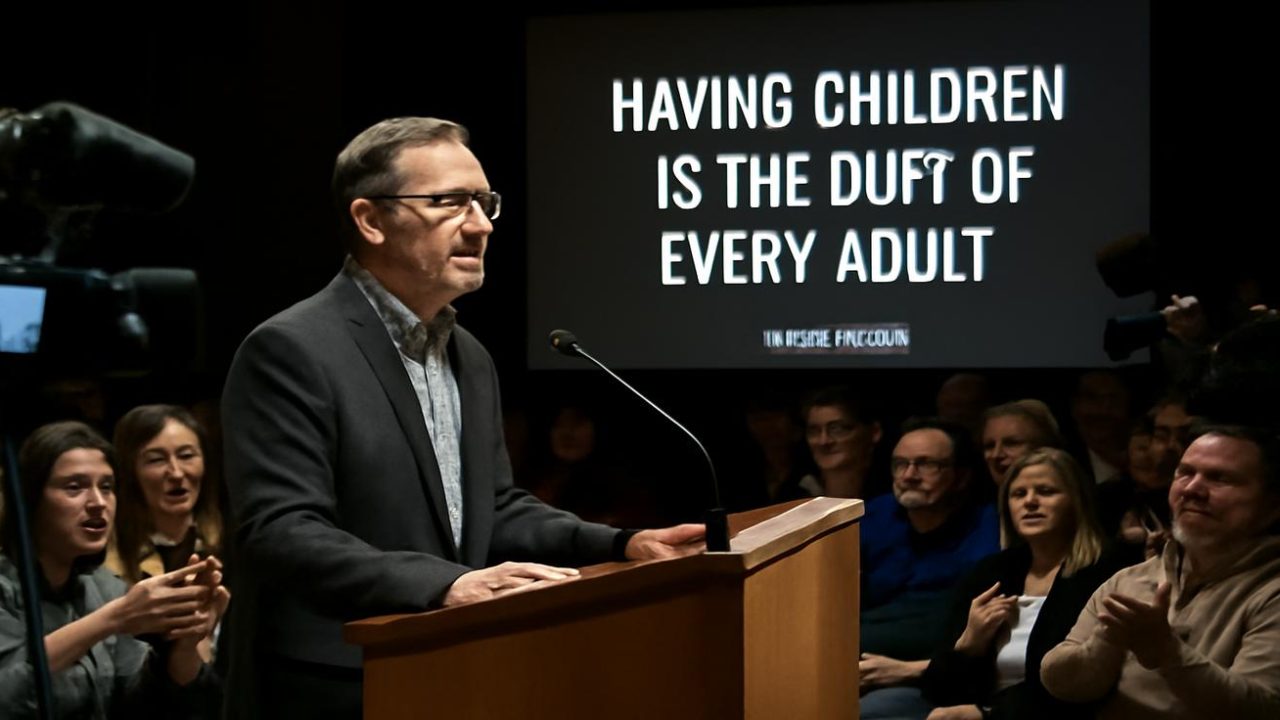
A psychologist’s televised statement that childfree couples should “have no right to expect support in old age” and “pay extra taxes instead of burdening other people’s children” has ignited a fierce debate about social responsibility, generational support, and who owes what to whom in modern society.
The controversial remarks, delivered during a studio interview, have sparked immediate and polarized reactions across social media platforms and comment sections. Parents in some circles applauded the statement as validation of their sacrifices, while childfree adults expressed outrage at being labeled as burdens on society.
The debate cuts to the heart of fundamental questions about social contracts, mutual dependence, and how societies should structure support systems for aging populations.

The Statement That Sparked Nationwide Controversy
The psychologist’s remarks were engineered for maximum impact: sharp enough to provoke, simple enough to share widely. The core argument suggests that people who choose not to have children are essentially freeloading on a system supported by other people’s offspring.
According to this view, today’s workers—many of them someone’s children—fund the pensions, healthcare, and infrastructure that support elderly populations, including those who never raised kids of their own. The implication is that without producing future taxpayers, childfree individuals are unfairly benefiting from others’ contributions to society.
The reaction was swift and intense. Comment feeds filled with accusations and counter-accusations, with terms like “selfish,” “entitled,” “ungrateful,” and “irresponsible” flying in both directions.

What “Burden” Actually Means in Modern Society
The word “burden” carries significant weight in this debate, but the reality of who contributes what to society is far more complex than the psychologist’s framing suggests.
Childfree couples typically contribute to society through various channels that don’t appear in simple generational accounting. They pay income tax, sales tax, social security tax, and property tax. These taxes help fund maternity wards, playgrounds, and public schools they’ll never personally use.
Modern societies function as interconnected webs of mutual dependence. The children raised by others will eventually staff the hospitals, delivery services, and utilities that childfree people depend on in their later years. Meanwhile, the taxes paid by childfree individuals help support the infrastructure that benefits families with children.

Economists point out that this creates a shared system where everyone both contributes to and benefits from collective resources, even if the contributions and benefits don’t always align perfectly for each individual.
How Contributions and Benefits Actually Flow
The real picture of who pays what and receives what benefits is more nuanced than the viral statement suggests:
| Group | Typical Contributions | Typical Benefits |
|---|---|---|
| Parents | Raising future taxpayers, time, resources, education costs | Tax deductions, child benefits, school services |
| Childfree Adults | Higher lifetime tax payments, volunteer work, economic productivity | Social security, healthcare, infrastructure |
| Society Overall | Collective infrastructure, healthcare systems, education | Economic growth, social stability, mutual support |
This framework reveals that both groups make significant contributions to society, just in different ways. The question isn’t whether childfree people contribute—they clearly do—but whether their contributions are equivalent to those who raise children.

The Economics Behind the Emotional Debate
Beyond the heated rhetoric lies a genuine economic question about how aging societies should structure their support systems. Many developed countries face demographic challenges as birth rates decline and populations age.
The traditional model assumes that each generation of workers supports the previous generation through taxes and social security contributions. When fewer children are born, this model faces pressure as fewer workers support more retirees.
However, the solution isn’t necessarily as simple as penalizing the childfree. Alternative approaches might include:

- Recognizing non-parental contributions to society through caregiving, mentorship, and community service
- Adjusting tax structures based on total lifetime contributions rather than just parental status
- Investing in productivity improvements that reduce the need for larger workforces
- Creating more flexible support systems that account for diverse life choices
Why This Debate Matters Beyond Social Media
The controversy reflects deeper tensions about changing family structures, economic pressures, and social expectations. As more people choose to remain childfree—whether by choice or circumstance—societies must grapple with how to maintain mutual support systems.
The debate also reveals assumptions about what constitutes valuable contributions to society. While raising children clearly benefits future generations, other forms of contribution—from caring for aging parents to mentoring young people to supporting community organizations—also create social value.
Rather than viewing this as a zero-sum competition between parents and the childfree, the discussion might be better framed around how different types of contributions can be recognized and valued within existing social systems.

The psychologist’s statement, while provocative, oversimplifies a complex issue that requires more nuanced solutions than simply penalizing one group or another.
Frequently Asked Questions
What exactly did the psychologist say about childfree couples?
The psychologist stated that childfree couples should “have no right to expect support in old age” and should “pay extra taxes instead of burdening other people’s children.”
Do childfree people actually pay fewer taxes than parents?
Childfree individuals typically pay the same tax rates as parents and don’t receive child-related tax deductions, often resulting in higher lifetime tax contributions.

How do modern social security systems actually work?
Current workers fund current retirees through payroll taxes, creating a system where each generation supports the previous one regardless of individual parental status.
What are the main arguments on both sides of this debate?
Supporters argue that parents invest in future taxpayers who will support everyone. Critics contend that childfree individuals contribute significantly through taxes and other means.
Are there countries that already tax childfree people differently?
The source material does not provide information about specific tax policies targeting childfree individuals in different countries.

What solutions might address concerns from both sides?
Potential approaches include recognizing diverse contributions to society, adjusting tax structures based on total lifetime contributions, and creating more flexible support systems that account for different life choices.











Leave a Comment