Scientists exploring the depths beneath Antarctic ice weren’t looking for a metropolis when they lowered their cameras through the Weddell Sea. They were studying ocean currents and chemistry, expecting to find a quiet, nearly empty seafloor more than 400 meters below the frozen surface.
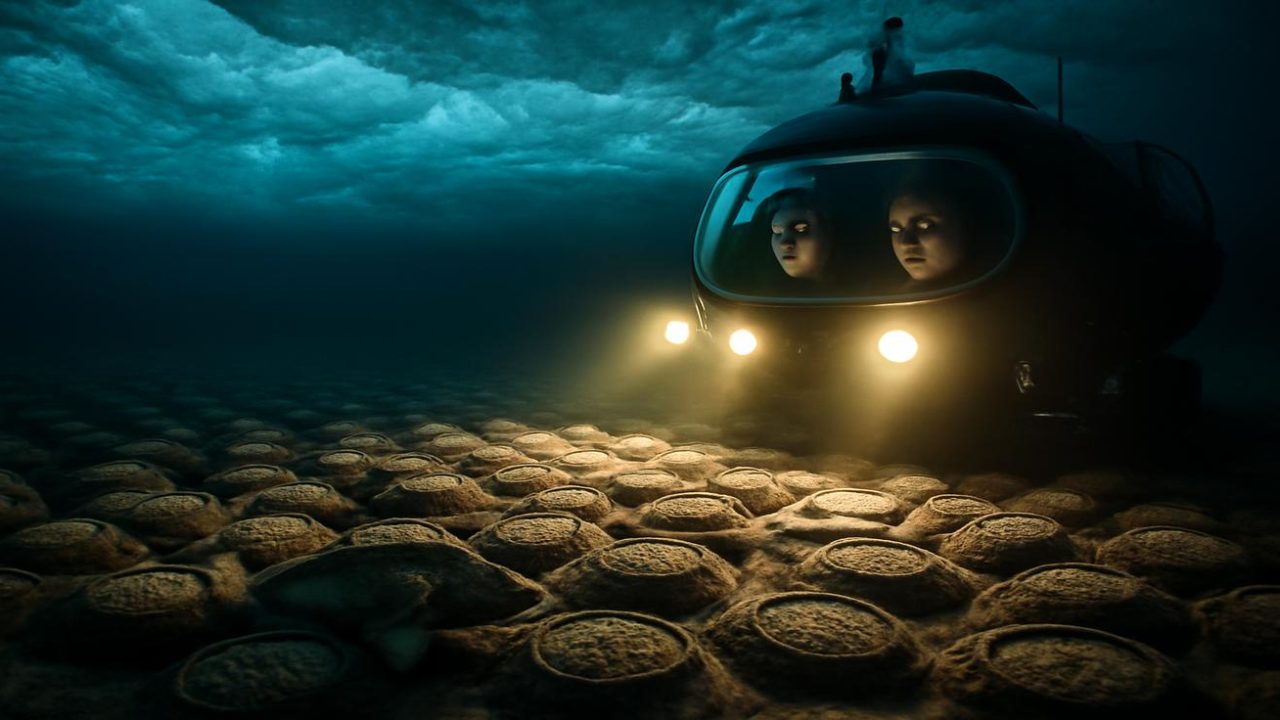
Instead, their screens filled with thousands of perfect circles scattered across the seabed like craters on an alien landscape. The research team had accidentally discovered what appears to be the world’s largest known fish breeding colony—a vast underwater city of nests stretching across hundreds of square kilometers.
The discovery has rewritten scientists’ understanding of life in one of Earth’s most extreme environments, revealing a thriving ecosystem where researchers expected barren ocean floor.

An Underwater Metropolis Hidden Beneath the Ice
The nests belong to Antarctic icefish—pale, ghostly creatures uniquely adapted to survive in water cold enough to freeze the blood of most other animals. These remarkable fish lack red blood cells entirely, instead carrying oxygen dissolved directly in their clear plasma.
Each nest appears as a carefully constructed shallow bowl scooped into the soft, gray-brown sediment of the seafloor. Many contain a single fish hovering protectively over a clutch of pale eggs, while others are ringed with pebbles and small stones in what looks like deliberate landscaping.
The nests appear so regularly that they transform the seafloor into a living pattern, spaced just a few meters apart across the vast underwater plain. The geometric precision suggests a level of organization and intention that challenges previous assumptions about fish behavior in extreme environments.

What started as a routine scientific expedition became a moment of stunned discovery as the camera feed revealed nest after nest, stretching far beyond what the team could have imagined.
The Scale of Discovery Defied All Expectations
Initial field estimates suggested the colony contained well over 20,000 nests. But as researchers conducted more careful mapping and analysis, that number exploded into something almost absurd—likely more than a million nests spread across an area that dwarfs any previously known fish breeding site.
| Discovery Metrics | Scale |
|---|---|
| Depth below ice surface | More than 400 meters |
| Initial nest count estimate | Over 20,000 nests |
| Revised estimate after analysis | Likely over 1 million nests |
| Colony coverage area | Hundreds of square kilometers |
| Nest spacing | Every few meters |
| Individual nest size | Width of a large dinner plate |
This isn’t just a lucky cluster of nests. The discovery represents an ecosystem-scale phenomenon that somehow remained hidden in one of the most studied oceans on Earth.

Previous knowledge of Antarctic icefish suggested they lived solitary lives, with individual nests occasionally spotted like cottages on an empty landscape. No one expected to find the equivalent of a sprawling underwater city.
How Antarctic Fish Build Their Underwater Neighborhoods
Each nest represents a small but deliberate act of construction. Individual icefish scoop out shallow depressions in the seafloor sediment, creating bowls about the width of a large dinner plate. Inside these carefully crafted spaces, they arrange and guard scores of pale eggs.
The architectural precision is striking. Many nests are bordered with pebbles and small stones, suggesting the fish actively landscape their breeding sites. This behavior indicates a level of planning and environmental modification that researchers hadn’t fully appreciated in Antarctic marine life.

The fish themselves blend almost seamlessly with their icy environment. In the harsh white glare of the submersible’s lights, their pale, translucent bodies seem to merge with the cold gloom of the deep ocean. Yet their nests stand out as startling geometric signs of life and parental care in one of Earth’s most extreme environments.
The regular spacing between nests suggests some form of territorial behavior or social organization that maintains order across this vast breeding ground.
Why This Discovery Changes Everything We Thought We Knew
Antarctica has a habit of quietly revealing secrets that reshape scientific understanding, and this discovery fits that pattern perfectly. The research expedition was primarily focused on ocean circulation and climate research—measuring how deep waters of the Weddell Sea move, mix, and carry heat and carbon around the globe.

Their towed camera and sensor platform was essentially an underwater scout, taking continuous images of the seafloor while measuring salinity, temperature, and currents. The massive fish colony was a complete surprise.
The discovery challenges assumptions about life in extreme environments and raises new questions about how such large populations can thrive in conditions previously thought to support only sparse marine life.
The finding also highlights how much remains unknown about Earth’s polar regions, even in areas that scientists consider well-studied. If a breeding colony of this magnitude can exist undetected beneath Antarctic ice, what other secrets might these remote waters be hiding?

What Scientists Are Learning About Life in Extreme Cold
The icefish themselves represent one of evolution’s most remarkable adaptations to extreme cold. Their lack of red blood cells—a trait that would be fatal to most vertebrates—allows them to thrive in sub-freezing waters where other fish cannot survive.
Instead of hemoglobin carrying oxygen through red blood cells, these fish rely on oxygen dissolved directly in their clear blood plasma. This adaptation, combined with their pale, almost ghostly appearance, makes them perfectly suited to life in the perpetual cold and darkness beneath Antarctic ice.
The discovery of such a massive breeding colony suggests these fish have developed complex social and reproductive behaviors that scientists are only beginning to understand. The scale and organization of the nesting site indicates a level of coordination that researchers hadn’t previously documented in Antarctic marine life.

The colony also represents a significant biomass concentration in what was thought to be a relatively sparse ecosystem, potentially reshaping understanding of food webs and energy flows in Antarctic waters.
Frequently Asked Questions
How did scientists accidentally discover this massive fish colony?
Researchers were studying ocean currents and chemistry in the Weddell Sea when their underwater cameras revealed thousands of circular nests on the seafloor, completely unexpected during what was meant to be routine oceanographic research.
What makes Antarctic icefish so unique?
Icefish lack red blood cells entirely and instead carry oxygen dissolved directly in their clear blood plasma, an adaptation that allows them to survive in water cold enough to freeze the blood of most other animals.

How large is this breeding colony compared to other known fish nesting sites?
Initial estimates suggested over 20,000 nests, but further analysis indicates the colony likely contains more than a million nests spread across hundreds of square kilometers, making it potentially the world’s largest known fish breeding site.
How deep beneath the ice was this colony found?
The nests were discovered more than 400 meters below the frozen surface of the Antarctic sea ice in the remote Weddell Sea.
What do the individual nests look like?
Each nest is a shallow, circular depression scooped into the seafloor sediment, about the width of a large dinner plate, often containing a single fish guarding pale eggs and sometimes bordered with carefully arranged pebbles and stones.
Why hadn’t this colony been discovered before?
The colony exists in one of Earth’s most remote and extreme environments, beneath thick Antarctic sea ice in an area that’s difficult to access and study, demonstrating how much remains unknown about polar marine ecosystems.










Leave a Comment