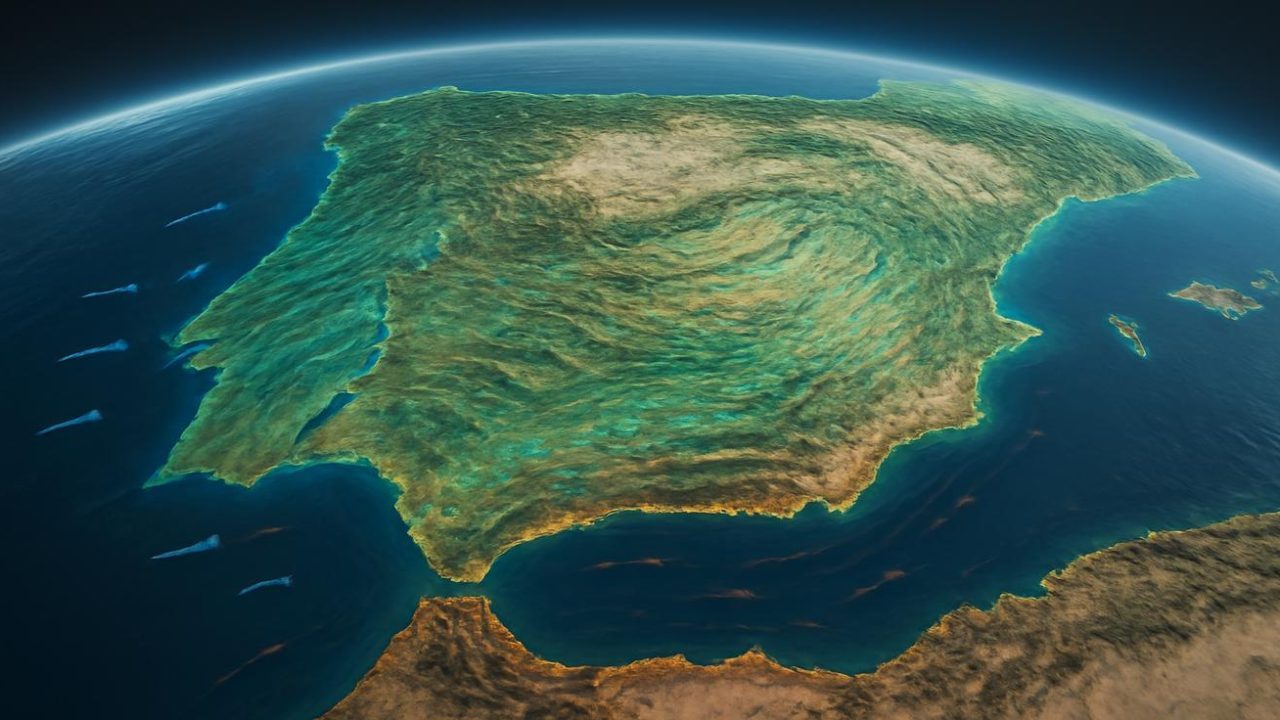
The Iberian Peninsula is rotating counterclockwise at just a few millimeters per year — a geological waltz so slow that human lifetimes can’t perceive it, yet scientists say this imperceptible motion could reshape coastlines and reactivate dormant faults over geological time. The discovery has split the scientific community and public into two distinct camps: those alarmed by the potential long-term consequences and others who dismiss it as an irrelevant curiosity.
Modern GPS networks and satellite measurements have revealed that Spain and Portugal aren’t simply drifting with the Eurasian Plate like the rest of Europe. Instead, the entire landmass appears to be pivoting like a massive stone raft in Earth’s crust, creating stress patterns that could breathe new life into ancient mountain ranges and sleeping fault lines.
The movement is so gradual that you could live ten lifetimes without feeling it. Yet in geology, where millions of years unfold like chapters in a book, these tiny rotations accumulate into significant changes that challenge our understanding of continental stability.

The Slow-Motion Continental Dance Scientists Are Tracking
Beneath the cobblestone streets of Madrid and the whitewashed villages of northern Portugal lies a much older story written in tectonic plates and crushed sediments. The Iberian Peninsula sits squeezed between Africa and Eurasia — the result of a slow-motion collision that gave Europe its alpine backbone and left the region caught between powerful geological neighbors.
Using GPS stations planted throughout the countryside and sensitive seismic instruments, geologists have been quietly assembling a puzzle. The data shows that tiny points on bedrock in Portugal and Spain move differently than reference points elsewhere in Europe and Africa. When scientists compare all that motion, a clear pattern emerges.
The rotation isn’t like a spinning top. Scientists describe it more like watching an enormous ship alter its course by a fraction of a degree across a vast ocean. Over centuries, that tiny angle change would land the ship somewhere completely different.

In Iberia’s case, the rotation changes how stress distributes throughout the crust. Where the plate experiences nudging and twisting, old faults can reactivate. Where stretching occurs, new geological features may emerge over time.
Why This Geological Discovery Splits Scientific Opinion
The controversy centers on a fundamental question that challenges human perception: does something happening on geological timescales matter to current generations? The debate pulls between alarm and indifference, with valid arguments on both sides.
Those expressing concern point to the potential for reactivated fault systems and altered stress patterns in the Earth’s crust. The models suggest that given enough time, these tiny rotations could subtly reshape coastlines and change seismic risk profiles across the region.

Skeptics argue that the timescales involved make this discovery more of an academic curiosity than a practical concern. They compare it to learning that our galaxy is drifting toward another one billions of years from now — scientifically fascinating but irrelevant to human planning.
| Geological Process | Rate of Change | Human Perception |
|---|---|---|
| Iberian Peninsula rotation | Few millimeters per year | Imperceptible across lifetimes |
| Fingernail growth equivalent | Fraction annually, circular motion | Comparable reference scale |
| Continental drift | Similar millimeter scale | Requires instruments to detect |
The challenge lies in reconciling human timescales with geological ones. Our minds instinctively rebel against planning for changes that unfold over millions of years, yet these processes shape the world our descendants will inhabit.
What Makes the Iberian Peninsula Unique
Understanding this continental rotation requires viewing Iberia not as a solid block but as a mosaic of old geological scars. Faults slice quietly beneath olive groves, while mountain belts stitched together from ancient ocean ruins create a complex crustal structure invisible to human eyes.

These geological features record the long history of collision between Africa and Eurasia. The ongoing rotation represents a continuation of forces that have shaped the Mediterranean region for millions of years, but modern technology now allows scientists to measure these changes in real-time.
The peninsula’s position between two major continental plates creates unique stresses. Unlike regions sitting firmly within a single tectonic plate, Iberia experiences complex forces from multiple directions, contributing to its distinctive rotational motion.
Satellite measurements reveal that this isn’t uniform across the entire peninsula. Different regions experience varying rates of rotation and stress, creating a complex pattern that scientists are still working to fully understand.

Real-World Implications for Spain and Portugal
While the rotation occurs on geological timescales, its effects could eventually influence everything from coastal engineering to seismic risk assessment. The changing stress patterns in the crust may alter how earthquakes distribute across the region over very long periods.
Coastal areas could experience subtle changes in land elevation relative to sea level, though these changes would be nearly impossible to distinguish from other factors like climate change and human activities. The rotation’s effects on coastlines would unfold over thousands of years.
For current residents of Spain and Portugal, the immediate practical impact remains essentially zero. The motion is far too slow to affect infrastructure planning, property values, or daily life in any measurable way.

However, the discovery does contribute to better understanding of seismic risks in the region. By mapping how stress accumulates and releases in the rotating peninsula, scientists can improve long-term geological hazard models.
The Ongoing Scientific Investigation
Researchers continue monitoring the rotation using increasingly sophisticated instruments. GPS networks provide millimeter-precision measurements, while satellite data offers a broader perspective on how the entire peninsula moves relative to surrounding regions.
The data collection represents a long-term scientific commitment. Meaningful patterns in geological processes require decades of consistent measurement to distinguish real trends from natural variation and measurement errors.

Future research will focus on understanding what drives this rotation and whether it represents a temporary phase or a long-term geological process. The forces causing the motion remain partially mysterious, involving complex interactions between the African and Eurasian plates.
Scientists also want to determine whether similar rotational motions occur in other regions caught between major tectonic plates. The Iberian Peninsula may represent a more common geological phenomenon than previously recognized.
Frequently Asked Questions
How fast is the Iberian Peninsula rotating?
The rotation occurs at just a few millimeters per year, comparable to a fraction of fingernail growth annually but in circular motion rather than straight-line movement.

Can people living in Spain and Portugal feel this rotation?
No, the motion is completely imperceptible to human senses and would remain undetectable even across multiple human lifetimes.
Will this rotation cause earthquakes or other immediate dangers?
The rotation itself poses no immediate threat, though it may influence long-term seismic risk patterns over geological timescales measured in thousands of years.
How do scientists measure such tiny movements?
Researchers use GPS networks, satellite measurements, and sensitive seismic instruments to track millimeter-scale changes in the position of reference points across the peninsula.
Is this rotation a new phenomenon or has it been happening for a long time?
The specific timeline remains under investigation, but the rotation likely represents a continuation of geological forces that have shaped the Mediterranean region for millions of years.
Could this affect property values or infrastructure in Spain and Portugal?
No, the motion is far too slow to influence infrastructure planning, construction, or property considerations on any human-relevant timescale.










Leave a Comment