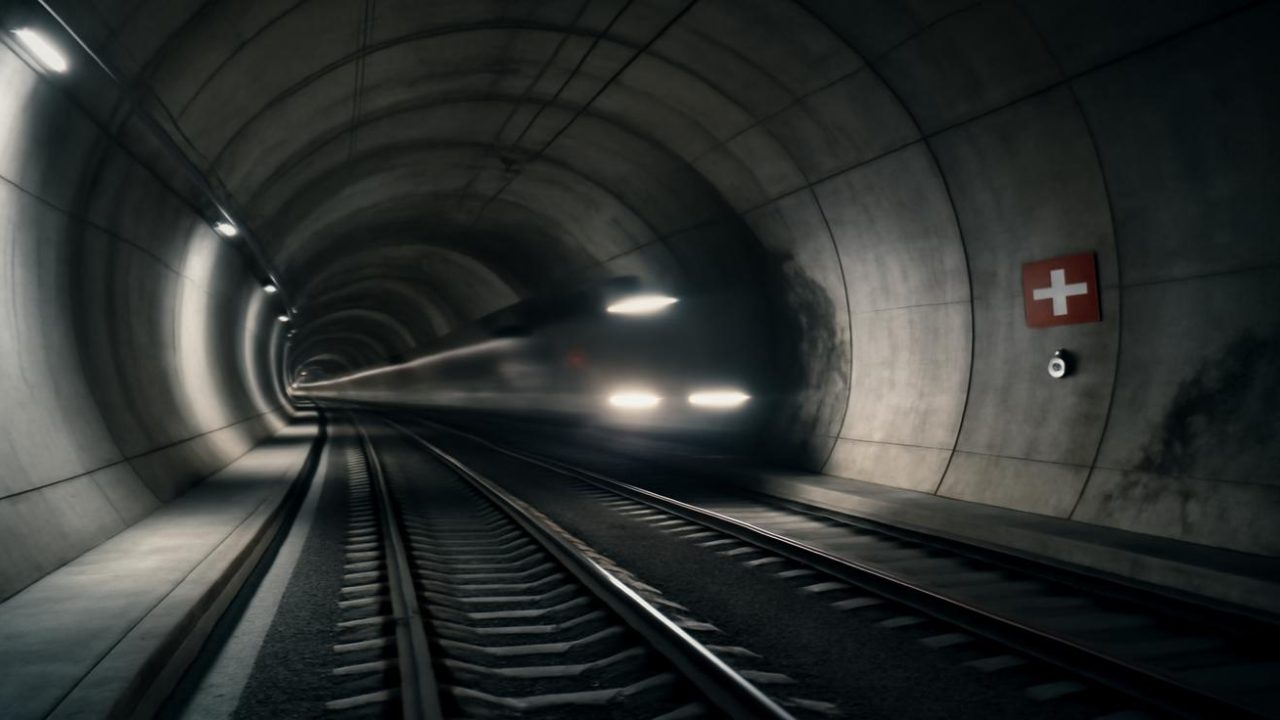
For nearly three decades, Switzerland has been carving through solid rock to create an underground infrastructure so massive it rivals the size of major cities above ground. This hidden network of tunnels, galleries, and service passages represents one of the most ambitious subterranean transformations on Earth.
What started as a practical solution to Switzerland’s dramatic Alpine geography has evolved into a second country beneath the mountains—a complex web of transportation arteries, utility corridors, and maintenance systems that most travelers never see.
The scale becomes clear when you experience it firsthand: your ears pop as trains plunge deeper into mountains, air temperatures drop by several degrees, and somewhere behind layers of rock, trucks glide silently through parallel tunnels while water races through buried pipelines.

How Switzerland Built a Hidden Country Under the Alps
Switzerland’s relationship with tunnels predates its modern rail system. The country’s compact landscape, thrust upward into jagged rock barriers, has always posed a fundamental challenge: how do you cross from one side to the other without spending half your life climbing?
The answer, increasingly, has been to go through instead of over. But the transformation that began in the 1990s took this instinct to its logical extreme.
Swiss voters used direct democracy to approve a massive underground infrastructure overhaul. The stated goals seemed modest: shift freight from road to rail, reduce travel times, and make Alpine crossings safer and cleaner.

In practice, this meant drilling some of the longest and deepest tunnels in the world. Engineers spent years blasting through granite and gneiss, freezing groundwater to stabilize unstable sections, and guiding tunnel-boring machines across marathon distances with millimeter precision.
The project also required threading new underground arteries into an already complex network of older tunnels, bunkers, water channels, and service caverns that had been built over previous decades.
The Underground Network That Rivals a Major City
Comparing Switzerland’s underground infrastructure to a city isn’t metaphorical—it’s an accurate scale reference. Like any major urban center, this subterranean network includes arteries of movement, connection hubs, hidden utilities, safety systems, and constant maintenance operations.

The system operates on multiple levels simultaneously. While passenger trains speed through base tunnels hundreds of meters beneath Alpine peaks, freight trucks roll onto rail shuttles and vanish into the rock. Above and below these main arteries, additional layers house essential infrastructure:
- Water pipelines and utility corridors
- Maintenance shafts and service galleries
- Emergency escape routes and safety systems
- Technical passages for equipment access
- Ventilation and climate control networks
The result allows travelers to cross the Alps in minutes rather than hours, following straight, silent paths through the mountain cores. Trucks that once navigated hairpin mountain passes now complete the same journey with a fraction of the emissions.
| Infrastructure Type | Function | Impact |
|---|---|---|
| Base Tunnels | High-speed rail passage | Minutes vs. hours travel time |
| Freight Shuttles | Truck transport through mountains | Reduced road congestion and emissions |
| Service Galleries | Maintenance and emergency access | System reliability and safety |
| Utility Corridors | Water, power, and data transmission | Protected infrastructure routing |
What It Feels Like to Travel Through Switzerland’s Hidden Infrastructure
The experience of using this underground network reveals its true scale. Passengers notice the sudden shift from sunlight glinting off snowfields and steel-blue lakes to windows that become dark mirrors reflecting tunnel lights racing past.

The silence is particularly striking—not the soft rural quiet of cowbells and distant church chimes, but a thick, almost physical hush that wraps around the train as it dives into the mountain.
Physical sensations mark the transition into this underground world. Air cools by several degrees as trains descend. Ear pressure changes signal the depth of the journey beneath jagged Alpine peaks that claw at the sky hundreds of meters overhead.
Most remarkably, Swiss life has adapted to these subterranean realities so smoothly that many travelers barely register the engineering marvel beneath their feet. The system operates with such efficiency that the complex choreography of multiple tunnel levels remains largely invisible to users.

The Engineering Challenge of Building Through Solid Rock
Creating this underground infrastructure required solving extraordinary technical challenges. Engineers had to blast through some of the hardest rock formations on Earth while maintaining precision that would allow different tunnel sections to meet perfectly after being drilled from opposite directions.
The project involved freezing groundwater to stabilize unstable geological sections—a process that requires careful temperature control to prevent damage to surrounding rock formations. Tunnel-boring machines had to navigate courses equivalent to marathon distances while maintaining millimeter accuracy.
Beyond the primary excavation, builders had to install complex ventilation systems capable of managing air quality across vast underground distances. Emergency systems required careful planning to ensure passenger safety in tunnels that stretch for dozens of kilometers through solid rock.

The integration challenge proved equally complex. New tunnels had to connect seamlessly with existing infrastructure that included military bunkers, water systems, and older transportation tunnels built under different engineering standards.
How This Underground Transformation Changed Swiss Transportation
The completion of Switzerland’s expanded underground network fundamentally altered how people and goods move through the country. Travel times that once required careful planning around mountain weather and road conditions became predictable year-round journeys.
Freight transportation saw perhaps the most dramatic change. Trucks that previously navigated dangerous mountain passes during limited weather windows now travel through the Alps regardless of surface conditions. This shift removed thousands of heavy vehicles from mountain roads while reducing transportation emissions.

The rail system’s capacity increased dramatically as new base tunnels allowed trains to maintain higher speeds through previously challenging terrain. Routes that once required multiple stops for locomotive changes now operate as direct services across the country.
For international travelers, the underground network transformed Switzerland from a challenging transit country into a high-speed corridor connecting northern and southern Europe. The country’s position as a transportation hub strengthened significantly as journey reliability improved.
Frequently Asked Questions
How long did it take Switzerland to build this underground infrastructure?
The major expansion has been ongoing for nearly 30 years, with Swiss voters approving the massive project in the 1990s through direct democracy.

How does the underground network compare to cities in size?
If the entire underground infrastructure could be lifted out and laid across the landscape, it would rival a major metropolis in total area and complexity.
What types of transportation use these tunnels?
The network handles passenger trains, freight rail, and truck shuttles, with separate tunnels and levels for different types of traffic.
How deep do the tunnels go beneath the mountains?
Trains travel hundreds of meters beneath Alpine peaks, with the exact depth varying by location and geological conditions.
Can travelers see any of the service infrastructure?
Most of the maintenance shafts, escape routes, and technical galleries remain hidden from public view, though passengers can sense the scale through physical changes like air temperature and pressure.
What was the main goal of building this underground network?
Switzerland aimed to shift freight from road to rail, shorten travel times, and make crossing the Alps safer and cleaner for both passengers and cargo.











Leave a Comment