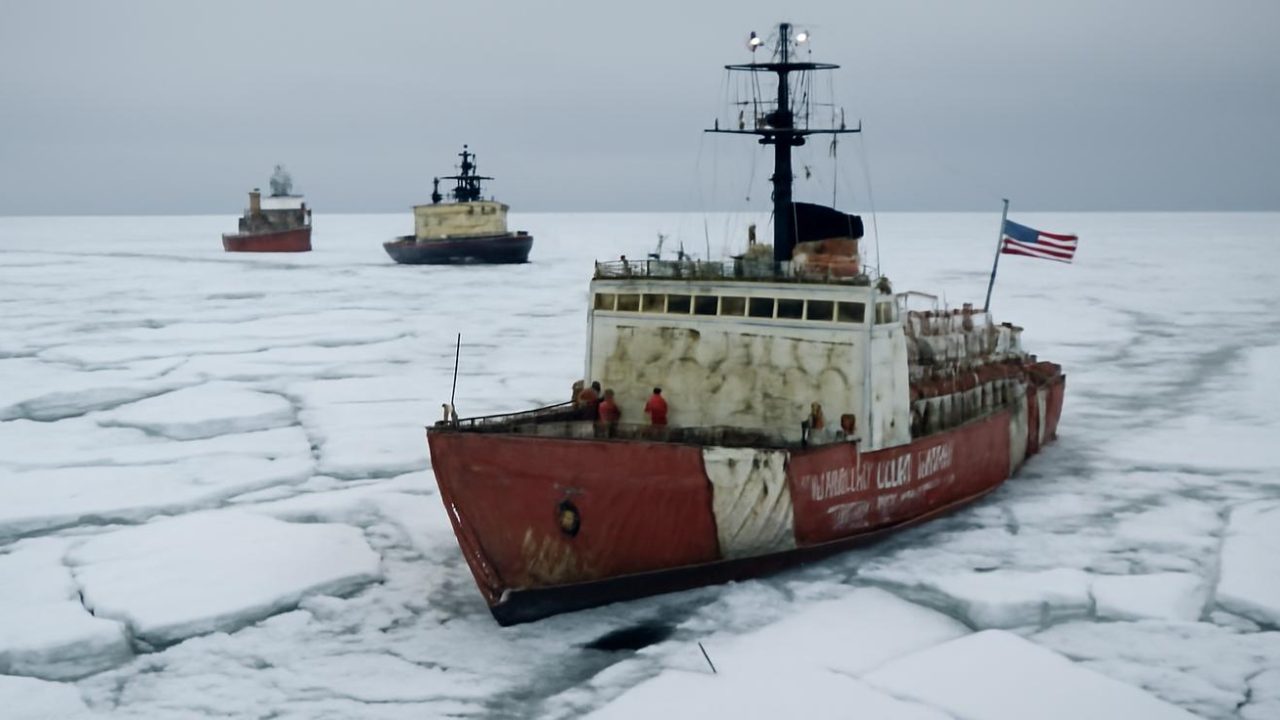
The United States operates exactly one heavy icebreaker capable of breaking through thick Antarctic sea ice—a 48-year-old vessel that suffers regular engine failures, floods, and fires. Meanwhile, two Western allies have quietly become global superpowers in icebreaker technology, leaving America scrambling to catch up in an arena that’s becoming critical to national security.
The stark reality of America’s icebreaker deficit has become impossible to ignore. While other nations expand their polar capabilities, the U.S. finds itself with aging equipment and no clear path forward without international help.
This maritime crisis isn’t just about ships—it’s about America’s ability to operate in polar regions that are becoming increasingly important for research, supply routes, and geopolitical influence.

America’s Lone Icebreaker Struggles to Stay Afloat
The Polar Star, commissioned in 1976, represents the entirety of America’s heavy icebreaking capability. At 399 feet long, she’s the only U.S. vessel capable of punching through the thick Antarctic sea ice needed to resupply McMurdo Station.
But age has taken its toll. During recent missions, the ship has suffered flooded compartments, engine room fires, and electrical failures. On one Antarctic deployment, her crew had to perform emergency welding repairs in the middle of the Southern Ocean—a makeshift solution that highlights just how precarious America’s polar operations have become.
According to crew members, there’s genuine uncertainty about whether the ship will complete each mission. The vessel was designed for a specific lifespan, and she’s now operating well beyond those original parameters.

The U.S. once operated multiple heavy icebreakers, including the Polar Star’s sister ship, the Polar Sea, which is now retired. Today, America’s icebreaking fleet consists of the aging Polar Star and the much smaller Healy, a medium icebreaker built for research rather than heavy ice-breaking operations.
How Finland Became an Icebreaker Superpower
While America’s icebreaker capabilities have withered, Finland has emerged as one of the world’s foremost builders of ice-capable ships. Despite having a population smaller than many U.S. states, Finnish shipyards have designed and built icebreakers for navies, coast guards, and research agencies worldwide.
Finland’s expertise stems from practical necessity. The sea between Finland and Sweden freezes regularly, and rather than treating this as a seasonal inconvenience, Finnish engineers have approached it as a design challenge to be solved.

Many of the world’s most advanced icebreakers trace their origins back to Finnish design tables. This includes the innovative double-acting ships that can sail bow-first through open water and then reverse to travel stern-first through ice—a design that maximizes efficiency in different conditions.
Finnish shipbuilders don’t just operate these vessels; they design them, refine them, and export the technical knowledge that allows other countries to maintain competitive icebreaking capabilities.
Canada’s Arctic Advantage
Canada represents the other Western icebreaker superpower, and geography explains why. The Northwest Passage weaves through Canada’s northern archipelago, and Inuit communities live in regions where winter isn’t a season but a permanent climate condition.

For Canada, icebreakers aren’t exotic military assets—they’re essential infrastructure. These ships serve as lifelines to remote communities and maintain Canada’s sovereignty over Arctic waters that are becoming increasingly accessible due to climate change.
This practical experience has translated into technical expertise. Canadian shipbuilders and operators have developed deep knowledge of polar operations, making them natural partners for countries looking to expand their icebreaking capabilities.
| Country | Icebreaker Strength | Key Advantage |
|---|---|---|
| United States | 1 heavy, 1 medium icebreaker | Experience in Antarctic operations |
| Finland | Advanced design capability | World-leading shipbuilding technology |
| Canada | Multiple vessels, Arctic expertise | Operational experience in polar regions |
Why America’s Icebreaker Gap Matters Now
The timing of America’s icebreaker shortage couldn’t be worse. The Arctic is warming and opening new shipping routes, while the Antarctic remains as challenging as ever for research and supply operations. Meanwhile, other nations have expanded their polar capabilities significantly.

The geopolitical implications extend beyond simple transportation. Icebreakers represent a nation’s ability to project power and maintain presence in polar regions. As these areas become more accessible and strategically important, countries without adequate icebreaking capabilities risk being sidelined.
For the United States, this means potential limitations on scientific research, reduced ability to support Antarctic stations, and diminished influence in polar affairs. The country that once led in polar exploration now finds itself dependent on aging equipment that could fail at any moment.
The technical challenges of building new icebreakers are substantial. These ships must withstand extreme conditions, break through ice several feet thick, and operate reliably in some of the world’s most remote locations. The specialized knowledge required to build them effectively has been concentrated in just a few countries.

America Turns to Allies for Help
Recognizing the severity of the situation, the United States is now looking to Finland and Canada for assistance in rebuilding its icebreaker capabilities. This represents a significant shift for a country that has traditionally prided itself on domestic shipbuilding capabilities.
The partnership approach makes strategic sense. Rather than attempting to rebuild specialized knowledge from scratch, America can leverage the expertise that Finland and Canada have developed over decades of icebreaker construction and operation.
This collaboration could take several forms, from direct ship purchases to technology transfer agreements that would allow American shipyards to build vessels using foreign designs. The exact structure of these partnerships is still being developed, but the acknowledgment that help is needed marks a important recognition of reality.

For Finland and Canada, these partnerships represent opportunities to expand their influence in the icebreaker market while strengthening ties with a key ally. The arrangements could provide economic benefits while advancing shared interests in polar research and operations.
Frequently Asked Questions
How many icebreakers does the United States currently operate?
The U.S. has one heavy icebreaker (Polar Star) and one medium icebreaker (Healy) in active service.
When was America’s main icebreaker built?
The Polar Star was commissioned in 1976, making it 48 years old and well beyond its intended operational lifespan.

What makes Finland and Canada icebreaker superpowers?
Finland excels in icebreaker design and shipbuilding technology, while Canada has extensive operational experience due to its Arctic geography and regular ice conditions.
Why can’t the U.S. build its own icebreakers?
The U.S. lacks the specialized expertise that has been concentrated in Finnish and Canadian shipyards over decades of continuous icebreaker construction.
What happens if the Polar Star fails completely?
The U.S. would have no heavy icebreaking capability, potentially ending regular resupply missions to McMurdo Station in Antarctica.
How do Finnish double-acting icebreakers work?
These ships can sail bow-first through open water and then reverse to travel stern-first through ice, maximizing efficiency in different conditions.









Leave a Comment