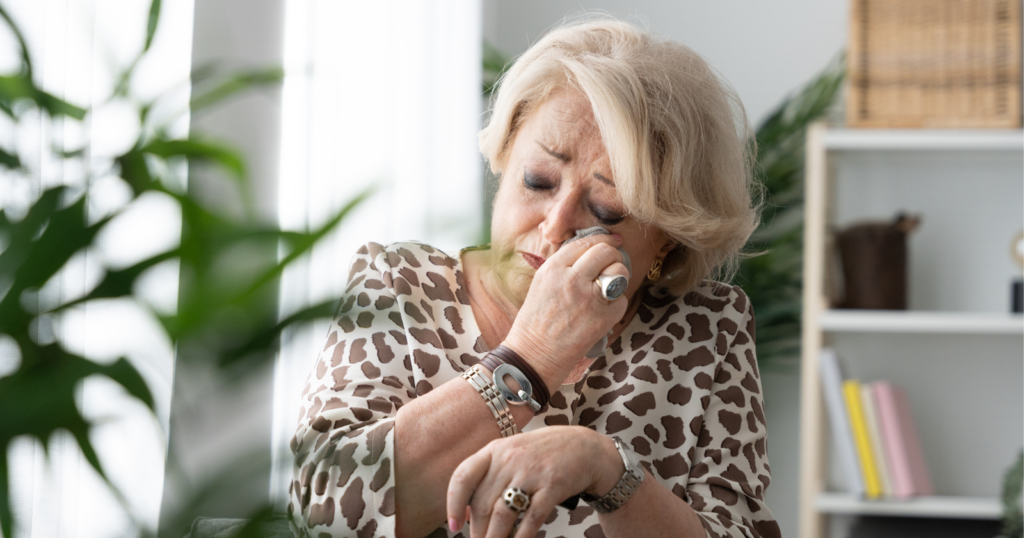
Behavioral scientists have identified a troubling pattern among women who successfully managed entire households for decades, only to experience what appears to be a sudden decline in their 60s. The research reveals these women didn’t become fragile — they simply stopped being needed, and the structure that held them together was never internal.
For years, she ran the household like a quiet command center. She knew when dentist appointments were scheduled, which child needed new shoes, and when her mother-in-law’s medication was running low. She mediated family arguments, absorbed everyone’s bad days, and somehow still managed to have dinner ready by seven.
Then the children grew up and moved out. Career responsibilities wound down. The aging parents she cared for passed away. The people who once depended on her every waking hour stopped calling as often. By 62, she wasn’t managing anyone’s life anymore — and something unexpected happened. Instead of freedom rushing in, emptiness did.

The Collapse Isn’t Fragility — It’s Structural
When researchers examine why so many women seem to unravel in their 60s, the findings are both consistent and uncomfortable. The problem isn’t that these women became weak. The architecture of their identity was never self-supporting to begin with.
Studies on caregiver role loss demonstrate that when someone’s primary role dissolves — especially one they held for decades — the sense of self built around it dissolves too. For women who spent their 30s, 40s, and 50s as the person everyone leaned on, the scaffolding was always external. The demand itself provided the structure.
Remove the demand, and there’s nothing underneath to hold the weight. Not because she lacked depth, intelligence, or capability, but because no one — including herself — ever invested in building an internal foundation. There was never time. Someone else always needed something first.

Her Identity Was Relational, Not Personal
Psychologists who study relational self-construal have found that women are significantly more likely than men to define themselves through close relationships — as daughter, wife, mother, or caregiver. These relational identities become the primary source of meaning, pride, and self-worth.
For decades, this approach works brilliantly. She becomes the glue, the anchor, the person who remembers birthdays and senses tension before it erupts into conflict. Her identity gets reinforced daily by the sheer volume of people who depend on her expertise and care.
But relational identity has a vulnerability that personal identity doesn’t: it requires other people to participate. When children leave, when spouses retire into their own routines, when aging parents are gone — the relationships that once defined her either vanish or fundamentally change shape. She’s left holding a self-concept that no longer has anything to attach to.

The Atrophy of Personal Preferences
Ask a woman in this situation what she’d like for dinner and she’ll respond, “I don’t mind, whatever you want.” Ask her what she’d do with a completely free Saturday — truly free, with no obligations to anyone — and she’ll go blank.
This isn’t indecisiveness. It’s atrophy.
She spent decades filtering every choice through someone else’s needs. What does the family want? What keeps the peace? What’s easiest for everyone? Her preferences weren’t suppressed in one dramatic moment. They were quietly set aside, one small sacrifice at a time, until the muscle that knew what she wanted gave out entirely.

By her 60s, she may not even recognize this absence. She just knows that when the house gets quiet and nobody needs anything, she feels unmoored rather than free.
| Life Stage | Primary Identity Source | Decision-Making Pattern | Support Structure |
|---|---|---|---|
| 30s-40s | Active caregiving roles | Family needs first | External demands |
| 50s | Managing multiple generations | Everyone else’s preferences | Constant external validation |
| 60s+ | Undefined/searching | Uncertain about own wants | Internal structure absent |
Why Rest Triggers Panic Instead of Peace
For women who built their entire identity around being needed, quiet moments don’t feel like relief — they feel like evidence of irrelevance. The absence of crisis doesn’t register as success; it registers as purposelessness.
Families often misinterpret this response as depression or declining mental health. They see a woman who once handled everything now struggling with basic decisions about how to spend her time. The assumption is that something broke inside her.

But behavioral scientists suggest the opposite: nothing broke. The external framework that was doing all the structural work simply disappeared, revealing that no internal framework had ever been built to replace it.
Understanding the Real Problem
This pattern represents a fundamental issue with how society structures women’s lives and identities. When someone’s sense of self depends entirely on being needed by others, the natural progression of life — children becoming independent, parents passing away, careers ending — becomes an identity crisis rather than a natural transition.
The research suggests that women experiencing this aren’t suffering from sudden onset fragility. They’re experiencing the predictable result of decades spent building their lives around external demands rather than internal purpose and preferences.

Recognition of this pattern offers a different framework for understanding what appears to be decline. Instead of treating the symptoms as individual failings or inevitable aging, it points toward the need for earlier development of identity structures that don’t depend on other people’s constant need for care.
The findings also suggest that families and communities might need to rethink how they support women through these transitions, recognizing that the challenge isn’t helping someone recover from weakness, but helping them discover strengths and interests that were never given space to develop.
Frequently Asked Questions
Why do women experience this pattern more than men?
Research shows women are significantly more likely to build their identities around relationships and caregiving roles, while men typically maintain more individual-focused identity structures throughout their lives.

Is this pattern inevitable for women who focus on family care?
The research suggests it’s common but not inevitable, particularly when women have opportunities to develop personal interests and identity markers alongside their caregiving roles.
What age does this transition typically affect women?
The pattern most commonly emerges in women’s 60s, when children have typically moved out and aging parents may have passed away, but the timing can vary based on individual family circumstances.
How can families recognize this isn’t depression or decline?
The key difference is that this represents structural identity loss rather than mental health decline — the woman hasn’t become less capable, she’s lost the external framework that organized her sense of purpose.

Can this pattern be prevented?
While the research doesn’t provide specific prevention strategies, it suggests that developing internal identity structures and personal interests throughout earlier decades might provide better support during these transitions.
Do all women who experience this pattern recover?
The source material doesn’t address recovery outcomes or long-term prognosis for women experiencing this type of identity transition.











Leave a Comment