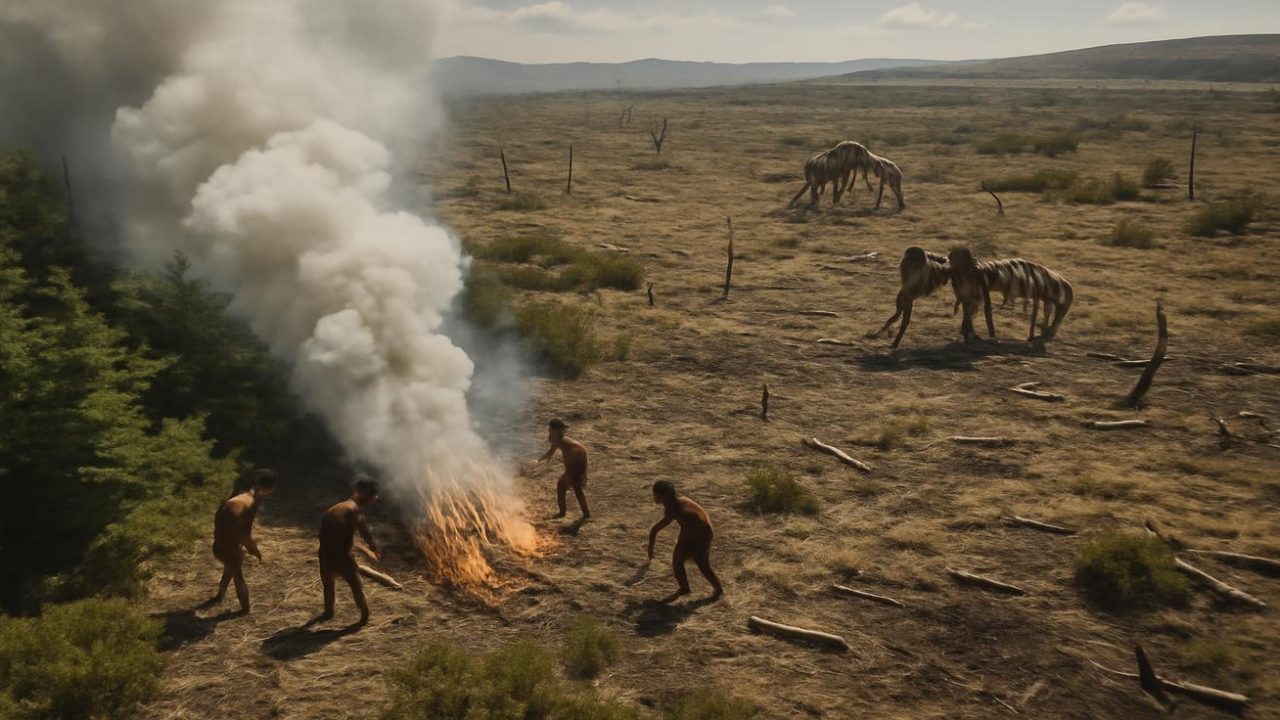
The comfortable story about humanity’s environmental impact is falling apart. For generations, scientists believed ancient humans lived lightly on the Earth, leaving barely a trace until the industrial age brought smokestacks and engines. But as archaeologists and ecologists dig deeper into sediments, pollen, bones, and ancient DNA, they’re discovering our ancestors were far more disruptive than anyone imagined.
Long before the first factory opened, ancient humans were already changing forests, redirecting animal populations, and quietly rewriting the map of Earth’s ecosystems. The evidence is buried in soil layers, written in charcoal deposits, and encoded in the very DNA of the landscapes we thought were untouched wilderness.
This revelation is forcing scientists to completely rethink humanity’s relationship with nature—and what it means for how we manage the planet today.

Ancient Humans Were Master Environmental Engineers
The Amazon rainforest was supposed to be nature’s masterpiece, a vast green expanse that evolved without human interference. Excavations are proving that assumption wrong. Researchers have uncovered ancient earthworks, soil deliberately enriched with human waste and charcoal, and the remains of extensive orchards.
Those patches of forest unusually dense with fruit and nut trees aren’t accidents of nature. They’re the echoes of Indigenous cultivation practices that shaped the landscape for thousands of years. The forest is still breathing with the memory of the people who tended it.
On the other side of the world, Aboriginal fire practices in Australia reach back tens of thousands of years. These weren’t random wildfires—they were controlled burns, a kind of ecological choreography. Cool, patchy fires set deliberately cleared underbrush, encouraged grass growth, attracted grazing animals, and prevented catastrophic wildfires.

Over millennia, fire-adapted plants thrived while animals followed the green waves of fresh growth. Landscapes that look completely wild today were actually painstakingly curated by human hands.
The Soil Tells the Real Story
The evidence is written in layers of earth that scientists can read like a history book. Charcoal deposits correspond precisely to times when humans arrived in new areas or expanded their populations. These are followed by sharp shifts in the kinds of plants that grew.
Where dense forest once dominated, open woodland appeared. Closed-in landscapes relaxed into mosaics of different habitats, each tuned to different rhythms of fire and regrowth. The pattern repeats across continents—in Africa, North America, and beyond.

| Region | Evidence Type | Environmental Change |
|---|---|---|
| Amazon | Ancient earthworks, enriched soil | Forest orchards, managed tree density |
| Australia | Charcoal layers, fire-adapted plants | Open woodlands, grassland expansion |
| North America | Pollen shifts, soil deposits | Forest clearings, habitat mosaics |
| Africa | Sediment analysis | Landscape burning patterns |
These discoveries are forcing scientists to abandon the idea that there ever was a truly “pristine” wilderness untouched by human influence.
The Vanishing Giants Changed Everything
Tens of thousands of years ago, Earth was crowded with enormous animals that seem almost mythic today. Elephants roamed outside Africa. Giant marsupials the size of cars wandered Australia. Ground sloths taller than humans when kneeling browsed across the Americas.
Most of those giants are gone, and the timing is suspicious. As modern humans spread to new continents and islands, the fossil record shows a recurring pattern: large mammals vanish within a few thousand years of human arrival.

Climate change was also shifting temperatures and vegetation patterns, but the pattern repeats across multiple continents—from North America to Australia, from Madagascar to New Zealand. Massive animals disappear just as people step onto the scene.
Scientists now understand these lost animals weren’t just victims—they were missing engineers of their ecosystems. Big herbivores knocked down trees, trampled paths, distributed seeds across vast distances, and fertilized soils with their dung. Predators pruned their herds and kept them moving.
When those giants vanished, everything rippled outward. Grasslands shrank or shifted. Forests grew thicker in some places, thinner in others. Fire patterns changed. Even the global carbon cycle may have been affected by the loss of these massive landscape architects.

What This Means for Modern Conservation
These discoveries are reshaping how scientists think about conservation and environmental management. The idea of returning landscapes to some “natural” state becomes complicated when there may never have been a truly natural baseline.
Indigenous fire management practices, once dismissed by colonial authorities, are being recognized as sophisticated ecological tools. In Australia, traditional Aboriginal burning techniques are being revived to prevent catastrophic wildfires and maintain biodiversity.
The Amazon’s human-influenced forests are proving more resilient and biodiverse than areas with less historical human management. This suggests that some forms of human intervention might actually benefit ecosystems rather than harm them.

Understanding ancient human impacts also helps explain why some modern conservation efforts fail. Ecosystems that evolved alongside human management for thousands of years may actually need continued human intervention to remain healthy.
The Bigger Picture for Earth’s Future
The revelation that ancient humans left a much larger ecological footprint than previously believed doesn’t diminish the urgency of modern environmental challenges. Instead, it provides crucial context for understanding how human societies can coexist with natural systems.
Modern industrial impacts operate at unprecedented speed and scale, but the principle of human-environment interaction is ancient. Learning from how our ancestors managed landscapes sustainably could inform better approaches to climate change, biodiversity loss, and ecosystem restoration.

The story emerging from archaeological research suggests that the question isn’t whether humans impact the environment—we always have. The question is how we can manage those impacts wisely, drawing on thousands of years of accumulated ecological knowledge.
As researchers continue examining sediments, pollen, and ancient DNA, they’re likely to uncover even more evidence of humanity’s deep environmental influence. Each discovery adds another piece to the complex puzzle of how our species has shaped the planet we call home.
Frequently Asked Questions
How do scientists know ancient humans caused these environmental changes?
Researchers find layers of charcoal in soil that correspond to human arrival times, followed by sudden shifts in plant pollen types, indicating deliberate landscape management rather than natural changes.

Did ancient humans cause all the giant animal extinctions?
Climate change also played a role, but the pattern of large mammals disappearing within a few thousand years of human arrival across multiple continents suggests humans were a major factor.
Were ancient human environmental impacts always negative?
No, many practices like controlled burning and forest management actually increased biodiversity and ecosystem resilience, creating the landscapes we now consider naturally beautiful.
How does this change modern conservation approaches?
It suggests that some ecosystems may need continued human management to remain healthy, and that indigenous land management practices deserve serious scientific attention.
Does this mean modern environmental problems aren’t serious?
Not at all—modern industrial impacts operate at unprecedented speed and scale, but understanding ancient human-environment relationships could help develop better solutions.
What regions show the strongest evidence of ancient human environmental impact?
The Amazon, Australia, parts of Africa, and North America all show clear archaeological evidence of extensive landscape modification by ancient human societies.











Leave a Comment